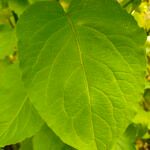
Leycesteria formosa
Pheasant-berry · Himalaya-honeysuckle · Himalayan honeysuckle · Pheasant Honeysuckle
Description
Source: leafsnapLeycesteria formosa, commonly known as Himalayan honeysuckle or pheasant berry, is a deciduous shrub native to the Himalayas and southwestern China. This plant can reach a height of 2 to 3 meters and features arching stems with oval-shaped green leaves that can grow up to 15 cm long. During the summer, it produces clusters of small white flowers, which are followed by reddish-purple berries in the fall. Although these berries are edible, they are not commonly consumed. Leycesteria formosa is a favored ornamental plant because of its attractive foliage and distinctive flowers. It thrives in moist, well-drained soil and partial shade but can also tolerate full sun if adequately watered. The plant can be propagated through seeds or cuttings. Beyond its ornamental use, Leycesteria formosa holds medicinal value in traditional Chinese medicine, where it is employed to treat various ailments such as fever and inflammation. The leaves contain compounds with anti-inflammatory properties, which have been shown to reduce pain and swelling. In summary, Leycesteria formosa is a versatile shrub that offers both aesthetic beauty and potential health benefits.
Care Guide
💧 Water Every 7 days
The Himalayan honeysuckle, which originates from mountainous regions, thrives in consistent moisture and partial shade. To prevent waterlogging, it requires weekly watering. As a deciduous shrub, its water needs are highest during the active growing season. It also adapts well to outdoor environments, benefiting from natural rainfall.
How much water does my Himalayan honeysuckle plant need?
The Himalayan honeysuckle requires about a gallon of water according to a schedule. If you have potted plants, water them deeply until you see water dripping from the bottom of the pot. Then, wait for the soil to dry before watering again. You can use a water calculator or a moisture meter to determine how much water you've given the plant in a week. During the flowering period, provide plenty of water but let the moisture evaporate to prevent root rot. If the Himalayan honeysuckle is planted outdoors and there is sufficient rainfall, it may not need additional watering. However, when it is young or newly planted, make sure it receives 1-2 inches of rain per week. As the plant grows, it can survive solely on rainfall. Only water it fully if the weather is too hot or if there has been no rainfall for 2-3 weeks. Do this during cooler moments of the day to protect the plant from heat damage. Additional watering will be necessary during extended dry periods.
How should I water my Himalayan honeysuckle plant?
To ensure excellent root development, it is recommended to place a garden hose at the base of the plant. Avoid spraying the leaves directly, as this can be detrimental. If the plant is outdoors and exposed to direct sunlight, the leaves will require more watering. One option is to use bubblers, which can be placed on each plant to moisten the roots. Soaker hoses are another useful tool, especially when adding or removing plants, as they help push the roots deeper into the soil. After watering, make sure to drain any excess water and allow the soil to dry before watering again. Watering at ground level is advised to prevent diseases. On sunny days, it can be beneficial to spray the entire bush with water. Whether the plant is in a pot or in the ground, remember that Himalayan honeysuckle prefers deep watering rather than light sprinkling.
If I water Himalayan honeysuckle too much or too little, what should I do?
When a Himalayan honeysuckle is overwatered, its leaves may turn yellow, drop off, and wilt. The plant may also appear dull and unhealthy, with mushy stems. If you notice these signs, it's best to adjust your watering schedule. On the other hand, wilting can also indicate under watering. In this case, the leaves may become crispy and dry. If the soil is dry and watering alone is not enough, give the plant a thorough watering. However, even with enough water, the damaged root system may cause the plant to still appear dry with yellow leaves after a few days. Once the plant returns to normal, the yellowing of leaves will stop. When you have a Himalayan honeysuckle indoors, always check the moisture levels in the pot. Avoid overwatering and watch out for black spots. If you notice them, allow the soil to dry by giving it a few days without watering. Overwatering can lead to root rot, so if you see discolored and slimy roots, consider transferring the plant to a different pot. It is important to prevent root rot by avoiding overly soggy soil. When planting a Himalayan honeysuckle outdoors, dig a little deeper and check the soil with your fingers. If it feels too dry, it may indicate underwatering. Adequate watering is necessary to help the plant recover.
How frequently should I water my Himalayan honeysuckle plant?
The Himalayan honeysuckle prefers to be watered deeply but infrequently. If you have potted plants, be sure to give them a gallon of water each time, as the water storage in the pots is limited and the soil dries out quickly. In cold regions, water every 3 to 5 days, preferably in the morning when the soil is dry. Check the soil inside the pot to see if watering is needed – if the top 2-3 inches are dry, it's time to water. During hot days, monitor the moisture daily as the heat can dry out the soil rapidly. In a garden, irrigation is necessary, especially in hot climates where watering once a week should suffice. Only water when you notice 2-3 inches of soil becoming too dry indoors or outdoors. Take into account the amount of rainfall and avoid overwatering to prevent root rot. Himalayan honeysuckle typically grows during spring and fall, so add a 3-4 inch layer of mulch outdoors to help conserve water. Sandy soil drains faster, so plants in this type of soil should be watered more frequently. On the other hand, plants in clay soil can go 2-3 days without water to avoid root rot. Keep track of watering by marking the date on a calendar and pay attention to any drooping leaves, which may indicate the need to water sooner.
Should I change how often I water my Himalayan honeysuckle depending on the time of year or the weather?
The Himalayan honeysuckle needs outdoor conditions with rainfall, but only needs watering during persistent dry weather. During spring and fall, keep the soil moist but not soggy. Alternating dry and moist conditions will help the plant thrive. In summer, hot weather can cause water to evaporate quickly, so you may need to water more frequently if rainfall is lacking. Generally, the plant needs less water during winter when it goes dormant. Use well-draining soil with moisture-retentive qualities for winter care. Once the plant starts leafing out in spring, you can rely on rainfall and skip watering. Cultivate the plant for growth and blooming in warmer temperatures. Good drainage is important at all times, especially during winter. In pots, ensure proper root growth by keeping them well-watered in summer. Deep soak the roots once or twice a week, but avoid shallow sprinkles that can promote fungal growth and fail to reach the roots. During fall and winter, even in dormancy, don't let the plant dry out completely. Avoid over-watering, as sitting in water for too long can harm the plant, especially during winter. Apply mulch when possible to reduce stress, conserve water, and promote healthy blooms.
☀️ Light Partial sun
Himalayan honeysuckle grows best in locations with moderate sun but can tolerate stronger light. It is native to areas where light is typically filtered. Too much sun can burn the leaves, while too little light can limit its growth and flowering.
What are the sunlight requirements for Himalayan honeysuckle?
Himalayan honeysuckle needs moderate amounts of sunlight to thrive, preferably in partial sun conditions of about 3-6 hours of sunlight daily, although it can also handle full sun (above 6 hours of sunlight) particularly in cooler weather. It’s crucial to watch the way sunlight moves through your garden to ensure you choose spots that provide the ideal balance of light and shade for the plants, promoting their health and happiness.
How do Himalayan honeysuckles respond to different lighting conditions?
Himalayan honeysuckle prefers environments with moderate sunlight but can adapt to more intense light, originally thriving in habitats where filtered light is prevalent. Excessive sunlight can lead to scorched leaves, while insufficient light may affect its growth and flowering. For indoor plants, adequate lighting is essential for optimal growth, especially when natural sunlight is lacking. Artificial lights, such as LED lights, should be considered to provide the necessary wavelengths of light, tailored to whether the plant needs full sun, partial sun, or shade.
What are the common symptoms of incorrect lighting for Himalayan honeysuckle?
Common symptoms of incorrect lighting for Himalayan honeysuckle include smaller new leaves, leggy or sparse growth, faster leaf drop, slower or no new growth, lighter-colored new leaves, chlorosis (leaves turning yellow due to chlorophyll breakdown), sunscald, leaf curling, wilting, and leaf scorching. These symptoms can occur due to both insufficient and excessive light exposure, impacting the plant's overall health and appearance.
What solutions can help Himalayan honeysuckle adapt to its light conditions?
To help Himalayan honeysuckle adapt to its light conditions, gradually shift the plant to sunnier spots each week until it receives the ideal 3-6 hours of direct sunlight daily, allowing for gradual adaptation. For indoor plants that are large or hard to move, consider using artificial light, keeping a lamp on for at least 8 hours daily or investing in professional grow lights. For outdoor plants, avoid sudden changes in light intensity to prevent sunburn. Remove obstructions to sunlight, such as pruning branches of trees, and for smaller plants, consider transplanting during their dormant period to a location with ample sunlight and good drainage. Note that parts of the plant affected by insufficient light may not recover, but new growth will be healthy with improved light exposure.
🌡️ Temperature 20–37.8°C
Himalayan honeysuckle originates from the temperate Himalayan regions where temperatures range from 68 to 100 °F (20 to 38 ℃). Ideally, it favors a milder climate. Seasonal temperature adjustments are necessary to ensure its healthy growth.
What is the native climate of Himalayan honeysuckle?
Himalayan honeysuckle, botanically known as Leycesteria formosa, is native to the temperate Himalayan regions. These areas typically experience temperatures ranging from 68 to 100°F (20 to 38°C), indicating that the plant prefers a milder climate. It is quite heat-loving, with optimal growth in temperatures above 20°C but can be negatively affected by cold temperatures. To maintain its health, adjustments in care must be made seasonally to accommodate its temperature sensitivity.
How should Himalayan honeysuckle be cared for in cooler temperatures?
Himalayan honeysuckle is sensitive to low temperatures and requires specific care during the colder months to ensure its health and survival. During winter or any time when temperatures are expected to fall below 20°C, it's advisable to keep the plant indoors, ideally in an area that receives ample bright light, such as near a bright window. However, it's important to avoid placing it too close to heaters, as maintaining a temperature above 20°C is beneficial for its growth, while temperatures nearing 5°C are harmful. If exposed to temperatures below 1°C, you may notice a lightening of the leaves' color, followed by browning or blackening after frost damage, along with wilting and drooping. To combat this, trim off the frost-damaged parts and move the plant into a warm, sunny spot indoors, ensuring not to place it near heaters or air conditioning vents to avoid air dryness.
What steps should be taken to protect Himalayan honeysuckle from high temperatures?
In the summer, it is crucial to protect Himalayan honeysuckle from temperatures exceeding 38°C, as it becomes more prone to sunburn and related damage when temperatures climb above 43°C, indicated by a lightening of the leaves' color. To mitigate sunburn or excessive heat exposure, trim away sun-damaged or dried parts of the plant. Relocate it to an area that offers protection from the intense midday and afternoon sun. It's also beneficial to water the plant in the morning and evening to ensure that the soil remains moist, helping the plant stay hydrated and healthy despite the heat.
💨 Humidity high (>60%)
This plant needs special care because it loves high humidity levels of 60-80% or more. The best way to achieve this is by placing a humidifier near the plant. Daily misting is also essential! Make sure the room has good ventilation.
🪴 Soil 6-7
🌱 Fertilizer
The best time to fertilize a Himalayan honeysuckle is in early spring, as it breaks dormancy. This encourages overall growth and flower formation. Fertilizing improves the foliage, stems, and branches, and promotes flowers that are larger, more vivid, and longer-lasting. It helps transfer nutrients from the roots to the blooms and enhances the plant’s health and resistance to disease.
Why is it necessary to feed my Himalayan honeysuckle plant?
Fertilization is essential for the overall health and well-being of your Himalayan honeysuckle. It provides the necessary energy and nutrients for the plant to develop healthy foliage, sturdy stems, and branches. The flowers of the Himalayan honeysuckle are particularly valuable to gardeners, and fertilization plays a crucial role in producing large, vibrant, and long-lasting flowers. This is because the right fertilizer helps the plant efficiently transfer fuel from its roots to its flowers through the stems. Additionally, proper fertilization keeps the plant in good general condition, making it more resistant to diseases.
When is the best time to put fertilizer on my Himalayan honeysuckle?
To fertilize a Himalayan honeysuckle, the best time is early spring when it is coming out of dormancy and getting ready to bloom. This will provide ample energy for growth and flowering. However, it's not just this time that the plant can benefit from fertilization. Another round of feeding in the fall can also be helpful, although a smaller amount will suffice. Some gardeners also fertilize the plant during planting, but this step is not always necessary.
When is it better not to use fertilizer on my Himalayan honeysuckle?
During the winter, a Himalayan honeysuckle does not require fertilization since it is in a dormant phase and doesn't need extra energy for growth. If you fertilize it during this time, there's a higher chance of overfertilization issues. The best times to feed a Himalayan honeysuckle are early spring and fall. This means that during most of spring and summer, fertilizer is unnecessary. It's also advisable to refrain from fertilizing if the plant is experiencing extremely hot or dry conditions.
What kind of fertilizer does my Himalayan honeysuckle plant require?
Typically, using a general-purpose fertilizer with even ratios of nitrogen, phosphorus, and potassium is acceptable. However, Himalayan honeysuckle plants usually perform better with a specific type of fertilizer. Nitrogen and phosphorus are the most crucial nutrients for these plants, so it's important that the fertilizer you use contains higher levels of these elements compared to potassium. A fertilizer with an N-P-K ratio of 10-10-8 or something similar should be effective. Additionally, applying organic materials like compost during one of your yearly feedings can also be beneficial. If you decide to use fertilizer, granular fertilizer is typically the most common choice for Himalayan honeysuckle plants.
How should I add fertilizer to my Himalayan honeysuckle plant?
Applying fertilizer for your Himalayan honeysuckle is a straightforward task that any gardener, even those with minimal experience, can easily perform. To feed your Himalayan honeysuckle with granular fertilizer, simply sprinkle it on the soil after moistening the soil with water. In addition, you can improve the soil for your Himalayan honeysuckle by adding organic materials like compost or manure. To do this, place some of the material on top of the soil and gently work it into the top few inches of soil using a hand rake. Be careful not to disturb the roots.
🪴 Pot & Repot Every 12 months
✂️ Pruning
The Himalayan honeysuckle showcases arching stems and tubular flowers, making it a striking addition to any garden. To maintain its health and appearance, it requires pruning in late spring. At this time, cut old stems down to ground level and remove any dead ones to encourage new growth. Pruning after the flowering period also helps to keep the plant tidy, enhances air circulation, and promotes abundant blooming for healthier overall growth.
🌿 Propagating
🐛 Diseases & pets
☠️ Toxicity
Leycesteria formosa has no toxic effects reported.
Characteristics
- Plant Type
- Shrub
- Life Cycle
- Perennial
- Genus
- Leycesteria
- Family
- Caprifoliaceae
- Hardiness Zone
- 10-11
- Mature Height
- 0.91 m to 2.13 m
- Mature Spread
- 2.44 m
- Leaf Color
- Green
- Leaf Type
- Deciduous
- Flower Color
- White, Purple
- Flower Size
- 2.54 cm to 5.08 cm
- Bloom Time
- Early summer, Mid summer
- Planting Time
- Spring, Autumn
- Harvest Time
- Mid summer
- Native Area
- Nepal, India, Myanmar, Bhutan, Pakistan, China