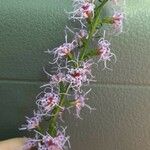
Liatris pilosa
Grass-leaf gayfeather · Shaggy blazing star · Grass-leaved blazing-star · Grass-leaved gayfeather
Description
Source: wikipedia (CC BY-SA)Liatris pilosa, the grass-leaf blazingstar, sandhills blazing star, shaggy blazing star, or shaggy gayfeather, is a species of flowering plant in the family Asteraceae. It is native to the US states of Pennsylvania, New Jersey, Maryland, Delaware, Virginia, North Carolina, and South Carolina, east of the Appalachian Mountains. A perennial reaching 4 ft (1.2 m), it is typically found in open woodlands or forest edges, at the edges of salt marshes, and in dune depressions.
🌳 Dense blazing star is not just pleasing to the eye but also serves as a flavor enhancer in traditional Native American cuisine. The bulbs are turned into a unique spice that gives their meals a distinctive taste. The showy purple flowers are also used to create dyes for fabrics that resist fading in the sun.
🎭 Alertness, diligent effort, burning love
Care Guide
💧 Water
Water the "shaggy blazing star" sparingly when it is sprouting to prevent soil-borne diseases. As the plant continues to grow, gradually increase the amount of water, ensuring that the soil remains consistently moist. During the winter, reduce watering to avoid soggy conditions that could promote disease while the plant is dormant.
☀️ Light Full sun
The dense blazing star requires abundant sunlight to reach its best growth. It does best in conditions similar to its native environment—areas drenched in plentiful sunshine. While it can tolerate some shade, too little sunlight can impede its health and growth. Excessive sun, however, does not greatly harm it.
What are the sunlight requirements for Shaggy Blazing Star?
Shaggy Blazing Star (Liatris pilosa) requires different amounts of sunlight depending on the specific need. For full sun exposure, it needs above 6 hours of sunlight. If the preference is for partial sun, about 3-6 hours of sunlight is suitable. It's important to observe how sunlight moves through your garden to ensure you place your Shaggy Blazing Star in a position that provides it with the ideal amount of light and shade, ensuring the plant's wellbeing.
What is the botanical name for Shaggy Blazing Star?
The botanical name for Shaggy Blazing Star is Liatris pilosa.
🌡️ Temperature 0–35°C
Dense blazing star originates from temperate regions and prefers temperatures of 68 to 95 °F (20 to 35 ℃). In hotter or colder periods it may need suitable adjustments, such as shade or insulation, to keep its preferred temperature.
What is the common name of Liatris pilosa?
The common name of Liatris pilosa is Shaggy blazing star.
What is the botanical name of Shaggy blazing star?
The botanical name of Shaggy blazing star is Liatris pilosa.
💨 Humidity
🪴 Soil 6-7
🌱 Fertilizer
The best time to fertilize a Dense blazing star is in early spring, as it is coming out of dormancy and starting active growth. Fertilization supplies essential nutrients for healthy development. Although Dense blazing star has relatively low fertilizer requirements, an annual application can help its survival and encourage better, longer-lasting flowers.
🪴 Pot & Repot
Repot Dense blazing star in early spring. Choose a pot that is wider than it is deep and has good drainage. Use a loamy, well-draining potting mix amended with compost. Gently remove old soil from the bulb and plant it at a depth equal to the bulb’s height. Water thoroughly after repotting and place the pot in a sunny spot. Avoid overwatering to prevent bulb rot.
✂️ Pruning
The shaggy blazing star is known for its tall, spiky flowers and hairy stems. To encourage growth and enhance blooming, prune the plant in early spring by cutting back last year's growth to ground level. Regular pruning also improves air circulation and reduces the risk of disease. For safe and effective pruning, be sure to use clean and sharp tools.
🌿 Propagating
🐛 Diseases & pets
☠️ Toxicity
Characteristics
- Plant Type
- Herb
- Life Cycle
- Perennial, Annual
- Genus
- Liatris
- Family
- Compositae
- Hardiness Zone
- 3-10
- Mature Height
- 0.2 m to 1.83 m
- Mature Spread
- 46 cm
- Leaf Color
- Green
- Leaf Type
- Deciduous
- Flower Color
- Purple, Lavender
- Flower Size
- 2.54 cm
- Bloom Time
- Early summer, Mid summer
- Planting Time
- Spring
- Harvest Time
- Mid summer