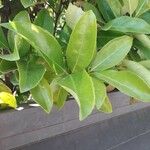
Ligustrum japonicum
لگستروم سفید · برگ نو ژاپنی، · یاس هلندی · Japanese wax-leaf privet · Japanese privet
Description
Source: leafsnapLigustrum japonicum, commonly known as Japanese privet, is an evergreen shrub native to Japan and Korea. It is part of the Oleaceae family and can reach heights of up to 20 feet, with a spread of 10-15 feet. The plant features glossy, dark green, oval-shaped leaves that can grow up to 3 inches long. In the summer, it produces small white flowers, which are followed by black berries in the fall. Japanese privet is a popular ornamental plant due to its attractive foliage and ease of pruning into various shapes. It can serve as a hedge or screen plant, or be grown as a specimen shrub in gardens or landscapes. The plant prefers full sun but can also tolerate partial shade and various soil types, including clay, loam, sand, and acidic soils. It requires moderate watering but can tolerate drought once established. While Japanese privet offers many benefits, such as being low maintenance and providing privacy screening, it also has drawbacks. In some parts of North America, where it was introduced from Asia for ornamental purposes, it has become invasive. In summary, Ligustrum japonicum is an attractive evergreen shrub with numerous uses, but it should be planted with caution due to its potential for invasiveness outside its native range.
🌳 Although commonly recognized as a hedge plant, japanese privet's usefulness goes well beyond garden borders. Many people are unaware that it can be processed to extract essential oils for perfumery, giving it a surprisingly versatile role in the cosmetics industry. Its wood is hard and durable, making it valuable for making small furniture or turned objects. With these multifaceted uses, japanese privet moves past its image as simply an ornamental shrub, revealing its potential as a resource in various industrial processes.
🎭 Safeguarding, ban, binding effect
Care Guide
💧 Water Every 7 days
Originating from moderate climates, Japanese privet thrives in well-maintained soil with consistent moisture, but without becoming waterlogged. While it is moderately drought-tolerant, it should be watered every 1-2 weeks. As an evergreen, Japanese privet does best when its watering schedule aligns with natural rainfall patterns.
When Should I Water My Japanese Privet?
Watering your Japanese Privet is crucial for its health, contributing to optimal growth, vibrant foliage, and disease resistance. You should check the soil's moisture by touching the top 1 to 2 inches; if it's dry, it's time to water. Wilted or droopy leaves are a sign your plant needs water, particularly during the pre-flowering stage or in warm temperatures and high sunlight exposure. Be cautious not to water too early when the soil is moist to avoid root diseases, and don't wait until the soil is excessively dry as this can cause plant stress or even death.
How Should I Water My Japanese Privet?
Watering your Japanese Privet correctly is vital for its health. The plant prefers moderate moisture and should be watered when the top inch of soil is dry. Bottom-watering is an effective method, which involves allowing the roots to absorb water from the bottom up, preventing fungal diseases. Use a watering can with a narrow spout to target the water at the plant's base, and consider employing a moisture meter to accurately determine when to water. Avoid wetting the foliage to prevent diseases, adjust your watering based on the environment, and ensure good drainage. Filtered or distilled water is preferable to tap water, which may contain harmful salts and chemicals.
How Much Water Does Japanese Privet Really Need?
The amount of water your Japanese Privet needs depends on root depth, pot size, and plant maturity. Since its roots are relatively shallow, the top few inches of soil should be kept moist but not waterlogged. Younger plants require less water than mature ones. Healthy plants will have lush, vibrant leaves and slightly moist soil. Overwatering can lead to root rot and nutrient absorption issues, while under-watering may stress the plant, leading to wilt and reduced growth. Use well-draining soil and adjust watering based on the season for optimal hydration.
What Kind of Water is Best for Japanese Privet?
Japanese Privet is moderately sensitive to water quality and fares best with rainwater due to its natural composition and balanced pH. Distilled or filtered water are suitable substitutes that are free from harmful contaminants. Tap water can be used but may contain chlorine and fluoride, which the plant is sensitive to, potentially causing leaf burn or discoloration. Letting tap water sit out for 24 hours before use or using a water filter can make it safer for the plant. Room temperature water is ideal, avoiding extremes that could shock the plant.
How Do Japanese Privet's Watering Needs Change with the Seasons?
Japanese Privet's watering needs vary throughout the year. In spring, the active growth phase, maintain consistent soil moisture. During summer, increased evaporation may require more frequent watering. As the plant prepares for dormancy in autumn, reduce watering frequency, allowing the soil to dry out slightly between waterings. In winter, water sparingly, only when the topsoil is dry, as the plant requires minimal moisture. Always adjust watering based on current weather conditions to meet the plant's needs.
☀️ Light Full sun
Japanese privet does best in places that receive full sun each day. That said, it has been found to tolerate lower light levels and even locations with minimal sunlight. Any move away from full daily sun can affect its growth rate, possibly making it grow less vigorously, though it will still survive.
What are the sunlight requirements for Japanese privet?
Japanese privet thrives best in areas where it can receive maximum sunlight, ideally above 6 hours of sunlight daily, categorized as full sun. It can also grow in partial sun to full shade, which consists of about 3-6 hours of sunlight. It's crucial to watch how sunlight moves through your garden, choosing spots that ensure a healthy balance of light and shade for optimal plant growth. Despite its preference for full sun, Japanese privet can adapt to less sun exposure, though it may grow less vigorously.
How does insufficient sunlight affect Japanese privet?
Insufficient sunlight can lead to various growth issues for Japanese privet. You might notice signs such as smaller new leaves, leggy or sparse growth, faster leaf drop, slower or no growth, irregular or paler leaf color, and conditions like chlorosis, sunscald, leaf curling, wilting, and leaf scorching. These symptoms indicate that the plant is struggling with light deficiency, and it's essential to adjust its exposure to sunlight or consider using artificial light sources for optimal health.
What are the essentials for growing Japanese privet indoors or in shaded areas?
When growing Japanese privet indoors or in areas with minimal light, using artificial lighting can be beneficial. For optimal growth, indoor plants require adequate lighting, which can be provided by LED lights customized to deliver specific wavelengths needed by the plants. The general guideline suggests that full sun plants need 30-50W/sq ft of light, partial sun plants need 20-30W/sq ft, and full shade plants need 10-20W/sq ft. The light source should be placed 12-36 inches above the plant, mimicking natural sunlight, and provided for 8-12 hours per day to promote faster, healthier growth.
How can I address symptoms of insufficient sunlight for my Japanese privet?
To counteract insufficient sunlight for Japanese privet, gradually adapt your plant to more sunlight by moving it closer to a sunnier location each week until it receives at least 6 hours of direct sunlight daily. If moving the plant isn't feasible, consider using artificial light sources. For outdoor plants, ensure a gradual transition to prevent sunburn. It's also important to reduce obstructions that block sunlight, such as by pruning trees. If necessary, transplant smaller plants during their dormant period to a location with better sunlight exposure and drainage. Remember, while parts of the plant that suffered might not recover, new growth should be healthy with improved light conditions.
🌡️ Temperature 15–35°C
The japanese privet favors a temperature range of 59 to 95 ℉ (15 to 35 ℃) in its native habitat. It adapts well to seasonal temperature changes, but it is advisable to avoid temperatures below 23 ℉ (-5 ℃) in winter and above 95 ℉ (35 ℃) in summer.
What is the preferred temperature range for Japanese privet?
The Japanese privet (Ligustrum japonicum) thrives in a temperature range between 59 to 95°F (15 to 35°C). It is adaptable to different seasonal temperatures but should ideally not be exposed to conditions below 23°F (-5°C) during winter or above 95°F (35°C) in summer. These plants have a strong resistance to cold, so they generally do not require special frost protection measures. However, in particularly cold winters where temperatures are expected to fall below the threshold, it is beneficial to protect the plant by wrapping its trunk and branches with insulating materials such as non-woven fabric or cloth. Additionally, watering the plant generously before the first freeze in autumn helps the soil retain moisture and prevents drought and water scarcity in winter and early spring.
How does low temperature affect Japanese privet and what are the solutions?
Japanese privet is cold-tolerant and performs best when temperatures are kept above a certain minimum threshold. During winter, temperatures should not fall below a specific limit to avoid damage. If temperatures drop below this limit, the plant may not show immediate distress, but by spring, the branches could become brittle and dry, and might not produce new shoots. The solution to this issue is to prune away any dead branches in the spring that have failed to produce new leaves, helping the plant to direct its energy to healthy growth.
How does high temperature affect Japanese privet and what are the solutions?
During the summer, it is crucial to ensure that the Japanese privet remains below a certain maximum temperature threshold. Exceeding this may result in the leaves turning lighter in color, tips becoming dry and withered, and an increased susceptibility to sunburn. To mitigate these effects, trim away sunburned and dried parts of the plant, relocate it to a shaded area or use a shade cloth to protect it from the intense midday and afternoon sun. Additionally, watering the plant during the cooler parts of the day, such as morning or evening, can help keep the soil suitably moist.
💨 Humidity
🪴 Soil 6-7
🌱 Fertilizer
Fertilize your Japanese privet in early spring to encourage healthy growth. Regular feeding improves overall health, leading to vigorous development, increased tolerance to harsh conditions, and enhanced resistance to pests and diseases. Keep to a consistent fertilization schedule for your Japanese privet to maintain foliage that is vibrant, richly colored, and lush in appearance.
What happens if I use too much fertilizer on my Japanese privet plant?
Feeding a Japanese privet carries the risk of overfertilization, which can be especially likely if done at the wrong time of year, too frequently, or without watering the soil first. Overfertilization may cause brown leaves or stunted growth in your Japanese privet. Conversely, excessive fertilizer can also lead to rapid but weak new growth, which can easily break and negatively affect the overall form and structure of the plant.
Why should I put fertilizer on my Japanese privet?
No matter what type of Japanese privet you have, regular fertilization is essential for maintaining its overall health. Providing the proper nutrients will result in stronger growth and increased resilience to difficult growing conditions, as well as improved ability to combat diseases and pests. The foliage of your Japanese privet is a major highlight, so it's important to prioritize its preservation. This can be achieved by implementing a consistent fertilization schedule tailored to your specific privet type. By doing so, you will encourage the development of vibrant, lush leaves that enhance the plant's aesthetic.
When should I fertilize my Japanese privet?
To ensure healthy growth, it is recommended to fertilize your Japanese privet for the first time in late winter or early spring. This provides the necessary nutrients for it to thrive when the weather becomes warmer. If you live in a warm climate, it is also beneficial to provide an additional fertilizer feeding in early fall. This helps to fortify your Japanese privet, making it more resilient to winter cold and preventing foliage damage. Fertilizing earlier in the year ensures that the new branches have ample time to grow and withstand the cold winter.
When should I not fertilize my Japanese privet?
There are certain times of the year when you should avoid fertilizing your Japanese privet. Firstly, during the early and mid-winter months, when the plant is dormant, it does not require any additional feeding. Secondly, it is not recommended to fertilize the plant in late spring and throughout the summer, as the weather tends to be hotter and drier. These conditions can have a negative impact on the Japanese privet if fertilized. To prevent any issues, it is best to stick to a fertilization schedule that only includes feeding during early spring and early fall.
What kind of fertilizer does my Japanese privet plant need?
For a Japanese privet, nitrogen is usually the most important nutrient, but phosphorus and potassium should not be overlooked. Although all three nutrients are needed in decent amounts for optimal growth, a balanced fertilizer like a 10-10-10 can be effective. However, a more specific nutrient ratio, particularly one with a slightly higher nitrogen content, such as 10-6-4, often leads to better results. When fertilizing, both granular and liquid-based fertilizers can be used.
🪴 Pot & Repot 2-3 years
When repotting Japanese privet, pick a pot 1–2 inches (2.5–5.1 cm) larger with good drainage. Use a well-draining potting mix. Repot in spring or fall, making sure the root ball sits slightly below the rim of the flower pot. Water thoroughly after repotting and place it in a warm spot with indirect sunlight.
✂️ Pruning
Pruning Japanese privet in early spring is crucial for maintaining its shape and promoting healthy growth. Trim any overgrown branches and thin out the interior to improve air circulation. To control its size and prevent pests, consider rejuvenation pruning by removing up to one-third of the old wood every few years.
🌿 Propagating
🐛 Diseases & pets
☠️ Toxicity
Characteristics
- Plant Type
- Shrub, Tree
- Life Cycle
- Perennial
- Genus
- Ligustrum
- Family
- Oleaceae
- Hardiness Zone
- 7-10
- Mature Height
- 2.13 m to 6.1 m
- Mature Spread
- 1.52 m to 1.83 m
- Leaf Color
- Green
- Leaf Type
- Evergreen
- Flower Color
- White
- Flower Size
- 0.51 cm to 0.51 cm
- Bloom Time
- Late spring, Early summer, Mid summer
- Planting Time
- Spring, Autumn
- Harvest Time
- Mid summer
- Native Area
- South Korea, Japan, China