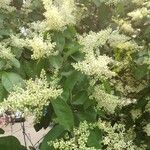
Ligustrum quihoui
Waxyleaf privet · Quihoui privet · Waxy-leaf-privet
Description
Source: leafsnapLigustrum quihoui, or waxyleaf privet, is a shrub native to Korea and China (Anhui, Guizhou, Henan, Hubei, Jiangsu, Jiangxi, Shaanxi, Shandong, Sichuan, Xizang (Tibet), Yunnan, Zhejiang). As with some other members of the genus, L. quihoui is cultivated as an ornamental in many places and has become naturalized and invasive in urban areas and scattered forested locales of the southeastern United States (Texas, Oklahoma, Alabama, Mississippi, Florida, North Carolina, Virginia, Maryland).Ligustrum quihoui is a shrubby, semi-evergreen to evergreen privet, one to three meters high. It is noted for its large sparse flowering panicles of scented white flowers, borne late in the growing season, for which it is sometimes grown in gardens.
🌳 Waxyleaf privet is an attractive nectar source for bees and may serve an overlooked role in apiculture. Although it is not often cited in mainstream discussions about bee-friendly plants, its flowers supply plentiful nectar during their flowering periods. With global concern about bee populations, waxyleaf privet’s contribution to bee health and honey production could be a largely untapped opportunity. Its unassuming support for beekeeping could be put to use, particularly in locations where usual nectar sources are limited.
Care Guide
💧 Water
The waxyleaf privet thrives in moderate climates with consistent moisture and can tolerate short dry spells. For optimal growth, water the plant every three weeks, ensuring the soil remains lightly moist but not waterlogged. Though typically grown outdoors, it benefits from mulching to retain moisture, particularly during its active growth period.
What do I need to do if I give Waxyleaf privet too much or too little water?
An overwatered Waxyleaf privet will show signs of yellowing, wilting, and dropping leaves. The plant may also appear dull and unhealthy, with mushy stems. Adjusting your watering schedule is necessary when these signs appear. Wilting can also indicate under watering, with leaves becoming crispy and dry. If the soil is dry and simply watering is not enough, give the plant a thorough watering. However, even with enough water, the damaged root system may cause the Waxyleaf privet to continue having dry, yellow leaves for a few days. Once the plant returns to normal, the yellowing will stop. When keeping the Waxyleaf privet indoors, always check the moisture levels in the pot and avoid overwatering. Look for signs of black spots, and if present, allow the soil to dry out for a few days without watering. Overwatering can lead to root rot, so if you notice discolored and slimy roots, consider transferring the plant to a different pot. Take precautions to prevent root rot and avoid excessively soggy soil. When planting the Waxyleaf privet outdoors, make sure to check the soil moisture by digging a little deeper with your fingers. If the soil is too dry, it might indicate underwatering, and adequate watering is necessary for the plant to recover.
☀️ Light Full sun
Waxyleaf privet does best when provided with plentiful light and thrives most vigorously in bright, sunny conditions. It can tolerate lower light levels, but growth may be less vigorous. Its native habitat is generally well illuminated. Excessive shading or insufficient light can weaken the plant, while too much sun can damage the foliage.
What are the sunlight requirements for growing Waxyleaf privet?
Waxyleaf privet thrives in conditions ranging from full sun, which means it requires more than 6 hours of direct sunlight per day, to partial sun with about 3-6 hours of sunlight. It's essential to watch how sunlight moves through your garden to find spots that offer the right balance of light and shade, ensuring optimal growth and health of your Waxyleaf privet.
How does insufficient or excessive sunlight affect Waxyleaf privet?
Waxyleaf privet performs best under ample sunlight, a condition reminiscent of its natural habitat. Reduced sun exposure can lead to less vigorous growth, while too little light may weaken the plant. On the other hand, too much sun exposure can damage the foliage. To combat insufficient natural light, particularly during winter or in less sunny locations, artificial lighting such as LED lights can be used, with specific wattages recommended for different plant types to promote healthy growth.
What symptoms indicate Waxyleaf privet is receiving improper sunlight?
Symptoms of improper sunlight exposure in Waxyleaf privet include smaller new leaves, leggy or sparse growth, faster leaf drop, slower or halted new growth, lighter-colored or irregularly patterned new leaves, chlorosis, sunscald, leaf curling, wilting, and leaf scorching. These symptoms can indicate either too much or too little light, affecting the plant's health and growth.
What are some solutions for Waxyleaf privet experiencing poor light conditions?
For indoor Waxyleaf privet struggling with low light, gradually increase sunlight exposure to at least 6 hours daily using a south-facing window or artificial light sources like desk or grow lights for 8 hours daily. Outdoors, gradually move plants to sunnier locations each week to avoid sunburn. If trees obstruct sunlight, consider pruning them to improve light access. For smaller plants, transplanting during the dormant period with careful handling of roots and soil to a sunnier location with good drainage is advised. Note that parts of the plant affected by insufficient light may not recover, but new growth should be healthy with increased light exposure.
🌡️ Temperature 10–35°C
Waxyleaf privet is native to areas with moderate temperatures between 50 and 95 °F (10 and 35 ℃). It performs best within this range, but in winter, measures such as mulching can help keep the soil warm if it becomes too cold.
What is the optimal temperature range for Waxyleaf privet?
Waxyleaf privet thrives in moderate temperatures ranging from 50 to 95 °F (10 to 35 °C). This range is optimal for its growth, and within this temperature bracket, the plant generally maintains good health and vigor.
How can Waxyleaf privet be protected during cold winters?
Although Waxyleaf privet has strong cold resistance, in regions where winter temperatures are expected to drop below -25°C, it is important to protect the plant. This can be done by wrapping the trunk and branches with non-woven fabric or cloth. Additionally, watering the plant abundantly before the first freeze helps keep the soil moist and reduces the risk of drought and water scarcity during winter and early spring.
What are the signs of Waxyleaf privet experiencing low temperatures beyond its tolerance?
When temperatures fall below -25°C, there may not be immediate visible damage during winter. However, in spring, the branches may become brittle and dry, and the plant may fail to produce new shoots. In such cases, it is advised to prune away any dead branches that have not sprouted new leaves.
How does Waxyleaf privet react to high temperatures, and what are the solutions?
During summer, Waxyleaf privet should ideally be exposed to temperatures below 35°C. Should the temperature exceed 38°C, the leaves may lighten in color, and tips may become dry and withered, increasing susceptibility to sunburn. To mitigate these effects, trim the sunburned and dried parts of the plant, provide shade during the midday and afternoon sun, and ensure the soil remains moist by watering in the morning and evening.
What is the botanical name of Waxyleaf privet?
The botanical name of Waxyleaf privet is Ligustrum quihoui.
💨 Humidity
🪴 Soil 5-7
🌱 Fertilizer
The timing of fertilizing Waxyleaf privet is important. Apply fertilizer in early spring and then once a month through early summer. Fertilizer encourages attractive blooms and supplies energy both during dormant periods and active growth.
When should I fertilize my Waxyleaf privet?
To ensure successful fertilization of Waxyleaf privet, timing is key. Applying fertilizer too early, when the plant is still dormant, will render it ineffective and susceptible to being washed away by rainwater, resulting in waste and pollution. It is advisable to apply the first round of fertilizer in early spring and subsequently continue fertilizing once a month until early summer.
🪴 Pot & Repot
✂️ Pruning
Waxyleaf privet benefits from annual pruning in early spring, which helps maintain its shape and promotes healthy growth. Effective pruning techniques include thinning out branches and cutting back to strong buds. These methods improve airflow and light penetration, reducing the risk of disease, encouraging blooming, and controlling the plant's size to prevent it from becoming invasive.
🌿 Propagating
🐛 Diseases & pets
☠️ Toxicity
Characteristics
- Plant Type
- Shrub
- Life Cycle
- Perennial
- Genus
- Ligustrum
- Family
- Oleaceae
- Hardiness Zone
- 6-9
- Mature Height
- 3.05 m
- Mature Spread
- 3.05 m
- Leaf Color
- Green
- Leaf Type
- Deciduous
- Flower Color
- White
- Flower Size
- 10.16 cm to 20.32 cm
- Bloom Time
- Late spring, Early summer, Mid summer
- Planting Time
- Spring, Autumn
- Harvest Time
- Mid summer
- Native Area
- South Korea, China