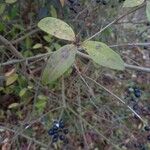
Ligustrum vulgare
برگ نو، مندارچه · European privet · Common Privet · Privet · Privet-hedge
Description
Source: leafsnapThis attractive dwarf privet features a dense growth habit and lush green foliage that responds well to pruning. If left unpruned, it produces lightly scented white flowers in late spring to early summer, followed by ornamental black berries in late summer. This plant is an excellent choice for low hedges and is a very easy-to-grow and versatile shrub. It is deciduous.
🌳 Besides its typical use as an ornamental hedge, common privet has traits that make it suitable for urban green spaces with practical functions. One especially original application is its ability to provide acoustic insulation in highly populated areas. Its dense foliage can absorb sound, thus decreasing noise pollution. This opens up possibilities in urban planning and landscape architecture for those seeking natural ways to create quieter environments. Additionally, the plant is employed as an indicator of certain soil contaminants, highlighting its ecological role in environmental monitoring.
🎭 Mending old wounds, releasing blocks, gentleness, do not proceed
Care Guide
💧 Water Every 1-2 weeks
Wild privet thrives best in environments with moderate humidity and consistent moisture. While it can tolerate short periods of dryness, it's important to water it every 1-2 weeks, allowing the soil to dry slightly between each watering. If you're growing wild privet outdoors, applying mulch can help retain moisture, regulate the soil temperature, prevent waterlogging, and ensure the plant stays adequately hydrated.
When Should I Water My Wild Privet?
Providing wild privet with a timely watering schedule is crucial for its health and growth, emphasizing the importance of neither overwatering nor under-watering. You should water when the soil feels dry to about an inch deep to prevent the plant from drying out completely. Look for signs like leaf wilt, which indicates the plant needs water, or a change in leaf color to lighter or yellowish hues as a sign of water shortage. If the plant's growth slows down or stops, it might need more water. Be cautious of overwatering, as it leads to risks like root rot and can kill the plant. On the other hand, late watering when signs of distress are visible can severely harm or even lead to the death of your wild privet.
How Should I Water My Wild Privet?
Wild privet's watering requirements specify a preference for bottom-watering to ensure that the roots receive adequate moisture without oversaturating the soil or wetting the foliage, which can lead to fungal diseases. If using a watering can, choosing one with a narrow spout is recommended to target water directly to the base of the plant, avoiding the leaves. This technique helps in delivering water more efficiently to the roots and minimizing the risk of foliar diseases.
How Much Water Does Wild Privet Really Need?
The amount of water your wild privet requires depends on several factors, including pot size, plant size, and the plant's growth stage, as well as environmental conditions. Ensure thorough watering, soaking the soil until water reaches the bottom of the pot, yet be mindful not to over-water. An optimally watered privet will display vibrant foliage and consistent growth, while signs of under-watering include drooping leaves and stunted growth. Conversely, over-watering results in yellow leaves, potentially indicating root rot. Check the soil's top layer; if dry, it's time to water your plant. Consistent, proper watering contributes to the optimal growth of wild privet, balancing hydration needs without causing waterlogged conditions.
What Kind of Water is Best for Wild Privet?
Wild privet thrives best when watered with rainwater or distilled water due to their balanced nutrient profiles that suit the plant's needs. Tap water, unless treated, can stress the plant because of its high salts and chlorine content. Wild privet is particularly sensitive to chlorine, so letting tap water sit for 24-48 hours before use or treating it can reduce these adverse effects. For water temperature, room temperature is ideal as extremes can shock the plant or promote harmful microorganism growth. Rainwater is particularly recommended for its natural pH, absence of chlorine, and balanced mineral content, but remember to store it properly to avoid contamination.
How Do Wild Privet's Watering Needs Change with the Seasons?
Seasonal changes impact wild privet's watering needs significantly. During spring, with new growth emerging, keep the soil consistently moist but not waterlogged. In summer, the active growth phase and higher evaporation rates mean the plant needs more water, maintaining a consistently moist top soil layer without watering in peak sun hours to minimize evaporation. As autumn approaches, reduce watering frequency as the plant prepares for dormancy, letting the top soil layer dry out between waterings. In winter, reduce watering further, only doing so when the soil's top layer is dry to the touch, and avoid freezing the plant's roots by watering at the warmest time of day.
☀️ Light Full sun
The ordinary privet flourishes when given plenty of sunlight during the day. It can also survive in places with slightly less light. However, overexposure to sunlight can result in scorched leaves, whereas inadequate light can hinder its development and liveliness. In its native habitat, there's a substantial amount of sun.
What type of sun exposure does wild privet require?
Wild privet thrives under conditions of generous sunlight exposure throughout the day and can also adapt to areas with slightly less light. However, excessive sun can cause leaf burn, while insufficient sunlight may hinder its growth and vitality. It's important to find a balance, ensuring the plant gets more than 6 hours of sunlight for 'full sun' conditions or about 3-6 hours for 'partial sun' exposure.
How should indoor wild privet plants be lit when natural sunlight is insufficient?
Indoor wild privet plants need adequate lighting for optimal growth, especially in conditions where natural sunlight is lacking. Utilizing artificial lights, such as LED lights, can be particularly beneficial. These lights should be customized to provide specific wavelengths needed by the plant. For full sun plants, 30-50W/sq ft of artificial light is recommended, 20-30W/sq ft for partial sun plants, and 10-20W/sq ft for full shade plants. The light source should be placed 12-36 inches above the plant to simulate natural sunlight. Furthermore, it's also critical to mimic the natural daylight duration, requiring 8-12 hours of light per day for most plants.
What are the symptoms of insufficient or excessive sunlight exposure in wild privet?
When wild privet is subjected to less than optimal light conditions, several symptoms may manifest. Insufficient light can lead to smaller leaves, leggy or sparse growth, faster leaf drop, slower or ceased new growth, and lighter-colored or chlorotic leaves. Excessive sunlight exposure can cause chlorosis, sunscald, leaf curling, wilting, and leaf scorching. These symptoms indicate either a lack of or too much sunlight, affecting the plant's ability to engage in healthy photosynthesis.
What solutions can be implemented for wild privet experiencing poor light conditions?
Improving light conditions for wild privet involves strategic actions whether the plant is indoors, outdoors, or in the ground. Indoors, gradually moving the plant to a sunnier spot or using artificial lights can help achieve at least 6 hours of direct sunlight daily. Outdoors, adjusting the plant's location for optimal sun exposure is key, avoiding sudden changes to prevent sunburn. For ground-planted wild privet, minimizing obstructions like pruning trees or transplanting to better locations during the plant's dormant season ensures ample sunlight and good drainage. It's important to remember that affected parts may not recover, but new growth will be healthy with improved light conditions.
🌡️ Temperature 5–32.2°C
Common privet thrives in its natural habitat at temperatures between 5 and 32 ℃ (41 and 90 ℉). In response to varying seasons, it might need safeguarding against excessively hot or cold conditions.
What temperatures can wild privet tolerate?
Wild privet, or Ligustrum vulgare, thrives in temperatures ranging from 5 to 32°C (41 to 90°F) in its native growth environment. It has a strong resistance to cold but may require protection during extreme heat or cold. Even though special frost protection measures are usually not necessary due to its cold resistance, it is important to protect the plant when winter temperatures are expected to drop below its growth limit. This can include wrapping the trunk and branches with non-woven fabric or cloth. Additionally, watering the plant abundantly before the first freeze in autumn is recommended to ensure the soil remains moist, which helps prevent drought and water scarcity during winter and early spring.
How should I care for wild privet in low temperatures?
Wild privet does best in temperatures above its minimum suitable growth temperature during winter and should be kept above its tolerable growing temperature minimum. When temperatures fall below its growth limit, the plant might not show immediate changes during winter, but in spring, branches may become brittle and dry, and failing to produce new shoots. To manage this, remove any dead branches that did not produce new leaves in spring.
What should I do if my wild privet experiences high temperatures?
During summer, it is essential to keep the wild privet below its maximum suitable growth temperature. If the temperature exceeds its tolerable growing temperature max, the leaves may lighten in color, and tips can dry out and become withered, increasing susceptibility to sunburn. To mitigate this, trim away the sunburned and dried parts. Relocate the plant to a shaded area during midday and afternoon sun or use a shade cloth. Ensure the plant is watered in the morning and evening to keep the soil moist.
💨 Humidity
🪴 Soil 6-7
🌱 Fertilizer
Fertilize your Common privet in early spring to encourage healthy growth. Regular feeding improves overall health, leading to vigorous growth, increased tolerance of adverse conditions, and better resistance to diseases and pests. Keep a consistent fertilization schedule for your Common privet to maintain vibrant, deeply colored, and lush foliage.
When is it better not to put fertilizer on my Wild privet?
To ensure the health of your Wild privet, avoid fertilizing at certain times of the year. Firstly, during the early and mid-winter months when the plant is dormant and does not require feeding. Secondly, it is not recommended to fertilize during the late spring and summer when the weather is hotter and drier. These conditions can have a negative impact on the plant's response to fertilization. Instead, follow a fertilization schedule that focuses on feeding in early spring and early fall to avoid any potential issues.
What kind of fertilizer does my Wild privet require?
Most Wild privets need nitrogen as the primary nutrient, but phosphorus and potassium are still important. A balanced fertilizer like 10-10-10 can be effective as it provides all three nutrients in decent amounts. However, a more nuanced ratio, such as 10-6-4 with higher nitrogen, often promotes optimal growth for Wild privets. Whether you choose granular or liquid-based fertilizers, both can be used for fertilizing.
What will happen if I give too much fertilizer to my Wild privet?
Feeding a Wild privet can be risky due to the potential for overfertilization. The risk is particularly high if you feed the plant at the wrong time, feed it too frequently, or forget to water the soil before feeding. Signs of overfertilization include the development of brown leaves and stunted growth. Alternatively, excessive fertilization may cause the Wild privet to grow rapidly, resulting in weak and breakable new growth. This weak wood can also affect the overall shape and structure of the plant.
Why should I put fertilizer on my Wild privet?
No matter what kind of Wild privet you have, regular fertilization is important for its overall health. By providing the right nutrients, you can promote stronger growth and increase its resilience against tough conditions, diseases, and pests. To preserve the attractive foliage of your Wild privet, it's crucial to follow a specific fertilization schedule. This will result in vibrant, deep-colored leaves and a lush appearance.
When should I fertilize my Wild privet?
To give your Wild privet the best care, consider fertilizing it twice a year. The first application should be in late winter or early spring, providing all the necessary nutrients for healthy growth. If you live in a warm climate, it's also helpful to fertilize again in early fall. This ensures the soil has extra nutrients for the following growing season and helps the plant become more resilient against winter cold. Fertilizing earlier in the fall will allow new branches to develop and better endure the cold winter conditions.
🪴 Pot & Repot 2-3 years
When rehousing Common privet, opt for a pot that is 1-2 inches (2.5-5 cm) bigger and has sufficient drainage. Utilize a potting mixture that drains well. Carry out the repotting during the spring or the fall, making sure the root ball is somewhat below the edge of the plant pot. Thoroughly water after repotting and position in a warm location with indirect light from the sun.
✂️ Pruning
Pruning wild privet in early spring can improve its growth and flowering. To achieve the best results, apply a few key techniques: thin out crowded branches to enhance air circulation, and shape the plant as desired. Make sure to make clean cuts just above the buds to prevent disease. Additionally, regularly remove any dead wood to maintain the plant's vitality.
🌿 Propagating
🐛 Diseases & pets
☠️ Toxicity
Characteristics
- Plant Type
- Shrub
- Life Cycle
- Perennial
- Genus
- Ligustrum
- Family
- Oleaceae
- Hardiness Zone
- 5-8
- Mature Height
- 1.52 m to 4.57 m
- Mature Spread
- 2.44 m to 4.57 m
- Leaf Color
- Green
- Leaf Type
- Deciduous
- Flower Color
- White
- Flower Size
- 0.51 cm to 0.51 cm
- Bloom Time
- Late spring, Early summer, Mid summer
- Planting Time
- Spring, Autumn
- Harvest Time
- Mid summer
- Native Area
- Turkey, Sweden, Austria, Slovakia, Montenegro, Slovenia, Morocco, Croatia, Russia, Germany, Romania, Belgium, Moldova, Portugal, Netherlands, France, Czech Republic, Bulgaria, Armenia, Poland, Greece, Ukraine, Serbia, Norway, Italy, Spain, Switzerland, Iran, Albania, Ireland, United Kingdom, Hungary, Azerbaijan