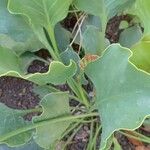
Limonium perezii
Perez's sea lavender · Perez's sealavender · Sea lavender · Sea rosemary · Sea statice
Description
Source: leafsnapLimonium perezii, commonly known as Perez's sea lavender, is a perennial plant species from the Plumbaginaceae family. Native to the Canary Islands, it thrives in coastal areas and on rocky cliffs. The plant features long stems that can reach up to 1 meter in height, adorned with large clusters of small flowers that bloom from summer through fall. The leaves of Limonium perezii are thick, fleshy, and exhibit a blue-green hue. The flowers are small, each with five petals, and come in shades of blue or purple. They are arranged in prominent clusters at the top of each stem. Ideal for coastal gardens, Limonium perezii is tolerant of salt spray from ocean winds. It prefers full sun exposure but can also thrive in partial shade. The plant requires well-draining soil with moderate moisture levels but does not tolerate waterlogged conditions or drought stress well. In summary, Limonium perezii is an attractive perennial that adds vibrant color to any garden setting and is low-maintenance once established.
🌳 Unlike typical garden plants, sea lavender is notable in floral design. Its bright lavender flowers are preferred for dried arrangements because they maintain their vivid violet-blue shade for a long time, unlike most dried plants that fade. Sea lavender is also used in potpourri thanks to its lasting color and gentle aroma. Although it is not widely used for essential oils, investigating its potential in that field is an intriguing possibility.
🎭 Fidelity, Affection, Commitment
Care Guide
💧 Water Every 7 days
Perez's sea lavender, native to arid coastal areas, is highly drought-tolerant and requires very little moisture to thrive. Although it can withstand dry conditions, it benefits from moderate hydration, ideally by watering once a week. As an evergreen plant, Perez's sea lavender retains water efficiently, allowing it to maintain lush foliage in a variety of climate zones.
☀️ Light Full sun
Sea lavender does best when given plenty of sunlight throughout the day, reflecting its native coastal environment. While it prefers bright light, it can tolerate reduced sun exposure, although that may limit its peak growth. Excessive light, however, can cause leaf bleaching.
What are the sunlight requirements for Perez's sea lavender?
Perez's sea lavender thrives in full sun, which means it requires above 6 hours of sunlight daily, but it can also adapt to partial sun conditions, which involve about 3-6 hours of sunlight. The right balance of light and shade is critical for the plant's health, so monitoring the movement of sunlight through your garden to find the ideal location is recommended.
What essentials should be considered for growing Perez's sea lavender?
Perez's sea lavender prefers ample sunlight throughout the day, mimicking its natural coastal habitat conditions. While it can tolerate lesser solar exposure, its growth might not be optimal. Overexposure could lead to leaf bleaching. If natural light is insufficient, especially during winter or in less sunny locations, artificial lighting such as LED lights can be a vital solution. For full sun plants, 30-50W per square foot is needed; partial sun plants require 20-30W per square foot, and full shade plants need 10-20W per square foot. The artificial light source should be placed 12-36 inches above the plant, and most plants will need 8-12 hours of light per day.
What are the symptoms of light deficiency or overexposure in Perez's sea lavender?
Symptoms of light deficiency in Perez's sea lavender include smaller new leaves, leggy or sparse growth, faster leaf drop, slower or no new growth, and lighter-colored new leaves. Overexposure to sunlight can lead to chlorosis, sunscald, leaf curling, wilting, and leaf scorching. These conditions can significantly affect the plant's health and its ability to photosynthesize effectively.
How can I address light-related issues for indoor and outdoor Perez's sea lavender?
For indoor Perez's sea lavender experiencing light-related issues, gradually moving the plant to a sunnier location each week until it receives at least 6 hours of direct sunlight daily is recommended. Using a south-facing window can maximize sunlight exposure. If the plant is large or difficult to move, consider using artificial light, keeping a lamp on for at least 8 hours a day or investing in grow lights. Outdoors, moving plants gradually to sunnier spots can help them adapt without getting sunburned. Note that parts of the plant affected by insufficient sunlight may not recover entirely, but new growth should be healthy after adjusting light exposure. Reducing obstructions and potentially transplanting to locations with better sunlight and drainage are additional steps for ground-planted specimens.
🌡️ Temperature 15–37.8°C
Sea lavender comes from temperate environments and thrives at temperatures of 68 to 100 °F (20 to 38 ℃). Like all weather-dependent plants, seasonal temperature adjustments may be needed to keep it in optimal health.
What is the native environment of Perez's sea lavender?
Perez's sea lavender, botanically known as Limonium perezii, is native to temperate environments. It thrives in a temperature range of 68 to 100 °F (20 to 38 °C). This plant prefers conditions that simulate its native habitat, adjusting to different temperatures across seasons to maintain optimal health.
Does Perez's sea lavender have any cold tolerance?
Yes, Perez's sea lavender has some degree of cold tolerance. It generally does not require special care when the temperature is above 0°C. However, if temperatures are expected to fall below freezing, it is advisable to take temporary measures to protect the plant. Wrapping the plant with plastic film, fabric, or other insulating materials can help. These protective measures should be removed once the temperature rises again to avoid damaging the plant.
How does Perez's sea lavender react to low temperatures?
Perez's sea lavender has a moderate tolerance to low temperatures, flourishing above 20°C and needing to be kept above 0°C during the winter. When temperatures drop below -10°C, the plant's leaves may droop and, in severe cases, wilt and fall off. To protect against frost damage, it is recommended to trim off the frost-damaged parts and wrap the plant in non-woven fabric or cloth, while also constructing a wind barrier.
What should be done if Perez's sea lavender experiences high temperatures?
During the summer, it is important to ensure that Perez's sea lavender is not exposed to temperatures above 38°C. Exceeding 43°C can lead to lighter leaf colors, dry and withered leaf tips, curling leaves, and increased susceptibility to sunburn. To mitigate damage, remove sunburned and dried parts, relocate the plant to a shaded area or use a shade cloth to protect it from intense midday and afternoon sun. Additionally, watering the plant in the morning and evening helps keep the soil adequately moist.
💨 Humidity
🪴 Soil 6-7
🌱 Fertilizer
The best time to fertilize sea lavender is in early spring, when it is coming out of dormancy and starting active growth. Fertilization supplies essential nutrients for healthy development. Although sea lavender has relatively low fertilizer requirements, applying fertilizer once a year can improve its survival and encourage better, longer-lasting flowers.
🪴 Pot & Repot 2-3 years
When repotting Sea lavender, pick a pot 1-2 inches (2.5–5.1 cm) larger that has ample drainage. Use a well-draining potting mix. Repot in spring or fall, making sure the root ball sits slightly lower than the rim of the flower pot. Water thoroughly after repotting and place it in a warm spot with indirect sunlight.
✂️ Pruning
To promote healthier growth and flowering, Perez's sea lavender benefits from pruning from early spring through late winter. Focus on removing spent blooms and damaged stems. This practice enhances bushiness, improves air circulation, and reduces the risk of disease. Regular trimming also helps maintain an attractive shape and prevents leggy growth, ensuring the plant's vitality throughout the year.
🌿 Propagating
🐛 Diseases & pets
☠️ Toxicity
Characteristics
- Plant Type
- Herb
- Life Cycle
- Perennial, Annual
- Genus
- Limonium
- Family
- Plumbaginaceae
- Hardiness Zone
- 8-11
- Mature Height
- 61 cm to 91 cm
- Mature Spread
- 61 cm to 91 cm
- Leaf Color
- Green
- Leaf Type
- Evergreen
- Flower Color
- Lavender
- Flower Size
- 0.76 cm
- Bloom Time
- Mid summer
- Planting Time
- Spring
- Harvest Time
- Mid summer, Late summer
- Native Area
- Coastal areas