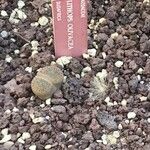
Lithops olivacea
Description
Source: leafsnapLithops olivacea is a species of the genus Lithops under the family Aizoaceae. The name olivacea refers to the Latin word for olive (oliva) combined with the suffix -cea, meaning "of the likeness," producing the idea of "olive likeness." Lithops olivacea grow primarily in the Bushmandland of South Africa. They grow most abundantly in the regions of Aggeneys, Pofadder, and Namies. L. olivacea also received the Royal Horticultural Society's Award of Garden Merit for being "excellent for ordinary use in appropriate conditions, available to buy, of good constitution, essentially stable in form & colour, [and] reasonably resistant to pests & diseases."
Care Guide
💧 Water
Lithops olivacea, native to arid regions, has an impressive ability to store water, making it highly drought-tolerant. It should be watered sparingly, about every three weeks. In low-humidity indoor environments, occasional misting during its growth period can be beneficial by mimicking the brief rain showers of its natural habitat.
☀️ Light Full sun
Originating in arid areas, Lithops olivacea performs best in full sun, since its natural habitat has intense sunlight and little shade. It will also tolerate partial sun, providing some flexibility in its growth.
🌡️ Temperature 20–37.8°C
While it tolerates some heat, Lithops olivacea mainly thrives and grows in cooler seasons and goes dormant in summer. In hot summer weather, provide shade to prevent scorching from intense sunlight. Watering should be reduced or stopped during the hottest part of the year to avoid root rot. Lithops olivacea grows most vigorously in winter and spring, and it will continue to grow steadily as long as temperatures do not fall too low.
💨 Humidity
🪴 Soil 6-7
🌱 Fertilizer
For Lithops olivacea, small amounts of fertilizer applied once or twice a year during the growing season are sufficient. Do not fertilize in winter or summer when the plant is dormant. Reduce feeding for recently repotted plants and wait a couple of months after repotting before applying fertilizer. Fertilizing helps maintain healthy growth and encourages flowering.
🪴 Pot & Repot Every 2 years
When repotting Lithops olivacea, choose a pot a little bigger than the current one that has good drainage. Plant it in a gritty succulent or cactus mix that drains well. Gently take the plant out of its old pot, brush away excess soil, and set it back in at the same depth. Hold off watering for several days to let any root damage recover. Repot during spring or fall, and place it in a brightly lit spot.
✂️ Pruning
To maintain the shape of Lithops olivacea, you may need to prune it, especially in the spring and autumn. Focus on removing any dense or redundant branches. For propagation, cut a sturdy stem with 5-6 leaves. Apply sulfur powder to the cut wound and allow it to heal before planting in slightly moist soil.
🌿 Propagating
🐛 Diseases & pets
☠️ Toxicity
Characteristics
- Plant Type
- Succulent
- Life Cycle
- Perennial
- Genus
- Lithops
- Family
- Aizoaceae
- Hardiness Zone
- 10-11
- Mature Height
- 1 cm
- Mature Spread
- 2 cm
- Leaf Color
- Green, Brown
- Leaf Type
- Semi-evergreen
- Flower Color
- Yellow
- Flower Size
- 2.03 cm to 3.05 cm
- Bloom Time
- Fall
- Planting Time
- Spring, Autumn, Winter
- Harvest Time
- Winter
- Native Area
- South Africa