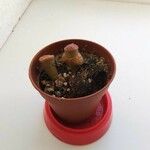
Lithops pseudotruncatella
Living stone · Pet rock · Butthole plant
Description
Source: leafsnapLithops pseudotruncatella, commonly known as the False Truncate Living Stone, is a small succulent plant native to South Africa. It belongs to the Aizoaceae family and is a popular ornamental plant due to its unique appearance and low maintenance needs. This plant exhibits a compact, stemless growth habit with two fleshy leaves that are fused at their base. The leaves are thick and rounded, featuring an indentation at the top that resembles a tiny window. This window-like structure allows light to penetrate into the leaf interior, facilitating photosynthesis. In autumn or winter, Lithops pseudotruncatella produces small yellow or white flowers that emerge from between the leaves. These flowers, which have five petals, typically remain open for only one day before closing again. Lithops pseudotruncatella thrives in well-draining soil with low moisture content, as it is adapted to survive in arid conditions. The plant requires bright light but should be protected from direct sunlight during the hot summer months. Overall, Lithops pseudotruncatella is a fascinating addition to any succulent collection, thanks to its unique appearance and minimal care requirements.
🌳 Although it looks like a rock, truncate living stone plays a significant role in water-wise garden designs. Its ability to store water enables it to thrive in arid environments, not only adding aesthetic value but also serving as a model plant for sustainable landscaping in drought-prone areas. The plant's distinctive form and texture contribute an intriguing element to rock gardens and succulent collections, serving as an educational tool for adaptations in extreme habitats.
🎭 Lovely
Care Guide
💧 Water Every 7 days
Living stone, a plant adapted to arid regions, requires minimal water and thrives when watered infrequently, approximately every three weeks. As a drought-tolerant indoor plant, it is crucial to avoid overwatering to prevent root rot. During its summer dormancy, watering should be particularly sparse.
How should I water my Truncate living stone plant in the best way?
To effectively water Truncate living stone, timing is important. Wait until spring when new leaves start growing before watering the plant. Only water when the soil inside the pot is completely dry. You can use tap water or distilled water for watering, but avoid watering overhead. Instead, water at the base of the plant, applying water slowly and evenly across the soil surface. This ensures consistent moisture for all parts of the soil without dampening the above-ground plant. You can keep watering until you see a light stream of excess water draining from the pot's hole.
What do I do if I give my Truncate living stone plant too much or too little water?
Overwatering a Truncate living stone is more common than underwatering, and it can be harmful to the plant's health, potentially causing it to die quickly. To avoid overwatering, it is important to let the soil dry completely before watering. Many people make the mistake of watering the plant incorrectly, especially when it enters dormancy. In this case, we will focus on how to fix the overwatering problem. If you notice signs of overwatering, it is best to remove the plant from its current pot and examine the roots for any signs of rot or moisture-related diseases. While some roots may need to be removed, others can be saved by cleaning them. Afterward, you should repot the Truncate living stone in soil with good drainage to prevent future overwatering. Though it is unlikely, underwatering can also occur. In this situation, you simply need to water the plant slightly more often, being careful not to overcompensate and overwater it.
How frequently should I give water to my Truncate living stone plant?
Truncate living stone plants are succulents and have low water needs due to their native hot and dry region. To care for this plant, allow the soil to completely dry between waterings, which typically takes 2-4 weeks. Watering frequency varies with the seasons. During spring and summer, when the plant is growing, the soil may take 2-3 weeks to dry. In the summer, the soil may dry out faster. However, when temperatures are below 60 or above 85 degrees Fahrenheit, the plant will be dormant and does not require watering. Instead, keep the soil dry until the temperature is appropriate for growth, and then resume watering.
How much water does my Truncate living stone require?
Truncate living stone is a plant that doesn't need a lot of water overall. It can go without water for a while but when it's time to water, you should give it a good amount. There isn't a specific amount, but you should keep watering until the soil is completely moist. If you're growing it in a pot, you can ensure this by watering until water comes out of the drainage holes at the bottom. Another way to check is by inserting a pencil deep into the soil and if it comes out moist, then you've watered enough.
How do I know if I'm giving enough water to my Truncate living stone?
Overwatering is a bigger problem than underwatering for Truncate living stone. When overwatering happens, you can quickly spot it by observing the leaves. They will lose their shape, become mushy, and change colors. In contrast, healthy living stone leaves should be sturdy and maintain their form. Underwatering is very unusual for this species, as they can often survive without any water. However, if underwatering does occur, you will typically see leaf discoloration and dryness.
☀️ Light Full sun
Truncate living stone prospers with plentiful sun exposure, which is vital to its growth and vigor. Originating in habitats with extended sunny periods, it can tolerate some shade, although that is not ideal. Excessive sun can cause leaf burn, whereas too little may prevent flowering. The required sunlight varies at different stages of growth.
What are the sunlight requirements for Truncate Living Stone plants?
Truncate Living Stone plants, botanically known as Lithops pseudotruncatella, thrive in environments with abundant sun exposure, requiring above 6 hours of sunlight for full sun and about 3-6 hours for partial sun. These conditions are crucial for their growth and vitality, mirroring their native habitats that are accustomed to prolonged sunny periods. While they can endure some shade, it is not ideal as overexposure may lead to leaf burn and insufficient exposure could inhibit blooming. It's important to observe how sunlight moves through your garden to find spots that offer a balance of light and shade, ensuring the plants' optimal growth.
How can artificial lighting be used for Truncate Living Stone plants indoors?
Indoor Truncate Living Stone plants require adequate lighting to thrive, especially in conditions where natural sunlight is insufficient, like in winter or less sunny spaces. Artificial lighting, such as LED lights, provides a vital solution by promoting faster and healthier growth. For optimal support, full sun plants should have 30-50W/sq ft of artificial light, partial sun plants 20-30W/sq ft, and full shade plants 10-20W/sq ft. The artificial light source should be positioned 12-36 inches above the plants, mimicking natural sunlight. Additionally, the duration of artificial lighting should mirror natural daylight hours, typically between 8-12 hours per day, depending on the plant species.
What are the symptoms of light deficiency in Truncate Living Stone plants?
When Truncate Living Stone plants are placed in rooms with insufficient lighting, they may exhibit several symptoms indicative of light deficiency. These symptoms include leggy or sparse growth, which is a thin and stretched appearance due to extended spaces between leaves or stems; chlorosis, a condition where leaves lose their green color and turn yellow due to the breakdown of chlorophyll; sunscald, which shows as pale, bleached, or necrotic areas on the plant tissue; leaf curling, a defense mechanism where leaves curl or twist under extreme sunlight to minimize water loss; wilting, where plants lose turgor pressure causing droopiness due to overexposure and increased water loss; and leaf scorching, characterized by brown, dry, and crispy edges on leaves from excessive sunlight.
What solutions can address light deficiency in Truncate Living Stone plants?
To combat light deficiency in Truncate Living Stone plants, several strategies can be employed. Indoors, gradually moving the plants to sunnier locations each week until they receive at least 6 hours of direct sunlight daily is beneficial. Using a south-facing window and keeping curtains open during the day maximizes sunlight exposure. If the plant is large or not easily movable, supplementing with artificial light, such as keeping a desk or ceiling lamp on for at least 8 hours daily or investing in professional grow lights, can provide ample light. Outdoors, plants should be moved gradually to sunnier spots to avoid sudden changes in light intensity, which could cause sunburn. Reducing obstructions, such as pruning trees that block sunlight, and transplanting to areas with more sunlight and good drainage, are effective measures. It's important to note that parts of the plant affected by insufficient sunlight may not recover, but new growth will be healthy after adjusting the light exposure.
🌡️ Temperature 20–37.8°C
The truncate living stone favors temperatures of 68 to 100 ℉ (20 to 38 ℃) and comes from areas with hot, dry climates. It is well adapted to temperature swings and can tolerate brief spells below freezing. In winter it prefers a cooler setting, but temperatures should not fall below 46 ℉ (8 ℃).
What are the optimal temperature conditions for Truncate Living Stone?
Truncate living stone, botanically known as Lithops pseudotruncatella, thrives in temperatures ranging from 68 to 100°F (20 to 38°C), native to hot and dry climates. They adapt well to fluctuating temperatures, including brief periods below freezing. During winter, which is their growing season, it is crucial to maintain temperatures above 68°F (20°C) for optimal growth. If temperatures fall below 41°F (5°C), the plant should be moved indoors to a well-lit area, increasing watering in higher temperatures and reducing it as temperatures approach 41°F (5°C). For plants overwintering outdoors, ensure they are in a sheltered spot with plenty of sunlight, and consider a temporary greenhouse for consistent low outdoor temperatures, keeping the plant adequately moist.
How should Truncate Living Stone be cared for in low temperatures?
Truncate living stone is sensitive to extremely cold temperatures, thriving best between 68°F (20°C) and 100°F (38°C). During winter, temperatures should not drop below 41°F (5°C) to avoid damage. Exposure to temperatures below 33.8°F (1°C) results in water-soaked necrosis and wilting of leaves, with symptoms like significant wilting and leaf fall appearing a week after mild frost damage. For recovery, trim off frostbitten areas and either move the plant indoors to a warm environment or set up a makeshift greenhouse for protection against the cold. Indoors, placing the plant near a south-facing window ensures ample sunlight. If using a greenhouse, ensure good ventilation to prevent plant decay from poor airflow.
What care is required for Truncate Living Stone in high temperatures?
In the summer, it's important to keep Truncate living stone below 100°F (38°C) as temperatures above 109.4°F (43°C) can induce dormancy and increase susceptibility to rot in high humidity. Care during such conditions includes removing any dry and rotten parts, moving the plant to a partially shaded area to avoid direct midday and afternoon sunlight, and ceasing watering until the weather cools. This prevention method helps manage the plant's health in extreme heat.
💨 Humidity
🪴 Soil 6-7
🌱 Fertilizer
Truncate living stone needs light doses of fertilizer once or twice a year during the growing season. Do not fertilize in winter or in summer when it is dormant. Reduce fertilization for plants that have been repotted and wait a couple of months after repotting before applying fertilizer. Fertilizing helps maintain healthy growth and encourages blooms.
Why do I have to put fertilizer on my Truncate living stone?
When you fertilize Truncate living stone, you provide nutrients to the growing medium. Even though it retains water and nutrients, applying plant food throughout the growing season promotes healthy growth. Fertilizing can also stimulate blooming in mature specimens during the growing season.
When should I add fertilizer to my Truncate living stone?
Truncate living stone plants need some nutrients, but they only require a small amount of fertilizer during their growing season. It is recommended to fertilize them 1-2 times a year, specifically in the spring and autumn. However, it's important to avoid fertilizing them in the winter and summer when they are dormant. When repotting these plants, it is necessary to decrease the fertilizer quantity. Additionally, it is advisable to wait a few months after repotting before beginning to apply fertilizer.
When should I not put fertilizer on my Truncate living stone?
Truncate living stone, like most plants, goes through a dormancy period. During this time, you should refrain from applying fertilizer. This plant stops growing in the summer and winter, so that is another period when fertilizer should not be used. Additionally, it is advisable to avoid fertilizing for a few months after repotting in the spring.
What kind of fertilizer does my Truncate living stone plant require?
When fertilizing Truncate living stone, it is important to use a liquid plant food made specifically for succulents and cacti. Dilute the fertilizer with water to half-strength to prevent excessive buildup in the soil. Apply the fertilizer to the base of the plant and water it thoroughly, making sure any extra moisture drains away.
How should I add fertilizer to my Truncate living stone?
There are two options for fertilizing Truncate living stone: liquid plant food or granules. If you use liquid plant food, make sure to follow the packaging instructions and dilute it to half-strength. Whether you choose granules or liquid, always apply the plant food to the soil. If you choose granules, cover them with a thin layer of soil and water afterwards.
🪴 Pot & Repot Every 2 years
When repotting Truncate living stone, choose a pot a bit bigger than the current one that has good drainage. Use a gritty, well-draining cactus or succulent potting mix. Gently take the plant out of its old pot, brush away excess soil, and set it into the new pot at the same depth. Hold off watering for several days so any root injuries can callus. Repot during spring or autumn and place it where it receives bright light.
✂️ Pruning
To maintain the shape of a truncated living stone plant, prune any excess or dense branches in the spring and autumn using tools such as knives and scissors. For propagation, cut healthy stems with 5-6 leaves, treat the cut areas with sulfur powder, and plant them once the wounds have healed. Ensure the soil for the cuttings is kept lightly moist.
🌿 Propagating
🐛 Diseases & pets
☠️ Toxicity
Lithops are safe for humans and house pets. It has a sweet and spicy smell but the smell does not reflect its flavor which suggests that this plant is not a food source although not poisonous. Even though it is generally non-toxic, any chemical sprayed on it can be poisonous to both humans and animals. If medical problems happen because of this plant, seek the doctor’s help immediately.
Characteristics
- Plant Type
- Succulent, Herb
- Life Cycle
- Perennial
- Genus
- Lithops
- Family
- Aizoaceae
- Hardiness Zone
- 10-11
- Mature Height
- 1 cm
- Mature Spread
- 2 cm
- Leaf Color
- Brown
- Leaf Type
- Evergreen
- Flower Color
- Yellow, White
- Flower Size
- 2.54 cm to 5.08 cm
- Bloom Time
- Fall, Winter
- Planting Time
- Spring, Summer, Autumn
- Harvest Time
- Fall, Winter
- Native Area
- Namibia