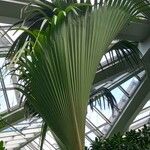
Lodoicea maldivica
Seychelles-nut · Double coconut · Sea-coconut · Double Coconut Palm · Sea coconut palm
Description
Source: leafsnapLodoicea maldivica, commonly known as the Coco de Mer or Sea Coconut, is a remarkable species of palm tree native to the Seychelles islands in the Indian Ocean. This unique and captivating plant has long intrigued people, particularly because of its large and distinctive fruit, which can weigh up to 30 kilograms and is regarded as one of nature's marvels. The Coco de Mer palm tree can grow up to 30 meters tall, with leaves extending over 6 meters in length. It takes approximately 25 years for the tree to reach maturity and begin producing fruit. Male flowers are small, while female flowers are larger and have a fleshy covering that eventually develops into the iconic double-lobed nut. The nut of Lodoicea maldivica is one of the largest in the world, measuring up to half a meter in length. These nuts have been highly prized throughout history for their unique shape, which some say resembles female buttocks or breasts. Sailors who found them washed ashore on remote islands once believed they came from mermaids. Today, Lodoicea maldivica remains a significant cultural symbol for the people of the Seychelles, who consider it their national emblem. It also holds a vital role in local medicine, where various parts of the plant have been used traditionally to treat ailments such as fever and stomach problems. Although the Coco de Mer has been legally protected from over-harvesting since the early 20th century due to its rarity and high value on international markets, the species remains vulnerable. Its primary threats are habitat loss caused by human activities such as logging and the expansion of agriculture into the forested areas where these palms naturally grow.
Care Guide
💧 Water Every 7 days
The double coconut, native to the Seychelles, thrives best in humid tropical climates with regular rainfall. It should be watered every 2-3 weeks to maintain consistent soil moisture without causing waterlogging. This plant flourishes when grown outdoors in areas that mimic its natural rainfall patterns, which supports deep root growth and long-lasting health.
☀️ Light Full sun
Double coconut performs best in locations that receive full sunlight for most of the day. Plenty of sun promotes healthy growth. Excessive or insufficient sunlight can disturb its growth pattern or harm its health.
How much sunlight does Double coconut need to grow?
Tropical ornamental plants that thrive in full sun require at least 6 hours of direct sunlight each day. These plants are well-suited to areas with strong and direct sunlight, as they need this light to flourish. In their natural habitats, they tend to grow in open fields or along forest edges, where they can enjoy abundant sunlight all day long.
What will happen if the Double coconut plant doesn't get enough sunlight?
Tropical ornamental plants that need full sun may face issues if they don't receive enough sunlight. They might become leggy and weak, and their leaves could turn yellow or pale. Furthermore, they may stop producing flowers. Ultimately, if these plants continue to lack the required amount of direct sunlight, there is a possibility that they may die.
🌡️ Temperature 20–37.8°C
Double coconut originates from habitats where temperatures fall between 68 and 100°F (20 and 38℃). This interval is its preferred temperature range. When the seasons change, the temperature of its environment may need to be adjusted to satisfy these requirements.
Does Double coconut need varying temperatures for different stages of growth?
Although Double coconut can transition between growing phases without changes in temperature, it is still important to maintain consistency. Fluctuations in temperature can hinder its growth, regardless of the current phase. Therefore, it is best to keep Double coconut in a controlled environment. Maintaining a temperature range between 75℉ and 90℉ (25-32℃) is crucial, with emphasis on staying above the lower limit. While exceeding 90℉ (32℃) is not ideal, this tropical plant can tolerate it to some extent. Conversely, temperatures below 50℉ (10℃), particularly 40℉ (5℃), will directly harm this species, which thrives in high heat.
💨 Humidity
🪴 Soil 6-7
🌱 Fertilizer
The best time to fertilize a Double coconut is in early spring when it comes out of dormancy. Doing so stimulates overall growth and encourages flower development. Fertilizing improves the foliage, stems, and branches and supports the production of large, vivid, and long-lasting flowers. It helps move nutrients from the roots to the flowers and enhances the plant's health and resistance to disease.
🪴 Pot & Repot
✂️ Pruning
To maintain the health and appearance of the double coconut, it is important to prune it in early spring. This involves removing any dead or damaged fronds. Pruning also helps to thin out crowded areas, which improves air circulation and light penetration, aligning with the tree's growth cycle for robust regrowth. With special care, the double coconut can retain its large, high-quality foliage and resilience.
🌿 Propagating
🐛 Diseases & pets
☠️ Toxicity
Characteristics
- Plant Type
- Tree
- Life Cycle
- Perennial
- Genus
- Lodoicea
- Family
- Arecaceae
- Hardiness Zone
- 11
- Mature Height
- 24.99 m to 34.14 m
- Mature Spread
- 7.92 m to 10.06 m
- Leaf Color
- Green
- Leaf Type
- Evergreen
- Flower Color
- Yellow, Brown
- Flower Size
- 30.48 cm
- Bloom Time
- All year round
- Planting Time
- Spring, Summer, Autumn
- Harvest Time
- All year round