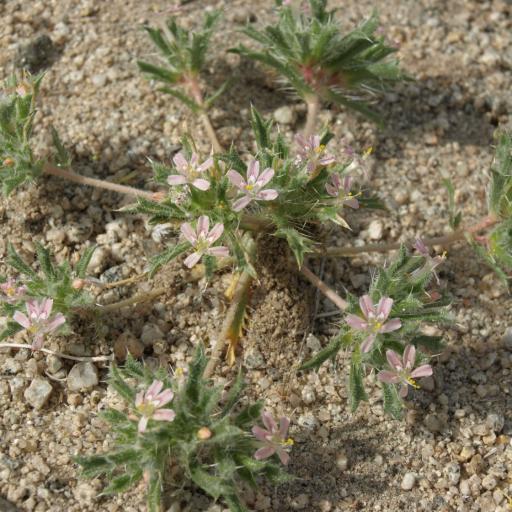
Loeseliastrum schottii is a species of flowering plant in the phlox family known by the common name Schott's calico. It is native to the southwestern United States and northern Mexico, where it is common in many parts of the desert region. It is a small, hairy annual herb with alternately arranged leaves each up to 4 centimeters long and edged with long bristle-tipped teeth. The flower generally has three lobes on its upper lip and two on its lower. It is spotted to mottled in pattern, varying in color from purple-speckled white to orange-speckled yellow, sometimes with reds and pinks. The protruding stamens are curved and tipped with yellow anthers.
Schott's calico is fairly disease-resistant and usually not affected by many illnesses. Nevertheless, it can be prone to pests and diseases present in its surroundings. Such infections are typically mild. In terms of care, the plant requires moderate upkeep. Regular pruning is needed to preserve a good appearance and encourage healthy growth. Fertilizing can also help stimulate flowering. Schott's calico is suitable for anyone who has outdoor space, like a garden or patio, and does not demand extensive care experience. It may need more attention when kept indoors.
How to keep Loeseliastrum Schottii.
Light
Schott's calico comes from bright, open habitats and does best in full sun. It can withstand partial sun but favors direct sunlight for ideal growth. This plant, which can be annual or biennial, is noted for its sun-loving character.
Water
Schott's calico, which originates from arid regions, is well adapted to conserve water and thrives in dry conditions. While it can tolerate occasional droughts, it benefits from weekly watering to mimic its natural environment. Typically grown outdoors, this plant relies on seasonal rains for optimal growth and efficient water absorption.
Temperature
Schott's calico stammt aus tropischen Regionen, in denen das Klima gewöhnlich warm und feucht ist. Deshalb ist die Pflanze an hohe Temperaturen und hohe Luftfeuchtigkeit gut angepasst. Sie mag keine abrupten Temperaturwechsel und bevorzugt eine gleichbleibende Temperatur, daher sollte man Temperaturschwankungen im Innenbereich vermeiden. Kälte verträgt sie normalerweise nicht und für ihr Wachstum sind höhere Temperaturen erforderlich. Wird die Umgebungstemperatur zu niedrig, kann das Wachstum aussetzen oder die Pflanze absterben.
Fertilizer
When most of the Schott's calico flowers have fully opened, resume fertilizing. During the period of peak bloom production, feed it every three to four weeks, as the weather allows. Then, once the plant begins producing fewer new flowers, stop fertilizing; there’s no reason to feed it when it can’t produce more blooms.
Pruning
Schott's calico is a low-growing plant known for its vibrant blooms and ability to withstand drought. To maintain its health and enhance its appearance, it's important to prune the plant between early and late spring. During this time, remove about one-third of the plant to shape it and encourage healthy growth. Proper pruning improves air circulation, reduces the risk of disease, and promotes vigorous flowering. For the best results, use clean and sharp tools when pruning.
Botanical profile.
- Plant Type
- Herb
- Life Cycle
- Annual
- Genus
- Loeseliastrum
- Family
- Polemoniaceae
- Hardiness Zone
- 8-11
- Mature Height
- 13 cm
- Mature Spread
- 0 cm to 0 cm
- Leaf Color
- Green
- Leaf Type
- Deciduous
- Flower Color
- Pink, Lavender
- Flower Size
- 1.02 cm to 2.03 cm
- Bloom Time
- Early spring, Mid spring
- Planting Time
- Spring, Summer
- Harvest Time
- Late spring, Early summer
- Native Area
- Mexico
Other names.
Reader questions.
How should I water my Schott's calico plant?
To water Schott's calico, you have several options: a garden hose with a spray nozzle, a watering can, or any other common watering tool. Luckily, this plant is not very particular about the type of water it receives. It can survive on rainwater, tap water, or filtered water. However, it's best to avoid watering from above as it can harm the leaves and flowers and even cause disease. Instead, a drip irrigation system is often the recommended method for watering this plant. These systems work well for Schott's calico because they distribute water evenly and directly to the soil. If you have a Schott's calico growing in a container, the watering technique is similar, but you can use a cup, watering can, or just pour water from the tap directly onto the soil.
How much light does Schott's calico need to make food?
The Schott's calico plant requires 6 to 8 hours of direct light daily during the summer or late spring, whether it is planted outdoors. However, if you are growing them in pots or during the winter, they need direct fluorescent lights to aid their growth. Ensure that you place them in an indoor area facing south or east to receive sufficient sunlight for photosynthesis.