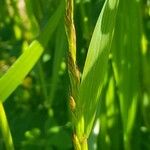
Lolium multiflorum
Annual ryegrass · Westerwold ryegrass · Westerwolds ryegrass · Lovitto ryegrass · Italian ryegrass
Description
Source: leafsnapLolium multiflorum (Italian rye-grass, annual ryegrass) is a ryegrass native to temperate Europe, though its precise native range is unknown.It is a herbaceous annual, biennial, or perennial grass that is grown for silage, and as a cover crop. It is also grown as an ornamental grass. It readily naturalizes in temperate climates, and can become a noxious weed in arable areas and an invasive species in native habitats.It is a host plant to wheat yellow leaf virus in its native Europe.It is sometimes considered a subspecies of perennial ryegrass (Lolium perenne). It differs from L. perenne in its spikelet, which has a long bristle at the top, and its stem, which is round rather than folded. It can be mistaken for couch (Elymus repens), which has spikelets along the broad side of the stem rather than the edge.Other common names in English include Australian ryegrass, short rotation ryegrass, and Westerwolds ryegrass. It is also one of several species called darnel.
Care Guide
💧 Water
Italian ryegrass flourishes in temperate climates and prefers consistent moisture. To encourage healthy growth without the risk of waterlogging, it benefits from weekly watering. This grass is usually cultivated outdoors, where its lush foliage relies on receiving adequate hydration throughout the growing season. It strikes a balance between drought tolerance and the need for humidity.
What should I do if I give too much or too little water to my Italian ryegrass?
If you overwater your Italian ryegrass, there are steps you can take to restore its health. Aerate your lawn to address compacted soils and improve drainage. Dethatching can also help in these situations. However, if you underwater your Italian ryegrass, the approach is different. Allow the lawn to grow a bit longer before mowing, and provide slightly more water than before.
How should I water my Italian ryegrass to make it thrive?
Italian ryegrass is commonly grown as a lawn, and it's important to water it correctly. One option is to use a hose with a spray nozzle, but a sprinkler system is even better. Consider setting it up with a timer to ensure that the grass receives the right amount of water at the right time. When watering, it's recommended to use cool or room temperature water. It's also best to water in the morning so that the soil can absorb the water while the sunlight can evaporate any extra moisture.
How many times a week should I water my Italian ryegrass?
The frequency of watering for Italian ryegrass depends on your region, climate conditions, and the season. In cooler northern regions, you should water every 1-2 weeks, while in southern regions, water about once a week. Adjust your watering if there is regular rainfall, but remember that rainfall alone is usually insufficient. During the summer, Italian ryegrass goes into a dormant period and may still need water to prevent drying out, but it doesn't require water for new growth.
How much water does my Italian ryegrass require?
Understanding how much water to give your Italian ryegrass is actually quite simple. Regardless of whether you live in the cooler north or the warmer south, the general rule is to give your Italian ryegrass about one inch of water every time you water it. However, there is one exception to this rule during the peak of summer when the grass goes through a short period of dormancy. During this time, it is best to provide light but adequate waterings to protect the grass from the harmful effects of the intense sun. Of course, the amount of water needed will vary depending on the size of the area covered by your Italian ryegrass. For instance, watering a large Italian ryegrass area will require more water compared to caring for a small Italian ryegrass lawn.
How can I know if I'm giving enough water to my Italian ryegrass?
If you water your Italian ryegrass too much or too little, there are clear signals that indicate whether it's an issue. When there is overwatering, the grass blades may feel softer than usual and there could be a buildup of thatch. On the other hand, if you underwater your lawn, you will likely see brown patches and the grass may suffer from heat stress, leading to fungus buildup and yellowing of the blades. Additionally, underwatered lawns tend to retain footprints longer compared to lawns that receive the correct amount of water.
☀️ Light Full sun
Italian ryegrass does best in settings that receive uninterrupted sunlight throughout the day. Its original native habitat is marked by clear skies and abundant daily sun. However, it can acclimate to different levels of light exposure. Plenty of sunlight speeds its growth, but too much can lead to drying out. Reduced light can slow growth and affect its overall vigor.
What are the sunlight requirements for Italian ryegrass?
Italian ryegrass thrives in full sunlight, needing more than 6 hours of sunlight daily to flourish. It's essential to observe the movement of sunlight through your garden to find the optimal balance of light and shade for these plants. Although native to regions with clear skies and ample sunlight, Italian ryegrass can adapt to varying light conditions. Adequate sunlight accelerates growth, but excessive exposure can lead to desiccation, while insufficient light may slow growth and affect the plant's health.
How can artificial lighting assist in the growth of Italian ryegrass indoors?
When natural sunlight is not enough, especially during winter or in spaces that receive limited sunlight, artificial lighting can be a vital solution for Italian ryegrass. LED lights, popular for indoor plant lighting, can provide specific wavelengths needed by the plants. Full sun plants require 30-50W/sq ft of artificial light, partial sun plants 20-30W/sq ft, and full shade plants 10-20W/sq ft. The artificial light source should be placed 12-36 inches above the plant, mimicking natural sunlight as closely as possible. Additionally, most plants need 8-12 hours of light per day, depending on their specific needs.
What are the symptoms of light deficiency in Italian ryegrass when grown indoors?
Italian ryegrass may show several symptoms when there's inadequate light, including smaller new leaves, leggy or sparse growth, early leaf drop, and slower or halted new growth. New leaves might also appear lighter in color or exhibit chlorosis - a condition where leaves lose their green color and turn yellow due to a breakdown of chlorophyll. Further, symptoms like sunscald, leaf curling, wilting, and leaf scorching can indicate excessive light exposure, damaging plant health.
What solutions can address light-related issues for Italian ryegrass, both indoors and outdoors?
To combat light-related issues in Italian ryegrass, indoor plants can gradually be moved to sunnier locations until they receive at least 6 hours of direct sunlight daily. Utilizing a south-facing window or artificial light sources like desk lamps or professional grow lights for at least 8 hours a day can also help. Outdoors, it's crucial to adjust plants gradually to sunnier spots to prevent sunburn. Observing which areas block sunlight and considering options like pruning trees can reduce obstructions. When transplanting smaller plants, choose their dormant period and ensure they're relocated to a sunny spot with good drainage. Remember, while parts of the plant that suffered due to insufficient sunlight may not recover, new growth should be healthy with improved light exposure.
🌡️ Temperature 5–32.2°C
Italian ryegrass is native to areas with moderate temperatures. It does best at temperatures between 68 and 95 °F (20 to 35 °C). Modify its environment to replicate these conditions, especially during harsh seasons.
What is the origin and ideal growing temperature for Italian ryegrass?
Italian ryegrass, or Lolium multiflorum, originates from regions with moderate temperatures. It thrives best within a temperature range of 68 to 95 °F (20 to 35 ℃). To ensure optimal growth, its environment should be adjusted to mimic these conditions, particularly during severe weather seasons.
Is Italian ryegrass cold-resistant, and how should it be protected in winter?
Italian ryegrass has strong cold resistance, making special frost protection measures generally unnecessary during the winter. However, in cases where winter temperatures are predicted to drop below -30°C, it's important to provide cold protection. This can be done by covering the plant with materials like soil or straw. Additionally, before the first freeze in autumn, watering the plant abundantly to keep the soil moist is recommended. This practice helps prevent drought and water scarcity during winter and early spring.
What should I do if the temperature falls below 0°C or rises above 38°C for Italian ryegrass?
For temperatures below 0°C, Italian ryegrass is cold-tolerant and generally fares well, but should ideally be kept above this temperature. Below -30°C, there might not be visible changes during winter, but sprouting in spring could be affected, resulting in decreased sprouting or none at all. The solution is to remove any parts that fail to sprout in spring. When temperatures exceed 38°C, the plant's leaves may become lighter, curl, become sunburned, and, in severe cases, the entire plant may wilt and dry out. To mitigate this, trim away sunburned and dried parts, move the plant to a shaded location or use a shade cloth, and water the plant in the morning and evening to maintain soil moisture.
💨 Humidity
🪴 Soil 5-7
🌱 Fertilizer
Italian ryegrass does well with regular, light applications of fertilizer to encourage healthy leaf growth. Apply fertilizer roughly once a month throughout the summer. Nitrogen is essential for foliage, and providing nitrogen-rich sources helps Italian ryegrass flourish.
🪴 Pot & Repot
✂️ Pruning
Pruning Italian ryegrass in early spring promotes rapid growth and creates dense foliage. To achieve this, start by trimming dead leaves and thinning out dense areas to improve light and air circulation. Be sure to use sharp tools to minimize stress on the plants. This practice helps maintain plant health, prevents disease, and keeps your garden looking attractive.
🌿 Propagating
🐛 Diseases & pets
☠️ Toxicity
Characteristics
- Plant Type
- Herb
- Life Cycle
- Annual, Biennial, Perennial
- Genus
- Lolium
- Family
- Poaceae
- Hardiness Zone
- 4-8
- Mature Height
- 61 cm to 91 cm
- Mature Spread
- 20 cm to 40 cm
- Leaf Color
- Green
- Leaf Type
- Semi-evergreen
- Flower Color
- Green, White, Yellow, Purple, Brown
- Flower Size
- 7.62 cm to 15.24 cm
- Bloom Time
- Late spring, Early summer, Mid summer
- Planting Time
- Spring, Summer, Autumn
- Harvest Time
- Mid summer, Late summer, Early fall
- Native Area
- Libya, Egypt, Turkey, India, United Arab Emirates, Slovakia, Montenegro, Pakistan, Croatia, Slovenia, Morocco, Yemen, Uzbekistan, Russia, Iraq, Jordan, Indonesia, Romania, Portugal, France, Saudi Arabia, Tunisia, Mauritania, Cyprus, Bulgaria, Armenia, Greece, Lebanon, Serbia, China, Afghanistan, Syria, Kyrgyzstan, Kazakhstan, Italy, Spain, Switzerland, Iran, Albania, Azerbaijan, Algeria, Kuwait, Turkmenistan