Japanese honeysuckle is quite disease-resistant and usually does not tend to get diseases. Regarding care, this plant is fairly low-maintenance. When grown outdoors it needs only minimal watering, and larger plants typically do not need pruning. Smaller plants, however, should be pruned after they have bloomed. Japanese honeysucklet is suitable for anyone with an outdoor area, such as a garden or deck, and does not require much care experience.
How to keep Lonicera Confusa.
Light
Japanese honeysuckle prefers locations with moderate sunlight. It can cope with direct sunlight but it is not a necessity. Its roots lie in habitats with diverse lighting conditions, hence it grows well without the need for high-intensity sunlight. Nevertheless, its growth may be marginally affected with too little or too much light.
Temperature
The Japanese honeysuckle thrives best in a moderate climate, ideally between 41 ℉ (5 ℃) and 95 ℉ (35 ℃). To maximize growth and bloom, it is suggested to maintain the temperature within these limits. During the colder months, while the plant can withstand cooler conditions, it may fare better with some protection against severe cold. Conversely, during hotter months, shielding it from harsh heat can be beneficial for the plant's health.
Fertilizer
The timing is key when fertilizing Japanese honeysuckle. Begin fertilization early in the spring, and continue on a monthly basis until early summer. Fertilizer aids in generating beautiful flowers and gives power during both dormant and active growth stages.
Botanical profile.
- Plant Type
- Vine
- Life Cycle
- Perennial
- Hardiness Zone
- 4-10
- Mature Height
- 2.13 m to 9.14 m
- Mature Spread
- 0.91 m to 1.83 m
- Leaf Color
- Green
- Leaf Type
- Semi-evergreen
- Flower Color
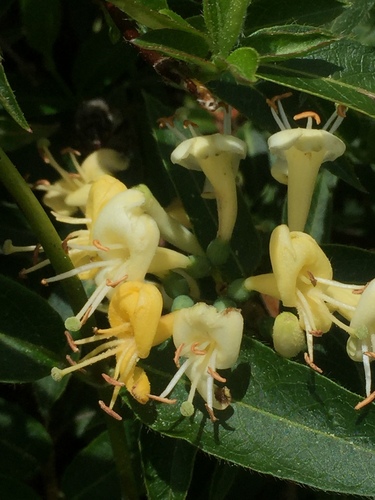
- White, Yellow
- Flower Size
- 2.03 cm to 6.35 cm
- Bloom Time
- Late spring, Early summer, Mid summer
- Planting Time
- Spring, Autumn
- Harvest Time
- Summer, Early fall
- Native Area
- Koppen, Japan, South Korea