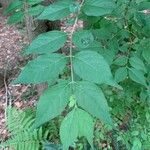
Lonicera maackii
Bush honeysuckle · Amur honeysuckle · Maack's Honeysuckle · Bad bush
Description
Source: leafsnapLonicera maackii, commonly known as Amur honeysuckle, is a deciduous shrub native to eastern Asia. It is widely cultivated as an ornamental plant in gardens and parks due to its attractive foliage and fragrant flowers. The plant can grow up to 6 meters in height and has a spreading habit with arching branches. The leaves of Lonicera maackii are oval-shaped with pointed tips, measuring up to 8 cm long. They are dark green on the upper surface and lighter green on the underside. The flowers of the plant are white or yellowish-white, tubular-shaped with five lobes that open into a trumpet shape. The fruit of Lonicera maackii is a red or orange berry that contains numerous small seeds. It ripens from late summer through fall and provides food for birds such as robins, thrushes, waxwings, and finches. Despite its ornamental value and ecological benefits for wildlife, Lonicera maackii has become an invasive species in many parts of North America. It was initially introduced as an ornamental shrub but has since outcompeted native vegetation by forming dense thickets that shade out other plants. In traditional Chinese medicine (TCM), various parts of Lonicera species have been used for their anti-inflammatory properties. However, further research is needed before any medicinal use can be recommended by healthcare professionals or TCM practitioners. Overall, Lonicera maackii remains an important species both ecologically, as a food source, and culturally, as a medicinal herb. However, it requires careful management when introduced outside its native range due to its invasive potential.
💡 Amur honeysuckle berries are a real treat for birds. Rich in sugar and nutrients, these berries provide the essential energy birds need for their long-distance migrations. As birds consume the berries, they help disperse the seeds, playing a crucial role in the life cycle of this highly invasive species.
🌳 Although amur honeysuckle is valued for its appearance, it has particular uses: its berries, which contain anthocyanins, can produce natural pink dyes. Its flowers also supply early-season nectar that benefits pollinators like butterflies and moths. However, because it is an invasive species, its use needs to be controlled to prevent ecological harm.
🎭 Magnanimity, joy, good fortune
Care Guide
💧 Water Every 7 days
Amur honeysuckle thrives in woodlands and prefers consistent moisture without becoming waterlogged. It typically needs watering every 1-2 weeks. In temperate regions, this outdoor plant benefits from mulching, which helps conserve soil moisture and supports its growth across different climate zones.
When Should I Water My Amur Honeysuckle?
To maintain the health and vitality of your Amur Honeysuckle (Lonicera maackii), it's crucial to water it properly. Check for soil dryness by feeling the top 1 to 2 inches; if dry, it's time to water. Pay attention to the leaves for signs of under-watering, such as wilting or color changes. Watering is especially critical during the pre-flowering stage to prevent bud drop. In warmer temperatures and higher sunlight exposure, increase your watering frequency but be cautious not to overwater, as this can cause root rot or fungal diseases. Conversely, late watering can lead to wilting and potentially stunt growth or cause the plant to die if conditions are extreme.
How Should I Water My Amur Honeysuckle?
Watering your Amur Honeysuckle effectively involves using methods that reach the deep root system, such as soaker hoses or drip irrigation. For targeted watering without wetting the foliage, a watering can with a long spout is recommended. Utilizing a moisture meter can help determine the ideal watering times, preventing over- or under-watering. Focus on watering the soil around the base, avoiding the foliage to prevent fungal growth. Amur honeysuckle benefits from consistent but well-drained soil moisture. Tools and techniques should ensure water goes deep without leaving the soil waterlogged.
How Much Water Does Amur Honeysuckle Really Need?
Amur Honeysuckle requires water that sufficiently moistens the soil to the root depth without causing excessive runoff. Typically, the root system reaches a depth of 12-18 inches, and the plant may need 1-2 liters of water per session for smaller pots, with larger pots requiring more, depending on various factors like temperature, humidity, and soil retention capabilities. The optimal watering amount maintains vibrant leaves and stems, encouraging vigorous growth. Over or under-watering can lead to problems such as yellowing leaves, wilting stems, or even root rot. Good drainage with a balance of soil moisture is key, supplemented by organic matter and mulching to help maintain appropriate moisture levels.
What Kind of Water is Best for Amur Honeysuckle?
Amur Honeysuckle thrives on water that is clean and free of harmful contaminants. Distilled water is ideal, followed by collected rainwater. Tap water can be used if it is devoid of chlorine and other harmful minerals or chemicals. Due to its high sensitivity to chlorine, allowing tap water to sit out for 24 hours before use can help evaporate the chlorine, making it safer for the plant. Filtration can also remove impurities, preparing tap water for use. The plant prefers room temperature water, avoiding extremes that could shock its system.
How Do Amur Honeysuckle's Watering Needs Change with the Seasons?
Seasonal changes affect how you should water Amur Honeysuckle. In spring, with active growth, keep the soil moderately moist as the plant requires more water for bud and leaf formation. Summer increases the plant's water needs due to higher temperatures; deep, less frequent waterings are advisable. In autumn, as growth slows, reduce watering frequency while keeping the soil slightly moist. During winter dormancy, minimize watering and ensure the soil is not waterlogged, paying attention to moisture levels before watering again. These adjustments help maintain the plant's health throughout the year.
☀️ Light Full sun
Amur honeysuckle does best with abundant sunlight, though it can tolerate moderate sun. It naturally grows in habitats with unobstructed sunlight. However, too much or too little light can harm its health and diminish its growth and vigor.
What are the sunlight requirements for Amur honeysuckle?
Amur honeysuckle requires abundant sunlight to thrive, ideally flourishing under full sun conditions, which is defined as more than 6 hours of sunlight daily. It is also capable of tolerating partial sun, receiving about 3-6 hours of sunlight. It's important to observe how sunlight moves through your garden to ensure you choose locations that provide optimal light for the plant's growth, striking a balance that caters to its needs for both light and shade.
How does sunlight affect the growth of Amur honeysuckle?
The growth of Amur honeysuckle is significantly influenced by sunlight exposure. It originates from habitats where sunlight is plentiful and unobstructed, making it ideal for its growth and vigor. However, both excessive and insufficient sunlight can adversely affect its health. Excessive sunlight can lead to symptoms like chlorosis, sunscald, leaf curling, wilting, and leaf scorching, while insufficient sunlight may result in smaller leaves, leggy growth, faster leaf drop, and lighter-colored new leaves, ultimately slowing down or halting growth.
Can artificial lighting be used for indoor Amur honeysuckle plants?
Yes, artificial lighting is a viable solution for indoor Amur honeysuckle plants, especially when natural sunlight is insufficient. Indoor plants can achieve optimal growth with the aid of artificial lights, such as LED lights, tailored to provide specific wavelengths necessary for plant health. For full sun plants, 30-50W per square foot is recommended, for partial sun plants, 20-30W per square foot, and for full shade plants, 10-20W per square foot. The light source should be placed 12-36 inches above the plant, ensuring it receives 8-12 hours of light per day to mimic natural daylight conditions.
What are the common symptoms of poor lighting in Amur honeysuckle?
Amur honeysuckle may exhibit several symptoms indicative of poor lighting conditions, including small, new leaves, leggy or sparse growth, premature leaf drop, halted growth, pale new leaves, chlorosis, sunscald, leaf curling, wilting, and leaf scorching. These symptoms suggest that the plant is either receiving too much or too little sunlight, negatively impacting its health and growth.
How can one address lighting issues for Amur honeysuckle?
To address lighting issues for Amur honeysuckle, consider the following solutions: For indoor plants, gradually increase sunlight exposure or use artificial lights, aiming for at least 6 hours of direct sunlight or 8 hours of artificial light daily. Outdoor plants should be moved gradually to sunnier spots to avoid sunburn. Minimizing obstructions by pruning or transplanting can improve sunlight access. Note that parts of the plant affected by unsuitable light conditions might not recover, but new growth should be healthy with proper light adjustment.
🌡️ Temperature 0–32.2°C
Amur honeysuckle naturally grows in temperatures ranging from 0 to 32 ℃ (32 to 90 ℉). The plant prefers cool to warm conditions and tolerates both heat and cold. To handle seasonal differences, water frequently and provide some daytime shade in hot summers. In cold winters, place a layer of mulch around the plant’s base to protect it from freezing.
What is the native growth environment for Amur honeysuckle?
The native growth environment for Amur honeysuckle requires temperatures ranging from 0 to 32 °C (32 to 90 °F). This species thrives in cool to warm temperatures and has a strong ability to tolerate both hot and cold conditions. To ensure the plant adjusts well across different seasons, during hot summers, it's important to provide frequent watering and some shade during the hottest part of the day. Conversely, in cold winters, applying a layer of mulch around the base of the plant can protect it from freezing. Amur honeysuckle has a robust cold resistance, so special measures to protect against frost are usually not necessary. However, in exceptionally cold winters with temperatures expected to drop severely, wrapping the trunk and branches with insulating materials like non-woven fabric or a cloth can offer additional protection. Additionally, watering the plant abundantly before the first freeze in autumn will help keep the soil moist, aiding the plant through winter and early spring.
How does low temperature affect Amur honeysuckle, and what are the solutions?
Amur honeysuckle is noted for its cold tolerance and generally thrives when temperatures are kept within its preferred range. During the winter season, ensuring that the temperature does not fall below its critical tolerance limit is vital for the plant's survival. When temperatures drop to severe lows, the plant might not exhibit immediate visible distress, but by springtime, the branches could become brittle and dry, with no new shoots emerging. To address this, any dead branches that have failed to produce new leaves by spring should be pruned away. This pruning helps the plant to focus its energy on healthy growth and maintain its vitality.
What implications does high temperature have on Amur honeysuckle, and how can they be mitigated?
During the summer, it is crucial to keep the Amur honeysuckle's environment below its threshold for high temperatures. Exceeding this maximum suitable temperature range, the plant may exhibit signs of stress such as leaves becoming lighter in color, tips drying out and withering, and increased susceptibility to sunburn. To mitigate these effects, the plant should have sunburned and dried parts trimmed away. Moving the plant to a shaded area during the midday and afternoon sun, or employing shade cloth can protect it. Additionally, watering the plant during cooler times of the day, such as morning and evening, helps keep the soil sufficiently moist and supports general plant health.
💨 Humidity
🪴 Soil 6-7
🌱 Fertilizer
Timing is important for fertilizing Amur honeysuckle. Apply fertilizer in early spring and then monthly through early summer. Fertilizer encourages attractive blooms and supplies energy during dormant and active growth periods.
Which fertilizer should I use for my Amur honeysuckle?
To best care for your Amur honeysuckle, it is important to use a fertilizer that contains a balanced mix of the three main plant nutrients, with slightly higher levels of phosphorus. Another option is to enhance the soil by incorporating organic materials like compost, worm castings, and manure. For more advanced gardeners, it may be beneficial to supplement with water-soluble fertilizers containing phosphorus 1-2 times when the flower buds begin to form. This will promote healthier flower development, resulting in larger and longer-lasting blooms. Various forms of fertilizers can be used for Amur honeysuckle, but liquid or powdered forms are considered some of the best options. Regardless of the form you choose, make sure to dilute the fertilizer and apply it while watering your Amur honeysuckle plant.
What will happen if I put too much fertilizer on my Amur honeysuckle?
It is important to avoid over-fertilizing your Amur honeysuckle because it can have negative effects. If you use too much fertilizer, it can cause brown leaf tips and edges, yellowing, wilting leaves, and a visible crust of fertilizer salts on the soil surface. This is known as fertilizer burn and occurs when there is an excess of salts in the plant's cells. Excessive nitrogen can lead to an abundance of leaves but limited flower growth, as nitrogen supports foliage growth. If you have already over-fertilized, you can try removing the top layer of soil under the Amur honeysuckle to get rid of the concentrated fertilizer area. Additionally, watering heavily can help flush out any excess fertilizer around the roots.
Why should I put fertilizer on my Amur honeysuckle?
Fertilizing your Amur honeysuckle is important for several reasons. Firstly, fertilizing will help your honeysuckle produce beautiful blooms. It is best to fertilize in early spring to ensure excellent flowers during that season. Additionally, fertilizer provides your honeysuckle with energy that can be stored in the ground during dormant growth phases. By giving your honeysuckle extra nutrients during fall planting or late spring, you can help it store more energy to use once active growth resumes.
When should I fertilize my Amur honeysuckle for the best results?
To ensure successful fertilization of Amur honeysuckle, timing is key. Applying fertilizer too early when the plant is still dormant is ineffective, as it will be washed away by rainwater, leading to waste and pollution. It is recommended to apply the first round of fertilizer in early spring, and then continue fertilizing once a month until early summer.
When should I not use fertilizer for my Amur honeysuckle?
To ensure optimal growth and blooming of Amur honeysuckle, it is important to be mindful of its nitrogen fertilizer levels. Avoid using fertilizers with excessive nitrogen content, as this can result in abundant foliage but few blooms. Instead, seek out fertilizers with a lower nitrogen concentration compared to other nutrients. Furthermore, refrain from fertilizing Amur honeysuckle after early autumn when winter is approaching. Fertilizing during this time can promote excessive growth right before winter sets in. Additionally, it is not advisable to fertilize Amur honeysuckle during hot and dry seasons as dry soil impedes effective delivery of nutrients. Fertilizing during dry periods can also stimulate growth, which in turn requires more water that may not be readily available. Therefore, it is best practice to apply fertilizer earlier in the season when temperatures are cooler. Lastly, bear in mind that Amur honeysuckle can absorb fertilizer applied to nearby plants or lawns. This means there is potential for unintentionally giving the tree or shrub an excessive amount of fertilizer. Take care to avoid inadvertently administering a double-dose of fertilizer to the Amur honeysuckle.
🪴 Pot & Repot 2-3 years
When repotting Amur honeysuckle, select a pot 1–2 inches (2.5–5.1 cm) larger with good drainage. Use a well-draining potting mix. Repot in spring or fall, making sure the root ball sits slightly below the rim of the flower pot. Water thoroughly after repotting and place the plant in a warm spot with indirect sunlight.
✂️ Pruning
Amur honeysuckle is an invasive shrub that features white flowers and red berries. To manage its growth effectively, prune it in early spring. Start by removing any dead or overcrowded branches and rejuvenating older stems by cutting them back by one-third. Regular pruning not only enhances the plant's health but also helps control its invasive nature.
🌿 Propagating
🐛 Diseases & pets
☠️ Toxicity
The red berries this plant produces in the fall can be poisonous to both humans and pets if ingested. Therefore, it is best to keep curious pets or children away from sampling the berries.
Characteristics
- Plant Type
- Shrub
- Life Cycle
- Perennial
- Genus
- Lonicera
- Family
- Caprifoliaceae
- Hardiness Zone
- 3-8
- Mature Height
- 6.1 m
- Mature Spread
- 3.05 m to 4.57 m
- Leaf Color
- Green
- Leaf Type
- Deciduous
- Flower Color
- White
- Flower Size
- 2.54 cm
- Bloom Time
- Late spring, Early summer
- Planting Time
- Spring, Summer, Autumn, Winter
- Harvest Time
- Mid summer
- Native Area
- Russia, Japan, Mongolia, Koppen, South Korea, China