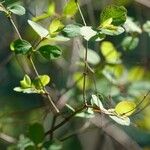
Lonicera subspicata
Southern honeysuckle · Santa Barbara honeysuckle · Moronel honeysuckle
Description
Source: leafsnapLonicera subspicata, commonly known as the mountain honeysuckle, is a deciduous shrub belonging to the Caprifoliaceae family. Native to western North America, it thrives in diverse habitats such as forests, meadows, and rocky slopes. This plant typically reaches heights of up to three meters, with a spreading habit and arching branches. The leaves of Lonicera subspicata are oval-shaped with pointed tips, arranged oppositely on the stem. They are dark green on the upper surface and a lighter shade of green underneath. The flowers bloom from late spring to early summer, appearing in clusters at the ends of branches. These tubular flowers have five petals, ranging in color from yellowish-white to pinkish-red. The plant produces red or orange berries, containing several small seeds. These berries attract birds like thrushes and waxwings, which feed on them. Lonicera subspicata has been used for medicinal purposes by Native American tribes for centuries, valued for its anti-inflammatory properties that can help alleviate pain caused by arthritis and other inflammatory conditions. Overall, Lonicera subspicata is an attractive shrub that provides food for wildlife and has medicinal properties, making it an important species in its native range.
🎭 Benevolence
Care Guide
💧 Water Every 7 days
To ensure your southern honeysuckle thrives, regularly check the soil moisture to assess its watering needs. Water the plant when the soil feels dry, but be careful not to let water accumulate. During the summer, increase the frequency of watering, while in the winter, you should reduce it. It's best to use rainwater instead of tap water. After pruning, water the plant every 3 to 5 days for optimal growth.
☀️ Light Partial sun
Southern honeysuckle naturally grows in places like forest understories or rocky sites, where it receives natural shade. It prefers partial sun but can tolerate both full sun and full shade, showing that it is versatile and hardy.
What are the sunlight requirements for Southern Honeysuckle (Lonicera subspicata)?
Southern Honeysuckle (Lonicera subspicata) requires specific amounts of sunlight depending on the type of sun exposure. For full sun exposure, it needs above 6 hours of sunlight daily. If the plant is in partial sun, it should receive about 3-6 hours of sunlight. It's important to observe the movement of sunlight through your garden to find spots that offer the ideal mix of light and shade, ensuring your plants thrive.
Why is it important to monitor sunlight in the garden for planting Southern Honeysuckle?
Monitoring sunlight is crucial when planting Southern Honeysuckle because it helps ensure that the plants get the perfect balance of light and shade they require for optimal growth and health. Watching how sunlight gracefully moves through your garden allows you to choose locations that meet the plants' sun exposure needs, whether it's full sun or partial sun, hence guaranteeing their happiness and well-being.
🌡️ Temperature 15–35°C
Southern honeysuckle shows strong temperature adaptability, tolerating higher heat and wider temperature swings. During hot periods, attention should be paid to watering and providing adequate shade to avoid sunburn. Conversely, Southern honeysuckle is less tolerant of low temperatures. It can endure some cold, but very low temperatures may cause frost damage.
What is the Southern Honeysuckle?
The Southern Honeysuckle is known botanically as Lonicera subspicata. It does not have any specifics mentioned regarding its essentials or symptoms, suggesting a need for more detailed research or information on this particular plant.
💨 Humidity
🪴 Soil 6-8
🌱 Fertilizer
Applying fertilizer at the correct time is important for Southern honeysuckle. Start fertilizing in early spring and continue once a month until early summer. Fertilizer encourages attractive blooms and supplies energy during both dormant and active growth periods.
🪴 Pot & Repot
✂️ Pruning
Pruning southern honeysuckle in early spring can significantly improve its vining growth and enhance its fragrant blooms. To do this effectively, focus on a few key techniques: remove any dead branches, thin the plant to increase airflow, and shape any overgrown stems. This practice not only promotes the plant's health and prevents disease but also encourages abundant flowering, which aligns with the natural growth cycle of southern honeysuckle.
🌿 Propagating
🐛 Diseases & pets
☠️ Toxicity
Characteristics
- Plant Type
- Shrub
- Life Cycle
- Perennial
- Genus
- Lonicera
- Family
- Caprifoliaceae
- Hardiness Zone
- 8-10
- Mature Height
- 0.91 m to 3.05 m
- Mature Spread
- 0.91 m to 2.13 m
- Leaf Color
- Dark Green, Forest Green
- Leaf Type
- Evergreen
- Flower Color
- White, Cream
- Flower Size
- 1.02 cm to 2.03 cm
- Bloom Time
- Mid spring, Late spring, Early summer
- Planting Time
- Spring, Summer, Autumn
- Harvest Time
- Mid summer, Late summer, Early fall
- Native Area
- Mexico