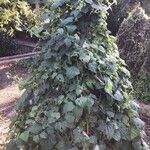
Lophospermum erubescens
Mexican Twist · Creeping-gloxinia · Roving sailor
Description
Source: leafsnapLophospermum erubescens, known as Mexican twist or creeping gloxinia, is a climbing or sprawling herbaceous perennial plant, native to the Sierra Madre Oriental mountains of Mexico, where it is found along forest margins or canyon walls. It climbs by means of twining leaf stalks. Wild plants have pink and white tubular flowers, although other colours are found in cultivation. It has been cultivated as an ornamental plant since at least 1830. Although not frost-hardy, it will survive if its base and roots are protected from freezing in the winter. It has escaped from cultivation and become naturalized in tropical and subtropical areas of the world.Lophospermum erubescens has been confused with Lophospermum scandens, partly because the earliest illustration of L. erubescens was labelled as L. scandens. Among other differences, L. erubescens has a more climbing habit than L. scandens, with many twining leaf stalks; also the sepals are broader and joined at the base for only 2–3 mm (0.08–0.12 in) rather than 7–11 mm (0.3–0.4 in). Despite the common name creeping gloxinia, it is not closely related to either the true Gloxinia species from South America, or the flowering houseplant commonly known as gloxinia, Sinningia speciosa.
Care Guide
💧 Water
Originating from the highlands of Mexico, the Mexican twist prefers a consistent level of humidity but can tolerate periods of dryness. It needs to be watered once a week and benefits from using rainwater for optimal growth. As a climbing plant, it thrives in moist conditions, so maintaining balanced hydration is essential, while avoiding over-saturation.
How should I water my Mexican twist plant?
When watering the Mexican twist, it's best to use filtered water at room temperature. Tap water may have harmful particles, so filtered water is preferred. The water should be at room temperature or slightly warmer since the Mexican twist is used to a warm environment and cold water can be a shock. Don't water from above as it can cause problems with the foliage. Instead, water the soil directly until it is fully soaked. This helps to moisten the roots and allows them to spread through the soil and collect nutrients.
What should I do if I give too much or too little water to my Mexican plant?
Both overwatering and underwatering can harm the health of your Mexican twist, but overwatering is more common. Too much water can cause wilting and yellowing of the stems and leaves, and can also lead to diseases like root rot, mold, and mildew that could kill your plant. While underwatering is less likely, it can still happen and result in brittle, brown leaves. It's important to recognize signs of overwatering early since some of the associated diseases may not be fixable if you wait too long. Reduce watering if you see early signs of overwatering and consider improving the soil drainage if it's poor. If you notice signs of underwatering, simply water more regularly until the signs improve.
How often should I give water to my Mexican twist plant?
If your Mexican twist plant is in a pot, the best way to determine if it needs water is by sticking your finger into the soil. If the top two to three inches of soil are dry, you should water it. The same method can be used if you grow your Mexican twist plant outdoors in the ground. When the top few inches of soil have dried out, it's time to water. In the spring and early fall, you will likely need to water this plant about once a week. During extremely hot weather, you may need to water it twice a week or more. However, mature and well-established Mexican twist plants are able to withstand drought.
How much water does my Mexican twist require?
When watering your Mexican twist plant, don't hold back on the amount of water you give. Make sure the top two to three inches of soil are dry before watering. Give the plant a thorough watering, making sure to completely saturate the soil. You should add enough water that excess water drains out from the bottom of the pot. If you don't see this excess water, you may not have watered enough. However, be careful not to let water accumulate in the soil, as this can harm the plant. On the other hand, if there is no water draining out from the pot, it could mean that the soil does not drain well, which can be harmful to the plant's health. If the plant is outside, receiving about 1 inch of rain per week is enough.
How should I water my Mexican twist plant as it grows?
The water needs of the Mexican twist can vary depending on its growth stages. In the first few years or after transplanting, you'll need to provide more water because the plant is focused on developing new roots for future growth. These young roots require more moisture. As the plant matures, it will require less water. Additionally, during the bloom period, the Mexican twist may need additional water as the flowers require more moisture for development.
☀️ Light Full sun
Mexican twist is a perennial herbaceous plant that favors sunny sites and is native to open habitats, often thriving in meadows and grasslands. It prefers full sun but can also tolerate partial sun.
What are the sunlight requirements for Mexican twist?
The Mexican twist, or Lophospermum erubescens, is a perennial herbaceous plant that thrives in full sun conditions, requiring above 6 hours of sunlight daily. It can also tolerate partial sun, needing about 3-6 hours of sunlight. It's essential to observe how sunlight moves through your garden to choose spots that provide an optimal balance of light and shade, ensuring the plant's health and happiness.
Can Mexican twist be grown with artificial lighting?
Yes, Mexican twist can be grown indoors with artificial lighting, especially when natural sunlight is insufficient. Adequate lighting is crucial for optimal growth. LED lights are a popular choice because they can provide specific light wavelengths needed by the plant. Full sun plants require 30-50W/sq ft, partial sun plants 20-30W/sq ft, and full shade plants 10-20W/sq ft of artificial light. The light source should be placed 12-36 inches above the plant and kept on for 8-12 hours per day to mimic natural daylight conditions.
What are the symptoms of inadequate light for Mexican twist?
Mexican twist shows several symptoms when it doesn't receive enough light. Symptoms include smaller new leaves, leggy or sparse growth, accelerated leaf drop, slower or halted new growth, lighter-colored new leaves, chlorosis (yellowing leaves due to chlorophyll breakdown), sunscald (damage from intense sunlight exposure), leaf curling as a defense against sunlight exposure, wilting from excessive water loss, and leaf scorching characterized by brown or crispy leaf edges.
How can I address insufficient light for indoor Mexican twist plants?
To address insufficient light for indoor Mexican twist plants, gradually move them to sunnier locations each week until they receive at least 6 hours of sunlight daily, using a south-facing window for maximum exposure. If the plant is large or not easily movable, consider using artificial lighting. Desk or ceiling lamps should be kept on for at least 8 hours daily, or you could invest in professional plant grow lights. Remember, parts of the plant affected by insufficient light may not recover, but new growth will be healthy after improving light exposure.
How can I address insufficient light for outdoor Mexican twist plants?
To help outdoor Mexican twist plants adapt to insufficient light, gradually move them to sunnier locations each week to avoid sunburn. It's essential to make light intensity changes slowly. If trees or other environmental features are blocking sunlight, consider pruning branches to allow more light through. For smaller plants, you might transplant them during their dormant period, usually in late winter or early spring, to a location with ample sunlight and good drainage. This approach helps ensure new growth is healthy, despite the non-recovery of parts previously affected by low light.
🌡️ Temperature 20–37.8°C
Mexican twist demonstrates good temperature adaptability, tolerating higher heat and wider temperature swings. In hot weather, attention should be paid to watering and suitable shading provided to prevent sunburn. Conversely, Mexican twist is fairly sensitive to low temperatures. While it can handle some cold, overly frigid conditions can cause frost damage.
💨 Humidity
🪴 Soil 6-8
🌱 Fertilizer
Early spring, when the Mexican twist is coming out of dormancy and starting active growth, is the best time to apply fertilizer. Fertilizing supplies essential nutrients needed for healthy development. Although the Mexican twist has fairly low fertilizer requirements, an annual application can help its survival and encourage healthier, longer-lasting flowers.
Why is it necessary to add fertilizer to my Mexican twist plant?
The Mexican twist plant is mostly made up of leaves, so fertilization is important for maintaining their appearance and function. Proper fertilization leads to consistent color and healthy texture in the leaves. It also supports root growth and maintenance, ensuring the plant's long-term health and ability to absorb nutrients from the soil.
When should I put fertilizer on my Mexican twist plant?
To grow your Mexican twist outdoors, expect new growth in early spring. This marks the ideal time to begin fertilizing for the year. Typically, a single application of fertilizer in spring suffices. However, for maximum growth, consider multiple feedings during spring and early summer. In this case, feed your Mexican twist every month to a month and a half.
When is it a bad idea to fertilize my Mexican twist plant?
During late fall and winter, your Mexican twist will go into a dormant phase and stop producing new growth. It is important to refrain from fertilizing your Mexican twist during this time. In the spring and summer, if you choose to fertilize, gradually decrease the amount as the summer season approaches because the growth rate of your Mexican twist will decrease. In general, it is not recommended to fertilize your Mexican twist during extremely hot weather or when the soil is very dry. Fertilizing in these conditions can cause stress and premature death of your Mexican twist.
What kind of fertilizer does my Mexican twist plant need?
Choosing the best fertilizer for a Mexican twist is a straightforward task. These plants thrive on a general-purpose garden fertilizer with equal amounts of nitrogen, phosphorus, and potassium, like a 10-10-10 ratio. Avoid fertilizers with high nitrogen content if unsure. Most effective fertilizers for a Mexican twist come in a granular form that is easy to apply. Opt for slow-release fertilizers and consider adding organic soil amendment like compost for feeding the Mexican twist.
How can I add nutrients to my Mexican twist plant?
To ensure the proper growth of your Mexican twist plant, wait until its first leaves start appearing in early spring. Once you notice this, apply a granular slow-release fertilizer with a balanced formula to the soil around the base of the plant. If needed, you can repeat this process later in the season. When applying fertilizer to the Mexican twist, focus on the soil at the base of the plant instead of the plant itself. This may involve moving some leaves to access the soil above the roots. Additionally, it is beneficial to water the plant before and after fertilizing.
🪴 Pot & Repot 2-3 years
Repot your Mexican Twist plant every 2-3 years in the spring. Use a medium-sized, deep pot with good drainage. After repotting, place the plant in a location with bright, indirect light and maintain consistent moisture to encourage new growth. With proper care, the Mexican Twist will twine gracefully and thrive.
✂️ Pruning
The Mexican Twist is a vigorous climbing plant known for its tubular flowers. To encourage bushiness, prune any leggy growth in early spring, and then again in late spring to remove spent blooms. Always use clean, sharp tools and make cuts just above the leaf nodes to ensure optimal health and continuous flowering.
🌿 Propagating
🐛 Diseases & pets
☠️ Toxicity
Characteristics
- Plant Type
- Herb, Vine
- Life Cycle
- Perennial, Annual, Biennial
- Genus
- Lophospermum
- Family
- Plantaginaceae
- Hardiness Zone
- 9-11
- Mature Height
- 2.44 m
- Mature Spread
- 1.83 m
- Leaf Color
- Green
- Leaf Type
- Evergreen
- Flower Color
- Pink
- Flower Size
- 5.08 cm to 6.35 cm
- Bloom Time
- Late spring, Summer, Fall
- Planting Time
- Spring, Summer, Autumn
- Harvest Time
- Mid summer, Late summer, Fall, Early winter
- Native Area
- El Salvador, Honduras, Mexico, Guatemala