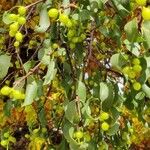
Loranthus europaeus
Yellow-berried mistletoe · European loranthus · Twisted willow
Care Guide
💧 Water
The European loranth flourishes when it receives a moderate amount of water, requiring consistent moisture without becoming waterlogged. Providing water once a week is usually sufficient, particularly during dry periods. As an evergreen plant, it makes good use of natural rainfall but may need additional watering to keep its foliage healthy.
☀️ Light Partial sun
European loranth naturally grows in habitats like forest understories or rocky areas where it is exposed to natural shade. It prefers partial sun but can tolerate full sun or full shade, reflecting its versatile and hardy nature.
🌡️ Temperature 10–35°C
European loranth shows strong adaptability to a variety of climatic conditions, from very hot summers to cold winters. However, it does have an optimal temperature range for growth. When temperatures become too high, the plant is vulnerable to heat and humidity stress, which can lead to its death. In areas where temperatures approach the lower limit of its cold tolerance, it is important to provide insulation to protect the plant.
💨 Humidity
🪴 Soil 6-8
🌱 Fertilizer
Apply fertilizer to your European loranth in early spring to encourage healthy growth. Regular feeding improves its overall health, producing vigorous growth, increased tolerance of harsh conditions, and enhanced resistance to diseases and pests. Adhere to a consistent fertilization schedule for your European loranth to maintain foliage that is richly colored and lush in appearance.
🪴 Pot & Repot
✂️ Pruning
The European loranth is a deciduous shrub that benefits from timely pruning between early and late winter. Pruning encourages growth and flowering while removing dead branches helps prevent disease and improves air circulation. Regular pruning is also essential for controlling the shrub's growth and maintaining its shape, ensuring a healthy and attractive plant.
🌿 Propagating
🐛 Diseases & pets
☠️ Toxicity
Characteristics
- Plant Type
- Shrub
- Life Cycle
- Perennial
- Genus
- Loranthus
- Family
- Loranthaceae
- Hardiness Zone
- 6-9
- Mature Height
- 30 cm to 91 cm
- Mature Spread
- 20 cm to 76 cm
- Leaf Color
- Olive Drab, Dark Olive Green
- Leaf Type
- Evergreen
- Flower Color
- Yellow
- Flower Size
- 0.51 cm to 0.51 cm
- Bloom Time
- Mid spring, Late spring
- Planting Time
- Spring, Summer, Autumn
- Harvest Time
- Late summer, Early fall, Mid fall
- Native Area
- Turkey, Austria, Czech Republic, Slovakia, Montenegro, Bulgaria, Greece, Croatia, Slovenia, Ukraine, China, Russia, Serbia, Hungary, Iraq, Germany, Syria, Italy, Iran, Albania, Romania