Ludwigia peploides
Floating primrose-willow · Creeping water primrose · Water primrose · Floating primrose · Floating water primrose
Description
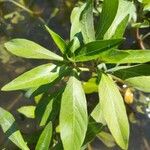
Source: leafsnapLudwigia peploides is a species of flowering plant in the evening primrose family known by the common names floating primrose-willow and creeping water primrose. It is native to Australia, New Zealand, North America, and South America, but it can be found on many continents and spreads easily to become naturalized. It is well known as a troublesome aquatic noxious weed that invades water ecosystems and can clog waterways. This is perennial herb which grows in moist to wet to flooded areas. The stem can creep over 2 meters long, sometimes branching. It spreads to form mats on the mud, or floats ascending in the water. The leaves are several centimeters long and are borne in alternately arranged clusters along the stem. The flower has 5 to 6 lance-shaped sepals beneath a corolla of 5 or 6 bright yellow petals up to 2.4 centimeters long. The fruit is a hard, cylindrical capsule.
Care Guide
💧 Water
☀️ Light Full sun
🌡️ Temperature 20–35°C
💨 Humidity
🪴 Soil
🌱 Fertilizer
🪴 Pot & Repot
✂️ Pruning
🌿 Propagating
🐛 Diseases & pets
☠️ Toxicity
Characteristics
- Plant Type
- Herb
- Life Cycle
- Perennial
- Genus
- Ludwigia
- Family
- Onagraceae
- Hardiness Zone
- 10
- Mature Height
- 1.83 m to 3.66 m
- Mature Spread
- 2.13 m
- Leaf Color
- Green, Blue
- Leaf Type
- Deciduous
- Flower Color
- Yellow
- Flower Size
- 2.54 cm
- Bloom Time
- Summer, Early fall, Mid fall
- Planting Time
- Summer
- Harvest Time
- Late summer, Fall, Early winter
- Native Area
- Chile, Honduras, Mexico, Guatemala, Peru, Dominican Republic, Panama, Jamaica, New Zealand, Uruguay, Colombia, Cuba, Paraguay, Argentina, Haiti, Bolivia, Venezuela, Brazil, El Salvador, Nicaragua, Ecuador, Costa Rica