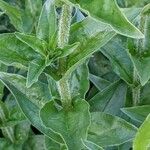
Lychnis chalcedonica
Maltese-Cross · Scarlet Lightning · Burning love · Common rose campion · Constantinople campion
Description
Source: leafsnapLychnis chalcedonica, commonly known as Maltese cross or scarlet lightning, is a herbaceous perennial plant that belongs to the family Caryophyllaceae. Native to Russia and Siberia, it has been widely cultivated in gardens around the world for its vibrant and showy flowers. The plant can grow up to 3 feet tall and features lance-shaped leaves arranged in opposite pairs along the stem. Its bright scarlet-red flowers are clustered in dense heads at the top of long stems, blooming from early summer to fall. Lychnis chalcedonica thrives in full sun or partial shade and prefers well-drained soil with moderate moisture levels. It is a hardy plant capable of tolerating cold temperatures, though it may require staking as it grows taller. The nectar-rich flowers attract butterflies, bees, and hummingbirds, making it a popular choice for gardens. It can be used as a border or accent plant and is also suitable for cut flower arrangements. Traditionally, Lychnis chalcedonica has been used for medicinal purposes, including treating digestive disorders, respiratory problems, and skin conditions, thanks to its anti-inflammatory properties. Overall, Lychnis chalcedonica is an attractive perennial with striking red blooms that add color to any garden setting while also offering medicinal benefits.
Care Guide
💧 Water Every 3 days
Maltese cross plants need evenly moist soil for the best growth. Water them once a week, increasing the frequency during hot summers. They are not very drought tolerant, so don't wait for them to dry out before watering.
☀️ Light Full sun
Maltese cross grows best in unblocked sunlight, though it can tolerate a little shade. In its native habitat it received sun all day, which enabled it to adapt to those conditions. Insufficient light can impede its growth, while an excess may cause it to dry out.
🌡️ Temperature 5–35°C
The Maltese cross is a plant native to regions with temperate climates and does best in temperatures of 68 to 95 °F (20 to 35 ℃). Seasonal adjustments may be required depending on the severity of local temperature extremes.
💨 Humidity
🪴 Soil 6-7
🌱 Fertilizer
The best time to fertilize a Maltese cross is in early spring, as it comes out of dormancy and begins active growth. Fertilizing supplies essential nutrients for healthy growth. Although the Maltese cross has relatively low fertilizer requirements, applying fertilizer once a year can improve its survival and encourage better, longer-lasting flowers.
🪴 Pot & Repot
✂️ Pruning
Deadheading spent flowers will encourage continuous blooms. However, you can withhold deadheading to allow the plant to self-seed and spread. Other than that, your Maltese cross will only need light maintenance by cutting off old stems to allow for new growth. Deadhead during the mid-summer and perform light pruning once every spring.
🌿 Propagating
🐛 Diseases & pets
☠️ Toxicity
Maltese cross plants are not toxic to humans and pets.
Characteristics
- Plant Type
- Herb
- Life Cycle
- Perennial, Biennial
- Genus
- Lychnis
- Family
- Caryophyllaceae
- Hardiness Zone
- 4-10
- Mature Height
- 34 cm to 91 cm
- Mature Spread
- 46 cm to 61 cm
- Leaf Color
- Green
- Leaf Type
- Deciduous
- Flower Color
- Red
- Flower Size
- 1.02 cm to 3.05 cm
- Bloom Time
- Early summer, Mid summer
- Planting Time
- Spring, Summer, Autumn
- Harvest Time
- Mid summer
- Native Area
- Russia, Kazakhstan, Belarus, Ukraine, China