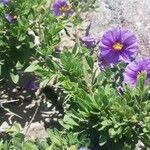
Lycianthes rantonnetii
Blue Potatobush · Blue potato-bush · Costarican nightshade · Divorce vine · Elisa
Description
Source: leafsnapLycianthes rantonnetii, commonly known as the blue potato bush or Paraguay nightshade, is a flowering plant native to South America. Belonging to the Solanaceae family, it is favored as an ornamental plant due to its striking blue-purple flowers and lush foliage. The plant can reach up to 6 feet in both height and width, with dark green, ovate leaves. The flowers of Lycianthes rantonnetii are trumpet-shaped with five petals that form a star shape. Blooming in clusters from late spring through fall, they attract bees and butterflies with their sweet fragrance. The plant also produces a small berry that changes from green to yellow when ripe. Lycianthes rantonnetii thrives in full sun or partial shade and well-drained soil. Although it can tolerate drought conditions, it benefits from regular watering during hot summer months for optimal growth. The plant can be propagated through stem cuttings or seeds. While generally low-maintenance, Lycianthes rantonnetii may be susceptible to pests such as spider mites or whiteflies if not properly cared for. Pruning may also be necessary during the winter months when growth slows down. In summary, Lycianthes rantonnetii is an attractive ornamental shrub that adds color and beauty to any garden landscape while requiring minimal care once established.
🌳 Besides their decorative charm, the vibrant flowers of the blue potato bush can be used to make natural dyes. This use aligns with rising interest in sustainable, eco-friendly textile processing and presents a novel, attractive source of color.
Care Guide
💧 Water Every 7 days
The blue potato bush thrives in well-drained soil and moderate humidity, and it typically needs watering every 1-2 weeks. As an evergreen plant native to South America, it requires careful attention during the growing season. Proper watering during this time is essential to support its foliage and blooms.
How should I water my Blue potato bush to make it grow best?
When watering your Blue potato bush, you have a lot of flexibility in how you do it. You can use any common watering tool like a watering can, hose, or even a cup. It's important to water the soil directly and make sure you moisten all areas equally to provide enough water for the entire root system. Using filtered water is a good idea because tap water may have harmful particles. It's also best to use water at or slightly above room temperature as extremely cold or hot water can be a bit shocking for the Blue potato bush. However, this plant usually responds well to any type of water you use.
What should I do if I give my Blue potato bush too much or too little water?
Outdoor plants, especially newly planted ones or seedlings, are prone to lack of watering. It's important to consistently water them for a few months when they are still small or newly planted, as once the roots are established, rainfall is usually enough for the Blue potato bush. Overwatering is more likely to happen when the Blue potato bush is planted in pots. If you accidentally overwater it, you should take immediate action. Stop watering the plant to minimize the effects of overwatering. Then, remove the plant from its pot to inspect the roots. If no root rot is found, you can return the plant to its container. But if you see signs of root rot, trim the affected roots and consider applying a fungicide. Finally, repot the Blue potato bush in well-draining soil. On the other hand, underwatering the Blue potato bush is an easy fix. If you notice drooping, drying out, or falling off leaves, simply water the plant more frequently. Adjust your watering frequency as soon as underwatering occurs to ensure the plant remains healthy.
How frequently do I need to water my Blue potato bush?
To support the natural growth of most outdoor plants, rainfall is usually sufficient. However, in areas where there is a lack of rainfall, it is important to ensure that plants receive adequate watering. During the spring and fall, watering every 2 weeks should be enough. In the summer, more frequent watering is necessary. In the winter, when plants require less water due to slower growth, watering should be done sparingly or may not be needed at all. If you have a young or newly planted Blue potato bush, it is advisable to water it more frequently to help it establish and grow into a more adaptable and drought-tolerant plant. For potted plants like the Blue potato bush, there are two main approaches to determine watering frequency. The first is a predetermined schedule, where you water the plant once every week or every other week. However, this method may not be suitable as it doesn't consider the specific conditions of your plant's growing environment. Another option is to base the watering frequency on soil moisture. It is recommended to wait until the top two to four inches of the soil, which is typically about ⅓ to ½ the depth of the pots, have completely dried out before watering again. This approach takes into account the plant's actual water needs and can be adjusted based on the season, particularly in summer when water requirements are higher.
How much water does my Blue potato bush require?
Watering requirements for the Blue potato bush may come as a surprise. Unlike other plants that require a lot of water, this plant only needs about five to ten ounces of water if the soil has dried a few inches since the last watering. You can determine the right amount of water by checking the soil moisture and noting how many inches have dried out. To ensure optimal moisture, water the plant enough to moisten all the dry soil layers. If more than half of the soil is dry, it's best to provide extra water until you see drainage from the pot's holes. If your Blue potato bush is in an area with regular rainfall, additional watering may not be necessary. When the plant is young or establishing, aim for 1-2 inches of rain per week. As it grows, it can rely on rainwater alone. However, during hot weather or long periods without rain, consider giving the plant a full watering to prevent stress.
How do I know if I'm watering my Blue potato bush enough?
The Blue potato bush is often overwatered, which can be easily recognized by certain signs. If your Blue potato bush is overwatered, its leaves will turn yellow and it may lose some of them. Overwatering can also cause the plant to shrink and promote root rot. On the other hand, if you underwater the Blue potato bush, it will start to droop and its leaves may become brown or brittle. Whether you see signs of overwatering or underwatering, it is important to take action and revive the health of your Blue potato bush.
☀️ Light Full sun
The blue potato bush requires continuous, all-day light and does not need any shade. Native to areas where sunlight heavily bathes the land, it thrives under those conditions. If light is either reduced or increased, the plant’s health may be harmed, affecting its flowering and overall vigor.
What are the sunlight requirements for the Blue Potato Bush?
The Blue Potato Bush (Lycianthes rantonnetii) thrives best in full sunlight, requiring over 6 hours of sunlight daily, but it can also tolerate partial sun, which means about 3-6 hours of sunlight. It's essential to observe how sunlight moves through your garden to choose the best spots that provide the right balance of light and shade for your plants, ensuring their optimal growth and happiness.
How does artificial lighting support the growth of indoor Blue Potato Bush plants?
For indoor Blue Potato Bush plants, especially in scenarios where natural sunlight is insufficient, such as during winter or in areas that do not get enough sunlight, artificial lighting can be a vital solution. Using the right type of artificial light like LED lights, which can be customized to provide specific wavelengths, helps promote faster and healthier growth. Full sun plants require 30-50W/sq ft of artificial light, partial sun plants need 20-30W/sq ft, and full shade plants require 10-20W/sq ft. The light source should be placed 12-36 inches above the plant to mimic natural sunlight conditions, and the duration should match the natural daylight hours, typically 8-12 hours per day for most plants.
What are the symptoms of insufficient sunlight for the Blue Potato Bush?
When the Blue Potato Bush does not receive adequate sunlight, it exhibits several symptoms. These include smaller than usual new leaves, leggy or sparse growth, premature leaf drop, halted or no new growth, lighter-colored or irregularly patterned new leaves indicating a lack of chlorophyll, chlorosis (yellowing of leaves due to the breakdown of chlorophyll), sunscald which appears as pale, bleached areas on plant tissue, curled or twisted leaves as a defense against excessive sunlight, wilting from loss of turgor pressure, and leaf scorching characterized by brown, dry, and crispy leaf edges.
What are some solutions for addressing insufficient sunlight for indoor and outdoor Blue Potato Bush plants?
To address insufficient sunlight for the Blue Potato Bush, indoor plants can be gradually moved to sunnier locations each week until they receive at least 6 hours of direct sunlight daily. Using a south-facing window and keeping curtains open during the day can maximize sunlight exposure. For those unable to move or large, consider using artificial lights for at least 8 hours a day. Outdoors, gradually acclimate your plants to sunnier spots to avoid sunburn. If trees block sunlight, pruning branches and leaves can help. For smaller plants, consider transplanting during their dormant period to a location with more sunlight and good drainage. Note that parts of the plant affected by insufficient sunlight may not recover, but new growth after increasing light exposure will be healthy.
🌡️ Temperature 20–37.8°C
Blue potato bush is native to warm regions and does best in temperatures from 68 to 100 °F (20 to 38 ℃). Mild winters combined with hot summers most closely mirror its natural environment. To ensure optimal growth, alter the blue potato bush's exposure during seasons with extreme temperatures.
What is the ideal temperature range for the Blue Potato Bush?
The Blue Potato Bush, native to warmer climates, flourishes best when the temperature ranges between 68 to 100°F (20 to 38°C). It is well-suited to mild winters and hot summers, which closely replicate its natural habitat. To ensure optimal growth, especially during harsh temperature seasons, it's crucial to adjust the plant's exposure. During winter, maintaining a temperature above 20°C is beneficial, and it is advisable to keep the plant indoors, near a bright window but away from direct heat sources to prevent damage from cold temperatures.
How does cold weather affect the Blue Potato Bush and what are the solutions?
The Blue Potato Bush is sensitive to cold weather and prefers temperatures above 20°C, requiring maintenance above 5°C during winter. Exposure to temperatures below 1°C may cause the leaves to lighten in color, and frost damage can lead to browning or blackening of the leaves, along with wilting and drooping. To manage frost damage, trim off the affected parts and move the plant indoors to a warm environment near a south-facing window for ample sunlight. It is important to avoid placing the plant near heaters or air conditioning vents to prevent air dryness.
How do high temperatures affect the Blue Potato Bush and what are the solutions?
The Blue Potato Bush should ideally be kept below 38°C during the summer to avoid heat stress. Temperatures exceeding 43°C can cause the leaves to lighten and increase the risk of sunburn. To mitigate the effects of high temperatures, remove sunburned or dried parts and relocate the plant to a spot that offers afternoon shade. Ensuring the soil remains moist through watering in the morning and evening can also help alleviate stress from high temperatures.
💨 Humidity
🪴 Soil 6-7
🌱 Fertilizer
The best time to fertilize a Blue potato bush is in early spring, as it comes out of dormancy. Fertilizing then supports overall growth and encourages flower development. It improves the foliage, stems, and branches and helps produce larger, more vibrant, and longer-lasting flowers. It also helps move nutrients from the roots to the flowers and enhances the plant's health and resistance to disease.
Why should I use fertilizer on my Blue potato bush?
The overall health of a Blue potato bush depends on fertilization. It ensures the plant has enough energy and nutrients for healthy foliage and sturdy stems and branches. The flowers of a Blue potato bush are highly valued by gardeners, and fertilization plays a crucial role in producing large, vibrant, and long-lasting blooms. This is because the right fertilizer facilitates the transfer of fuel from the roots to the flowers. Proper fertilization also improves the plant's overall health, making it more resistant to diseases.
When should I fertilize my Blue potato bush?
To properly fertilize a Blue potato bush, the best time is in early spring when the plant is emerging from dormancy and getting ready to bloom. This will provide the necessary energy for growth and flower development. However, fertilizing during this time is not the only option. Another feeding towards the end of the season, during the fall months, can also benefit the plant, although it doesn't need to be as substantial as the first feeding. Some gardeners choose to fertilize when planting, but it is not always necessary.
When is the best time to not fertilize my Blue potato bush?
During the winter, Blue potato bushes are in a dormant phase and do not require fertilization. They do not need to obtain much energy from the soil for growth during this time. Fertilizing in winter increases the risk of overfertilization. The two main feeding times for a Blue potato bush are early spring and fall. This means that during most of spring and summer, fertilizer is not needed. It is also advisable to refrain from feeding the plant if it is subjected to excessively hot or dry conditions.
What kind of fertilizer does my Blue potato bush need?
When fertilizing Blue potato bush plants, it is generally fine to use a general-purpose fertilizer with equal amounts of nitrogen, phosphorus, and potassium. However, for optimal growth, Blue potato bush plants tend to benefit from a specific type of fertilizer. Nitrogen and phosphorus are the most important nutrients for these plants, so the fertilizer should contain higher amounts of these nutrients compared to potassium. An N-P-K ratio of 10-10-8 or similar should be suitable. Additionally, incorporating organic material such as compost during one of the annual feedings can be beneficial. If choosing to use fertilizer, granular fertilizer is typically the most common choice for Blue potato bush plants.
How can I put fertilizer on my Blue potato bush?
Applying fertilizer to your Blue potato bush is a simple task that even novice gardeners can do. To feed your Blue potato bush with granular fertilizer, just sprinkle it on the soil after moistening it with water. You can also improve the soil by adding organic materials like compost or manure. To do this, place the material on top of the soil and gently work it into the first few inches using a hand rake without disturbing the roots.
🪴 Pot & Repot 2-3 years
To keep your blue potato bush looking lush and bushy, repot it every 2-3 years during the spring. Choose a container that's just a bit larger than the previous one. Once you've repotted the plant, ensure it gets plenty of sunlight and regular watering. This care will help the bush recover well and encourage it to produce vibrant blooms.
✂️ Pruning
Prune the blue potato bush in late spring, after it has finished flowering, to encourage new growth and more blooms. Remove any dead branches and shape the plant to promote vigor. Regular maintenance not only improves the appearance of the foliage but also keeps it healthy. Make sure to use clean, sharp tools to prevent disease and promote quick healing.
🌿 Propagating
🐛 Diseases & pets
☠️ Toxicity
Characteristics
- Plant Type
- Shrub
- Life Cycle
- Perennial
- Genus
- Lycianthes
- Family
- Solanaceae
- Hardiness Zone
- 10-11
- Mature Height
- 1.83 m
- Mature Spread
- 1.83 m to 3.05 m
- Leaf Color
- Green
- Leaf Type
- Evergreen
- Flower Color
- Purple
- Flower Size
- 2.54 cm
- Bloom Time
- All year round
- Planting Time
- Spring, Autumn
- Harvest Time
- All year round
- Native Area
- Bolivia, Peru