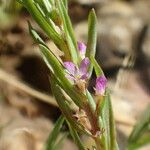
Lythrum hyssopifolia
خون فام زوفایی · Grass-poly · Lesser loosestrife · Small loosestrife · Hyssop loosestrife
Description
Source: leafsnapLythrum hyssopifolia (orth. var. L. hyssopifolium) is a species of flowering plant in the loosestrife family known by the common names hyssop loosestrife and grass-poly. It is native to Europe but it is known elsewhere, including parts of Australia and eastern and western North America, as an introduced species and sometimes a weed. It is rare in the United Kingdom, with occasional isolated populations. It often grows in moist habitats, such as marshes and wet agricultural fields, rice paddies, for example. It is a mostly upright, branching annual or biennial herb growing 10 to 60 centimeters (4" to 24") tall. The oval leaves are arranged oppositely lower on the plant, and often alternately toward the top. They are up to 3 centimeters (1") in length. The inflorescence is a terminal spike of flowers with pinkish petals up to half a centimeter (¼") long. The fruit is an oval capsule containing many minute seeds. The Latin word hyssopifolia (which occurs in several plant names) means "hyssop-leafed".
🎭 Cleansing, Safeguarding
Care Guide
💧 Water
Grass-poly flourishes in humid environments and needs weekly watering to keep its lush appearance. It is well-suited to various climate zones and is a resilient outdoor plant that can endure occasional rain showers, making it a valuable addition to any garden.
How should I water my Grass-poly?
You can water Grass-poly using various methods such as a garden hose with a spray nozzle, a watering can, or any common watering tool. Grass-poly is not particular about the type of water it receives – rainwater, tap water, or filtered water all work fine. It is best to avoid watering this plant from above as it can harm the leaves, flowers, and potentially cause disease. Instead, setting up a drip irrigation system is often the most effective way to water Grass-poly as it provides even and direct watering to the soil. When watering a container-grown Grass-poly, you can use a cup, watering can, or tap to water the soil directly.
What should I do if I give my grass too much or too little water?
The solution for underwatering your Grass-poly is simple: when you notice it lacks moisture, water it more regularly. Overwatering, on the other hand, can be a bigger problem. If not caught early, it can cause diseases that lead to the plant's decline and death. To prevent this, choose a proper growing location with plenty of sunlight to dry the soil and good drainage to avoid water accumulation. For potted Grass-poly that is overwatered, consider switching it to a new pot with better soil drainage and more effective drainage holes. When repotting, use loose soil and an efficient drainage pot.
How often should I water my Grass-poly? -> How often do I need to water my Grass-poly?
Grass-poly requires regular watering throughout the growing season. In the spring, water this plant once a week. As it gets warmer, increase watering to two or three times a week, but be careful not to overwater. The soil should be moist, but not wet. If you have Grass-poly in a pot, you'll need to water it more frequently. Potted plants dry out faster, so plan to water them a few times per week, compared to once a week for plants in the ground.
How much water does my Grass-poly require?
Determining how much water to give your Grass-poly can be approached in a few different ways. One method involves feeling the soil to check for moisture and watering until the first six inches are moist. Another option is to use a set measurement, such as giving about two gallons per week, adjusting for weather and soil dryness. However, it's important to be cautious of overwatering if your plant needs less than two gallons. When growing Grass-poly in a container, you should ensure all layers of soil are moist by either testing with your finger or watering until excess water trickles out of the drainage holes.
How can I know if I am giving enough water to my Grass-poly?
Avoiding overwatering your Grass-poly can be a bit challenging. On one hand, these plants have deep roots that require weekly soil moisture. However, Grass-poly is highly prone to root rot, which can lead to browning. Underwatering is less of a concern as these plants can survive for a while without additional watering. However, if you wait too long, the plant will likely wilt and you may notice dry leaves.
☀️ Light Full sun
Grass-poly flourishes when it receives a significant amount of sun each day, but it can also grow in places with moderate sunshine. For optimal development, it requires a brightly illuminated setting, mirroring its roots in bright, sunny ecosystems. Too much or too little sunlight can impede growth and result in health problems.
What are the sunlight requirements for Grass-poly?
Grass-poly requires a substantial amount of daily sun for optimal growth and can also thrive in moderate sun exposure. Full sun is defined as over 6 hours of sunlight per day, while partial sun refers to about 3-6 hours of sunlight per day. It's vital to watch how sunlight moves through your garden and choose spots that offer a balance of light and shade, ensuring the plants' happiness and health.
How can artificial lighting benefit indoor plants?
Indoor plants, including Grass-poly, benefit significantly from adequate lighting, especially when natural sunlight is insufficient. Artificial lighting, such as LED lights, can be tailored to provide specific wavelengths needed by the plants, ensuring they continue to grow healthily even indoors. Full sun plants require 30-50W/sq ft of artificial light, partial sun plants need 20-30W/sq ft, and full shade plants need 10-20W/sq ft. The light source should be placed 12-36 inches above the plant to mimic natural sunlight, and plants generally need 8-12 hours of light per day.
What are the symptoms of inadequate light for Grass-poly?
Grass-poly may show several symptoms when exposed to inadequate light, including smaller new leaves, leggy or sparse growth, faster leaf drop, and slower or no new growth. Leaves can develop lighter colors or chlorosis, indicating a lack of chlorophyll and essential nutrients. Sunscald, leaf curling, wilting, and leaf scorching are also symptoms that can occur due to overexposure to sunlight, affecting the plant's overall health.
What solutions are there for Grass-poly suffering from light issues?
To address light issues for Grass-poly, indoors, you can gradually move plants to sunnier locations until they receive at least 6 hours of direct sunlight daily or use artificial lighting for additional support. Outdoors, gradually adapting plants to the best sunlight spots is crucial to avoid sunburn. Reducing obstructions like pruning trees can also help. For smaller plants, transplanting during the dormant period to a sunnier location with good drainage is beneficial. It's important to note that damage from insufficient sunlight may be irreversible, but new growth should be healthy with improved light conditions.
🌡️ Temperature 15–37.8°C
Grass-poly naturally occurs in surroundings with temperatures typically between 68 and 100.4°F (20 to 38°C). This plant prospers in such warm weather conditions and may necessitate temperature modifications during the cooler months.
What are the ideal temperature conditions for Grass-poly?
Grass-poly, with its botanical name Lythrum hyssopifolia, is native to environments where temperatures range closely from 68 to 100.4°F (20 to 38°C). It thrives best in these warm climates. Although Grass-poly has strong cold resistance and special frost protection measures aren't usually necessary, it's crucial to provide cold protection if temperatures are expected to drop below -15°C by covering the plant with materials such as soil or straw. Before the first freeze in autumn, abundantly watering the plant to ensure the soil remains moist and enters a frozen state can help prevent drought and water scarcity during winter and early spring.
How does low temperature affect Grass-poly, and what are the solutions?
Grass-poly is cold-tolerant and performs best when the temperature stays above 20°C. During winter, temperatures should be kept above 0°C. In cases where the temperature falls below -15°C, there may not be noticeable changes during winter, but there can be a decrease in sprouting or even no sprouting during springtime. If this occurs, it's recommended to remove any parts of the plant that have failed to sprout in spring.
How does high temperature affect Grass-poly, and what are the solutions?
Grass-poly should ideally be kept below 38°C during the summer. When temperatures exceed 43°C, the plant's leaves may become lighter in color, prone to curling, susceptible to sunburn, and in severe cases, the entire plant may wilt and become dry. To counteract these effects, trim away the sunburned and dried-up parts of the plant. Moving the plant to a location that provides shade from the midday and afternoon sun or using a shade cloth can offer protection. Additionally, watering the plant in the morning and evening to maintain soil moisture is beneficial.
💨 Humidity
🪴 Soil 6-7
🌱 Fertilizer
Grass-poly does well with regular, dilute fertilizer applications to encourage healthy leaf development. Fertilize Grass-poly about once a month throughout the summer. Nitrogen is important for foliage, and providing nitrogen-rich sources helps Grass-poly thrive.
🪴 Pot & Repot
✂️ Pruning
Grass-poly boasts vibrant flowers and dense foliage, flourishing with strategic pruning from early to late spring. By focusing on removing dead or overgrown stems, you can improve air circulation and light penetration. This promotes healthy growth and encourages vigorous flowering throughout the season.
🌿 Propagating
🐛 Diseases & pets
☠️ Toxicity
Characteristics
- Plant Type
- Herb
- Life Cycle
- Annual
- Genus
- Lythrum
- Family
- Lythraceae
- Hardiness Zone
- 7-11
- Mature Height
- 10 cm to 61 cm
- Mature Spread
- 10 cm to 49 cm
- Leaf Color
- Green
- Leaf Type
- Deciduous
- Flower Color
- Pink, Lavender
- Flower Size
- 0.20 cm to 0.25 cm
- Bloom Time
- Summer
- Planting Time
- Spring, Autumn
- Harvest Time
- Late summer, Early fall, Mid fall
- Native Area
- Libya, Somalia, Egypt, Turkey, Austria, Slovakia, Montenegro, Eritrea, Slovenia, Morocco, Croatia, Belarus, Uzbekistan, Russia, Iraq, Germany, Ethiopia, Romania, Belgium, Portugal, France, Saudi Arabia, Tajikistan, Tunisia, Czech Republic, South Africa, Cyprus, Bulgaria, Poland, Armenia, Greece, Ukraine, Serbia, Chad, Lebanon, Syria, Kyrgyzstan, Kazakhstan, Italy, Spain, Switzerland, Iran, Albania, Azerbaijan, United Kingdom, Hungary, Algeria, Turkmenistan