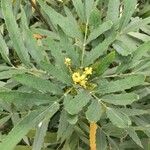
Mahonia fortunei
Fortune's mahonia · Holly grape · Chinese mahonia
Description
Source: leafsnapMahonia fortunei, commonly known as Fortune's mahonia, is an evergreen shrub belonging to the Berberidaceae family. Native to China, this plant has gained popularity worldwide as an ornamental species due to its appealing foliage and flowers. Typically, it grows up to 6 feet tall and 4 feet wide, with a dense growth habit. The leaves of Mahonia fortunei are dark green and glossy. They are pinnately compound with spiny leaflets, giving the plant an exotic look. The flowers bloom in late winter or early spring, forming clusters of bright yellow blossoms that are fragrant and attract pollinators. Mahonia fortunei thrives in partial to full shade, preferring well-drained soil rich in organic matter. While it can tolerate drought once established, it requires regular watering during its initial growth period. In addition to its ornamental value, the plant has several medicinal uses. It contains alkaloids such as berberine, which have anti-inflammatory properties and have been used for centuries. Overall, Mahonia fortunei is an excellent choice for gardeners seeking an evergreen shrub with year-round interest, thanks to its attractive foliage and fragrant winter blooms.
🌳 Chinese mahonia exhibits a notable ability to signal the presence of certain metals in the soil, such as aluminum. This feature could make it useful in phytoremediation, where plants are used to decontaminate polluted soils. Although it is not as widely known or utilized as hyperaccumulators, Chinese mahonia’s response to elevated metal concentrations can assist in monitoring and assessing soil health, offering both ecological and practical benefits for environmental management.
Care Guide
💧 Water Every 7 days
☀️ Light Partial sun
Chinese mahonia grows best in filtered, dappled light that mirrors the ambient illumination of its native environment. It can withstand full sun, but that is not ideal. Across its growth stages it can adapt to different light levels. Both too little and too much light can hinder the plant's healthy development.
🌡️ Temperature 0–37.8°C
Chinese mahonia is suited to temperatures from 32 to 100 °F (0 to 38 ℃). While it can tolerate different conditions, it grows best within this span. To maintain healthy growth across seasons, make temperature adjustments based on specific situations.
💨 Humidity
🪴 Soil 6-6
🌱 Fertilizer
The timing of fertilizing Chinese mahonia is important. Feed it in early spring and continue once a month until early summer. Fertilizer encourages attractive flowering and supplies energy during both dormant and active growth periods.
🪴 Pot & Repot
✂️ Pruning
🌿 Propagating
🐛 Diseases & pets
☠️ Toxicity
Characteristics
- Plant Type
- Shrub
- Life Cycle
- Perennial
- Genus
- Mahonia
- Family
- Berberidaceae
- Hardiness Zone
- 3-11
- Mature Height
- 2.13 m to 3.96 m
- Mature Spread
- 0.91 m to 1.52 m
- Leaf Color
- Dark Green, Forest Green
- Leaf Type
- Evergreen
- Flower Color
- Yellow
- Flower Size
- 2.54 cm
- Bloom Time
- Spring
- Planting Time
- Spring, Autumn
- Harvest Time
- Early summer, Mid summer