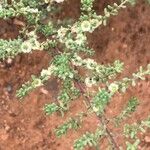
Maireana brevifolia
Eastern cottonbush · Small-leaf bluebush · Cotton bush · Eastern cotton-bush · Short-leaf bluebush
Description
Source: leafsnapMaireana brevifolia, commonly known as Short-leaf Bluebush, is a small shrub in the Chenopodiaceae family. Native to Australia, it thrives in the arid and semi-arid regions of Western Australia, South Australia, and the Northern Territory. This plant features a rounded shape with blue-green leaves that are short and resemble succulents. It can grow up to 1 meter tall and spread as wide as 1 meter. The flowers are small and inconspicuous with white or pinkish petals. Maireana brevifolia is well adapted to harsh environments by employing water conservation strategies. Its succulent leaves can store water for extended periods, and its deep roots enable access to water well below the surface. The Short-leaf Bluebush plays a crucial role in the ecosystem by providing food for native animals such as kangaroos, wallabies, birds, reptiles, and insects. Beyond its ecological importance, Maireana brevifolia holds cultural significance for Indigenous Australians, who have used its leaves for medicinal purposes, including treating skin conditions like eczema. Overall, Maireana brevifolia is an important plant species both ecologically and culturally within its native range in Australia.
Care Guide
💧 Water Every 7 days
☀️ Light Full sun
Yanga bush comes from open habitats, such as sunny meadows and forest edges, which offer abundant light. It does best in Full Sun but can also tolerate Partial Sun, showing good adaptability to different sunlight levels.
🌡️ Temperature 20–37.8°C
Yanga bush shows strong adaptability to a variety of climate conditions, from blazing summers to frosty winters. However, it has an optimal temperature range for growth. If temperatures rise too high, the plant becomes susceptible to heat and humidity stress, which can cause it to die. In areas where temperatures approach the lower limit of its cold tolerance, taking insulating measures is important to protect the plant.
💨 Humidity
🪴 Soil 6-8
🌱 Fertilizer
Fertilize your Yanga bush in early spring to encourage healthy growth. Regular feeding improves its overall health, promotes vigorous growth, increases resilience to difficult conditions, and strengthens resistance to diseases and pests. Keep to a consistent fertilization schedule for your Yanga bush to maintain vibrant, deeply colored foliage and a lush appearance.
🪴 Pot & Repot
✂️ Pruning
🌿 Propagating
🐛 Diseases & pets
☠️ Toxicity
Characteristics
- Plant Type
- Shrub
- Life Cycle
- Perennial
- Genus
- Maireana
- Family
- Amaranthaceae
- Hardiness Zone
- 9-11
- Mature Height
- 30 cm to 91 cm
- Mature Spread
- 0.49 m to 1.52 m
- Leaf Color
- Gray
- Leaf Type
- Evergreen
- Flower Size
- 0.25 cm to 0.51 cm
- Bloom Time
- Early fall, Mid fall
- Planting Time
- Spring, Autumn
- Harvest Time
- Late fall, Early winter