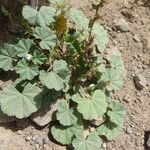
Malva parviflora
پنیرک گل ریز · خبيزة · Egyptian mallow · Cheeseweed · Least mallow
Description
Source: leafsnapMalva parviflora, commonly known as small-flowered mallow, is a herbaceous annual plant belonging to the family Malvaceae. Native to Europe and Asia, it has spread across the globe and can now be found in many regions. The plant typically grows up to 60 cm in height and exhibits a sprawling habit with stems that are covered in fine hairs. The leaves of Malva parviflora are alternate, heart-shaped with serrated edges, and have long petioles. Its small flowers, about 1 cm in diameter, are pink or purple and feature a cup-shaped corolla with five petals. The plant blooms from spring through summer. Malva parviflora thrives in full sun or partial shade and prefers well-drained soil, though it can tolerate poor soil conditions. It is often found growing along roadsides and in disturbed areas such as fields or gardens. For centuries, the plant has been used for medicinal purposes due to its anti-inflammatory properties, which are effective in treating skin irritations such as eczema and insect bites. Additionally, it contains high levels of antioxidants, which may help protect against certain diseases. Overall, Malva parviflora is an attractive herbaceous annual that adds color to any garden while also providing medicinal benefits. This makes it an excellent choice for both ornamental purposes and health advantages.
🌳 Though unassuming in appearance, Cheeseweed plays an important role in nutrition and traditional medicine; its young leaves and shoots supply dietary fiber, essential minerals such as calcium and iron, and vitamins A, B, and C. Beyond human health, it benefits beekeeping with plentiful nectar and provides birds with protein-rich seeds.
🎭 Pleasant disposition
Care Guide
💧 Water Every 3 days
Cheeseweed mallow naturally grows in areas with varying moisture levels and does well with moderate watering. It prefers soil that stays consistently moist but is not waterlogged. A weekly watering routine works best, but you should water more often during dry spells to make up for any lack of rain.
How should I water my Cheeseweed mallow plant to keep it healthy?
To water Cheeseweed mallow, you can use a garden hose with a spray nozzle, a watering can, or any other common watering tool. Cheeseweed mallow is not particular about the type of water it receives, as it can thrive with rainwater, tap water, or filtered water. However, it is best to avoid watering it from above to prevent leaf and flower damage and potential disease. The most effective method for watering this plant is setting up a drip irrigation system, which ensures even and direct watering to the soil. For container-grown Cheeseweed mallow, you can use a cup, watering can, or tap water to directly water the soil.
What should I do if I give my Cheeseweed mallow too much water or too little water?
To remedy underwatering of Cheeseweed mallow, simply water it more regularly. However, overwatering can cause more serious issues, such as diseases that can lead to the plant's decline and death. To prevent this, choose a growing location with ample sunlight and good drainage. If you overwater a potted Cheeseweed mallow, consider transferring it to a new pot with loose, well-draining soil.
How frequently should I water my Cheeseweed mallow?
To keep your Cheeseweed mallow healthy, it's important to water it regularly. In spring, aim to water it once a week. As the weather gets warmer, you may need to increase watering to two or three times a week. However, be careful not to exceed this frequency as it can harm the plant. It's also important to keep the soil moist but not overly wet, regardless of how often you water. If your Cheeseweed mallow is in a pot, you'll need to water it more frequently than if it were in the ground. Generally, watering a potted Cheeseweed mallow a few times a week is recommended, compared to once a week for a plant in the ground.
How much water does my Cheeseweed mallow plant need?
Determining the appropriate amount of water for your Cheeseweed mallow can be approached in a few different ways. Some gardeners prefer to gauge the soil moisture by feeling it, suggesting that you water until the first six inches of soil feel moist. Another option is to use a specific measurement, such as providing about two gallons of water per week, considering factors like temperature and soil dryness. However, following these guidelines might result in overwatering if your plant requires less water. When growing Cheeseweed mallow in a container, a different method is necessary. It's typically recommended to water enough to moisten all layers of dry soil, which can be tested by inserting your finger. Another indication is when you notice excess water trickling out of the pot's drainage holes.
How can I know if I'm giving enough water to my Cheeseweed mallow plant?
Avoiding overwatering your Cheeseweed mallow can be somewhat difficult. These plants have deep roots that need to be watered weekly, but they are also prone to root rot and browning if overwatered. Underwatering is less of a concern as Cheeseweed mallow can survive without additional watering for a while, but prolonged lack of water can cause wilting and dry leaves.
☀️ Light Full sun
Cheeseweed requires abundant sunlight for optimal growth and naturally favors locations where it can absorb ample solar radiation. It is also adaptable and can tolerate areas with reduced light. Severe light deficiency can impede its growth, while excessive exposure may diminish the plant’s health and vigor.
What are the sunlight requirements for Cheeseweed Mallow?
Cheeseweed mallow (Malva parviflora) flourishes in full sun, which means it requires more than 6 hours of sunlight daily for optimal growth. It can also survive in partial sun, receiving about 3-6 hours of sunlight. However, it's important to watch how sunlight moves through your garden and choose spots that offer a good balance of light and shade to ensure the plant's health. The vitality of cheeseweed mallow can be hindered by both insufficient light and overexposure.
How does artificial lighting support Cheeseweed Mallow growth indoors?
Indoor cheeseweed mallow plants can benefit significantly from artificial lighting, especially when natural sunlight is not enough. LED lights are recommended because they can be tailored to provide specific wavelengths needed for the plant's growth. The requirement for artificial light intensity varies by plant type: full sun plants need 30-50W/sq ft, partial sun plants need 20-30W/sq ft, and full shade plants only need 10-20W/sq ft. Ideally, artificial lights should be placed 12-36 inches above the plant and kept on for 8-12 hours per day to mimic natural daylight conditions.
What are the symptoms of light deficiency in Cheeseweed Mallow?
When cheeseweed mallow doesn't receive adequate light, it may exhibit symptoms like small, new leaves growing smaller than those previously matured; leggy or sparse growth giving a stretched-out appearance; quicker dropping of older leaves as a resource conservation measure; slower or halted new growth due to survival mode; new leaves appearing lighter in color or with irregular patterns, indicating a lack of chlorophyll; and conditions such as chlorosis, where leaves turn yellow, sunscald with bleach-like areas on the plant, leaf curling as a defense mechanism against extreme sunlight, wilting from excessive water loss, and leaf scorching characterized by brown and crispy leaf edges.
What solutions can address Cheeseweed Mallow's light-related issues?
To combat light-related growth issues in cheeseweed mallow, move the plants gradually to a location with at least 6 hours of direct sunlight daily, using a south-facing window for indoor plants and ensuring curtains are open during the day. If moving the plant is not feasible, consider artificial lighting with lamps or professional grow lights for at least 8 hours daily. Outdoors, transition your plants to sunnier spots gradually to avoid sunburn. Note that parts of the plant already affected by insufficient light might not recover but adjusting light exposure can promote healthy new growth. Additionally, reducing obstructions like pruning trees or transplanting to sunnier locations can also enhance light access.
🌡️ Temperature 10–35°C
Cheeseweed is native to temperate regions, where the preferred temperature is between 68 and 95 °F (20 to 35 °C). Although it can tolerate cooler conditions, its best growth occurs within this range. During colder seasons, adjustments may be needed to preserve the plant's health.
What is the ideal temperature range for Cheeseweed mallow?
Cheeseweed mallow, or Malva parviflora, thrives best in temperate environments with ideal temperatures ranging between 68 to 95 °F (20 to 35 °C). Although the plant is adaptable to lower temperatures, its optimal growth occurs within this preferred temperature range. It's important to make necessary adjustments during the colder seasons to maintain the plant's health.
Does Cheeseweed mallow require special frost protection?
Cheeseweed mallow has strong cold resistance, and special frost protection measures are usually not required during winter. However, if temperatures are expected to drop below -25°C, it is essential to provide cold protection to prevent damage. This can be done by covering the plant with insulating materials such as soil or straw. Additionally, before the first freeze of autumn, watering the plant abundantly to ensure the soil is moist helps prevent drought and water scarcity during winter and early spring.
How does Cheeseweed mallow react to low temperatures?
Cheeseweed mallow is cold-tolerant and performs best when temperatures are above 20°C. Even though it generally withstands winter conditions well and should be kept above 0°C, exposure to temperatures below -25°C may not show immediate adverse effects during winter but can lead to a decrease in sprouting or even a lack of sprouting in spring. In such cases, it is recommended to remove any parts of the plant that have failed to sprout in spring.
How should Cheeseweed mallow be cared for in high temperatures?
In the summer, it is crucial to ensure that the Cheeseweed mallow's environment does not exceed 35°C. Should temperatures rise above 38°C, the plant's leaves may lighten in color, curl, become prone to sunburn, and in severe cases, wilt and dry out entirely. To care for the plant under these conditions, trim away any sunburned or dried-up parts. Move the plant to a spot that offers shade during the midday and afternoon sun, or use a shade cloth. Additionally, water the plant in the morning and evening to keep the soil adequately moist.
💨 Humidity
🪴 Soil 6-7
🌱 Fertilizer
Cheeseweed benefits from regular, light applications of fertilizer to encourage healthy leaf growth. You should apply fertilizer roughly once a month during the summer. Nitrogen is important for foliage, and providing nitrogen-rich sources helps Cheeseweed thrive.
🪴 Pot & Repot
✂️ Pruning
The cheeseweed mallow benefits from occasional pruning, which is best done in late winter or early spring after the frosts have passed. To promote healthy growth, trim the shoots back to the first set of leaves. Make sure to use clean, sharp shears, and disinfect your tools between cuts to prevent cross-contamination.
🌿 Propagating
🐛 Diseases & pets
☠️ Toxicity
Characteristics
- Plant Type
- Herb
- Life Cycle
- Annual, Biennial, Perennial
- Genus
- Malva
- Family
- Malvaceae
- Hardiness Zone
- 6-9
- Mature Height
- 49 cm
- Mature Spread
- 2.13 m
- Leaf Color
- Green, Blue
- Leaf Type
- Deciduous
- Flower Color
- White
- Flower Size
- 0.51 cm to 0.51 cm
- Bloom Time
- Mid spring, Late spring, Summer
- Planting Time
- Spring
- Harvest Time
- Late spring, Summer, Early fall
- Native Area
- Saudi Arabia, Libya, Egypt, Turkey, Tajikistan, Tunisia, United Arab Emirates, Cyprus, Armenia, Greece, Croatia, Morocco, Yemen, Lebanon, Chad, Afghanistan, Iraq, Syria, Italy, Spain, France, Oman, Iran, Albania, Azerbaijan, Algeria, Qatar, Turkmenistan, Portugal