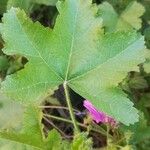
Malva sylvestris
پنیرک · پنیر قرمز · Μολοχα · Mallow · Common mallow
Description
Source: leafsnapMalva sylvestris is a species of the mallow genus Malva in the family of Malvaceae and is considered to be the type species for the genus. Known as common mallow to English-speaking Europeans, it acquired the common names of cheeses, high mallow and tall mallow (mauve des bois by the French) as it migrated from its native home in Western Europe, North Africa and Asia through the English-speaking world.M. sylvestris is a vigorous plant with showy flowers of bright mauve-purple, with dark veins, standing 3–4 feet (0.91–1.22 m) high and growing freely in meadows, hedgerows and in fallow fields.
🌳 Common mallow, usually known for its medicinal qualities, unexpectedly helps soften leather through the mucilage of its seeds, a method adopted by tanneries. It may also serve as an unconventional source of renewable energy, since the plant's oil could have energy uses. Beekeepers prize common mallow for its flowers' nectars, which attract bees and are excellent for producing high-quality honey.
🎭 Affection, protection and health
Care Guide
💧 Water Every week
Common mallow thrives in temperate regions where the soil is well-drained and consistently moist, but not waterlogged. To keep the plant hydrated without over-saturating it, water it once a week. Although common mallow is usually grown outdoors, it shows strong growth when moisture levels are carefully managed, especially during its active growing season.
What's the difference between watering my Common mallow inside and outside?
Common mallow is commonly grown indoors by gardeners who live in non-temperate or tropical regions. If you grow it in a container, keep in mind that the soil may dry out faster compared to ground soil. Additionally, if you have drying elements like air conditioning units, your Common mallow will require more frequent watering compared to when it is planted outside. In outdoor conditions, you may not need to water your Common mallow much, especially if you receive regular rainfall. However, for indoor cultivation, you will need to water it more often since relying on rainwater is not possible.
☀️ Light Full sun
For healthy growth, common mallow requires a generous amount of light. This plant naturally flourishes in places with abundant sunlight. While it can tolerate lower light levels, this may hinder its vigorous growth. However, exposing it to too much light could potentially result in problems such as leaf burn or dehydration.
What are the sunlight requirements for Common Mallow (Malva sylvestris)?
Common Mallow requires full sun, defined as over 6 hours of sunlight daily, or partial sun, which is about 3-6 hours of sunlight. It is important to observe how sunlight moves through your garden to choose spots that ensure a balance of light and shade, promoting the plants' well-being.
What essentials should be considered for the healthy growth of Common Mallow?
For healthy growth, Common Mallow needs plenty of sunshine as it thrives in environments with ample sunlight. Although it can tolerate some shade, lower light levels may limit its growth, and overexposure to light could lead to issues like leaf scorching or dehydration. In cases of insufficient natural sunlight, particularly during winter or in less sunny spaces, artificial lights such as LEDs, which can mimic natural sunlight conditions (30-50W/sq ft for full sun plants, 20-30W/sq ft for partial sun plants, and 10-20W/sq ft for full shade plants), can be used to promote healthier growth.
What are the symptoms of inadequate sunlight for Common Mallow?
Symptoms of inadequate sunlight in Common Mallow include smaller new leaves, leggy or sparse growth, faster leaf drop, slower or no new growth, lighter-colored or chlorotic new leaves, sunscald, leaf curling, wilting, and leaf scorching. These symptoms indicate the plant is not receiving enough light for optimal growth or is suffering from overexposure to light.
How can I address sunlight-related issues for Common Mallow?
To address sunlight-related issues, gradually move Common Mallow to a location where it receives at least 6 hours of direct sunlight daily, utilizing a south-facing window for indoor plants and considering pruning or transplanting to reduce obstructions for outdoor or ground plants. Artificial lighting can be used as a supplement for indoor plants. It's important to avoid sudden changes in light intensity to prevent sunburn and recognize that parts of the plant damaged by inappropriate sunlight exposure may not recover, although new growth should be healthy.
🌡️ Temperature 5–32.2°C
The common mallow plant is indigenous to regions with a temperate climate, thriving in a temperature scope of 20 to 35 ℃ (68 to 95 °F). It is a resilient plant that can withstand chillier environments, but to ensure its best growth, it's recommended to keep temperatures within its preferred spectrum.
What is the native region and optimal temperature range for growing Common mallow (Malva sylvestris)?
Common mallow (Malva sylvestris) is native to temperate regions and thrives in a temperature range of 68 to 95 °F (20 to 35 °C). While it can adapt to cooler climates, for optimal growth, maintaining temperatures within this preferred range is advisable. The plant exhibits strong cold resistance, so it doesn't typically require special frost protection measures during winter. However, in extreme conditions where winter temperatures are expected to dip below -30°C, providing cold protection through measures such as covering the plant with soil or straw can be beneficial. To prepare for winter, watering the plant abundantly before the first freeze is recommended to ensure the soil is moist and enters into a frozen state, which helps prevent drought and water scarcity during the colder months.
How does low temperature affect Common mallow and what are the recommended solutions?
Common mallow is cold-tolerant and performs best in temperatures above 20°C. During winter months, it is advisable to keep the temperature above 0°C. If temperatures fall below -30°C, the plant may not show noticeable changes immediately, but there might be a reduction in sprouting or even a complete lack of sprouting come spring. The recommended solution for this situation is to remove any parts of the plant that have failed to sprout in spring, to encourage new growth and maintain the health of the plant.
What effects do high temperatures have on Common mallow, and how can they be mitigated?
During the summer, it is crucial to ensure that the temperature surrounding Common mallow does not exceed 35°C. If temperatures rise above 38°C, the plant's leaves may start to lighten in color, curl, become susceptible to sunburn, and in severe cases, the entire plant may wilt and dry up. To combat this, sunburned and dried parts of the plant should be trimmed away. The plant should also be moved to a location that offers shade from the midday and afternoon sun, or a shade cloth can be used to create some shade. Additionally, watering the plant in the morning and evening can help keep the soil moist and improve the plant's tolerance to high temperatures.
💨 Humidity
🪴 Soil 6-7
🌱 Fertilizer
Common mallow typically only requires a solitary application of fertilizer in the springtime, though its growth can be optimized by providing multiple feedings. Aim to feed the plant every one to one and a half months. Fertilizing helps to improve the look and function of the leaves, ensuring they maintain an even coloration and vigorous texture. Moreover, it encourages the growth of roots and the uptaking of nutrients, contributing to the overall long-lasting health of the plant.
Why should I put fertilizer on my Common mallow?
The main structure of the Common mallow is made up of its leaves. Fertilization is a crucial way to ensure that these leaves look great and function properly. Proper fertilization helps to maintain consistent color and a healthy texture in the leaves. It also works beneath the soil's surface to promote the growth of new roots and maintain the existing root system. This not only keeps the plant healthy in the present, but also improves its ability to absorb nutrients from the soil in the future.
When should I put fertilizer on my Common mallow plant?
If you grow your Common mallow outdoors, it will start growing new leaves in early spring. This is the signal to start fertilizing for the year. While a single application of fertilizer in spring is usually enough, you can fertilize multiple times throughout the spring and early summer if you want to maximize growth. In this case, you can feed your Common mallow approximately once every month to a month and a half.
When is the best time to not fertilize my Common mallow?
During late fall and winter, your Common mallow will go into a dormant phase and stop producing new growth. It's advisable to avoid fertilizing your Common mallow during this time. In spring and summer, if you choose to fertilize multiple times, start reducing the fertilization rate as summer approaches because the growth rate of your Common mallow will also slow down. In general, it's not recommended to fertilize your Common mallow when the weather is abnormally hot or the soil is excessively dry. Fertilizing under these conditions can stress your Common mallow and lead to premature death.
What kind of plant food does my Common mallow need?
Choosing the best fertilizer for a Common mallow is quite simple. To ensure their growth, use a general-purpose garden fertilizer that has equal amounts of nitrogen, phosphorus, and potassium. A fertilizer with a ratio of 10-10-10 or similar will work well. Avoid fertilizers with high nitrogen content if unsure. Granular fertilizers are the most recommended for Common mallows as they should be slow-release and easy to apply to the soil. Additionally, consider feeding your Common mallow with an organic soil amendment like compost.
How can I make my Common mallow plant grow better?
To ensure the healthy growth of your Common mallow, wait until it starts showing its first leaves in early spring. Once you see this, apply a granular slow-release fertilizer with a balanced formula to the soil surrounding the base of the plant. If you want, you can repeat this process later in the season. When reapplying fertilizer, remember to focus on the soil at the base of the plant rather than applying it directly to the plant itself. Sometimes, you may need to move some leaves aside to access the soil above the roots. Additionally, it's a good idea to water your Common mallow before and after applying fertilizer to promote the absorption of nutrients.
🪴 Pot & Repot 2-3 years
When transferring Common mallow, select a container that is 1-2 inches (2.5-5 cm) wider, ensuring adequate drainage. Opt for a potting mix that drains well. The best time to repot is during spring or fall, positioning the root ball so that it is marginally beneath the edge of the flower pot. Following the repositioning, water it abundantly and place it in a cozy area that receives indirect solar light.
✂️ Pruning
The common mallow features attractive purple flowers and grows quickly. To encourage bushiness and better flowering, prune it in early to late spring. Remove one-third of its height, concentrating on the older branches. Make sure to use sharp, clean tools to avoid infection and effectively control its spread.
🌿 Propagating
🐛 Diseases & pets
☠️ Toxicity
Characteristics
- Plant Type
- Herb
- Life Cycle
- Perennial, Biennial, Annual
- Genus
- Malva
- Family
- Malvaceae
- Hardiness Zone
- 4-8
- Mature Height
- 0.49 m to 1.22 m
- Mature Spread
- 61 cm to 91 cm
- Leaf Color
- Green
- Leaf Type
- Semi-evergreen, Deciduous
- Flower Color
- Pink, Purple
- Flower Size
- 3.05 cm to 5.08 cm
- Bloom Time
- Late spring, Early summer, Mid summer
- Planting Time
- Spring
- Harvest Time
- Summer
- Native Area
- Libya, Egypt, India, Turkey, Sweden, Austria, Slovakia, Montenegro, Croatia, Slovenia, Morocco, Belarus, Uzbekistan, Russia, Iraq, Germany, Indonesia, Romania, Belgium, Portugal, Nepal, Netherlands, France, Tajikistan, Tunisia, Czech Republic, Cyprus, Bulgaria, Poland, Armenia, Greece, Ukraine, Serbia, Chad, Lebanon, Norway, Afghanistan, Syria, Kyrgyzstan, Kazakhstan, Italy, Spain, Switzerland, Denmark, Finland, Iran, Albania, Ireland, United Kingdom, Hungary, Algeria, Azerbaijan, Turkmenistan