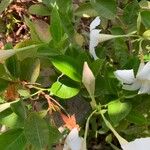
Mandevilla boliviensis
White dipladenia · White mandevilla
Description
Source: leafsnapMandevilla boliviensis is a species of flowering plant in the dogbane family Apocynaceae, native to a region ranging from Costa Rica south to Bolivia and Brazil. Common names include white mandevilla and white dipladenia.A twining woody climber (vine) with glossy oval evergreen perennial leaves, in its natural surroundings Mandevilla boliviensis can grow to 4 m (13 ft) tall, and in more northern places it reaches a height of about 2 m (6.6 ft) and may become deciduous. It has big white flowers with a yellow center which grow in clusters. It flowers from spring until the autumn.It does not tolerate freezing temperatures, though in summer it can be placed outside. It requires a sheltered spot in full sunlight. In cultivation in the United Kingdom, it has gained the Royal Horticultural Society’s Award of Garden Merit. Hybrid ornamental cultivars have been developed, e.g. ‘Cosmos White’.
Care Guide
💧 Water Every 3-5 days
Unlike many flowering plants, the Mandevilla species can tolerate moderate dryness while still blooming. They do, however, require a steady degree of moisture, so keep the soil wet but not waterlogged. Water the plant carefully to let the soil absorb the moisture, then spritz the foliage to deter pests and increase humidity surrounding the plant.
☀️ Light Partial sun
White mandevilla originates from habitats like forest understories or rocky sites, where it grows in natural shade. It prefers partial sun but can tolerate full sun or full shade, showing its adaptable, hardy character.
🌡️ Temperature 20–37.8°C
White mandevilla comes from tropical areas, which are generally warm and humid. As a result, it is adapted to high temperatures and humidity. It is sensitive to sudden temperature shifts and prefers a steady temperature, so avoiding indoor temperature fluctuations is important. It typically cannot tolerate cold and needs higher temperatures to grow. If the ambient temperature falls too low, the plant may stop growing or even die.
💨 Humidity
🪴 Soil 6-7
🌱 Fertilizer
The best time to fertilize a White mandevilla is in early spring, when it breaks dormancy. This encourages overall growth and flower development. Fertilization improves foliage, stems, and branches and promotes flowers that are larger, more vibrant, and longer-lasting. It helps transport nutrients from the roots to the blooms and enhances the plant’s health and resistance to disease.
🪴 Pot & Repot 2-3 years
To keep your white mandevilla healthy, repot it every 2-3 years during the spring. Choose a pot that is 2-3 inches wider than the current one, and make sure it is well-draining to prevent root rot. After repotting, water the plant regularly and provide support for its vines. Position it in a location with bright, indirect light to help it recover and encourage the growth of lush, white blooms.
✂️ Pruning
The white mandevilla is a beautiful plant with glossy leaves and striking trumpet-shaped white flowers. For optimal shape and growth, prune it in early spring by removing any weak stems and overgrown branches. This helps improve air circulation. Be sure to use sterilized tools to prevent infection, and try to avoid heavy pruning while it is in bloom to preserve the quality of the flowers.
🌿 Propagating
🐛 Diseases & pets
☠️ Toxicity
All parts of mandevilla plants are toxic to people and animals when ingested. And sap from the plants can cause skin irritation, as well as allergic reactions in those who are sensitive to mandevilla species.
Characteristics
- Plant Type
- Vine
- Life Cycle
- Perennial
- Genus
- Mandevilla
- Family
- Apocynaceae
- Hardiness Zone
- 10-11
- Mature Height
- 0.91 m to 3.05 m
- Mature Spread
- 91 cm
- Leaf Color
- Green
- Leaf Type
- Semi-evergreen
- Flower Color
- White
- Flower Size
- 5.08 cm to 7.62 cm
- Bloom Time
- All year round
- Planting Time
- Spring, Summer, Autumn
- Harvest Time
- All year round
- Native Area
- Colombia, Bolivia, Venezuela, Peru, Ecuador, Costa Rica