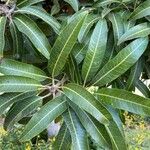
Mangifera indica
مانجو · انبه · آم کا درخت · امب · Mango
Description
Source: leafsnapMangifera indica, commonly known as mango, is a species of flowering plant in the family Anacardiaceae. It is a large fruit tree, capable of growing to a height of 30 metres (100 feet). There are two distinct genetic populations in modern mangoes – the "Indian type" and the "Southeast Asian type".
🌳 Mango is not only known for its tasty fruit; its wood is commonly used to make inexpensive, durable furniture and agricultural tools because it is strong and naturally resistant to termites. Its bark, rich in tannins, is valued in the leather industry for softening and preserving leather. Additionally, mango leaves are used to wrap "tepu" — a fermented fish that flavors many local dishes in Assam — highlighting the tree's wide-ranging uses.
🎭 Fruit born of love
Care Guide
💧 Water
Mango trees, native to tropical regions, thrive in environments with high humidity and regular rainfall. They prefer consistent moisture and should ideally be watered every 1-2 weeks. Typically grown outdoors, mango trees benefit from warm temperatures and seasonal rains, which significantly enhance their growth and fruiting cycles.
When Should I Water My Mango Tree?
Proper and timely watering is vital for the health and development of your mango tree, influencing its growth, fruit production, and disease resistance. To determine when to water, check the soil moisture by inserting your finger 1-2 inches deep into the soil; if it feels dry, it's time to water. Additionally, signs like drooping leaves, yellowing or browning of leaves, reduced growth rate, and flower bud dropping are indicators of water stress. Consider the temperature and weather conditions as they can greatly affect the tree's water needs. Be cautious of early and late watering risks such as root rot and dehydration, respectively.
How Should I Water My Mango Tree?
Mango trees thrive on deep, infrequent watering that mimics their natural tropical environment. Utilize the soak and dry method, allowing the soil to dry out completely between waterings, and water slowly at the base of the tree to ensure deep soil penetration. Using tools like a moisture meter, long hose, or soaker hose can aid in effective watering. Focus on watering the drip line area to promote deep root growth and avoid watering the foliage to reduce the risk of fungal diseases.
How Much Water Does Mango Tree Really Need?
The amount of water a mango tree needs depends on various factors including pot size, root depth, and the tree’s age. Generally, an adult tree may need around 25-40 liters per watering. Signs of proper hydration include healthy, glossy leaves and a vibrant green color, while yellowing leaves or wilted appearance might indicate over-watering or under-watering respectively. To prevent issues, ensure the tree is watered deeply to reach the bottom of the root system and allow the top 2-3 inches of soil to dry out before the next watering. Regular watering schedules are beneficial, especially for potted trees to ensure adequate drainage.
What Kind of Water is Best for Mango Tree?
Mango trees prefer rainwater or filtered water, as they are soft water types free from harmful elements like chlorine and fluoride, to which mango trees are sensitive. Tap water can be used if left to sit for 24 hours to allow chlorine to evaporate. Avoid water with high levels of boron, salt, or heavy metals. Room temperature water is ideal to prevent shock to the roots. If using tap water, consider treatment to reduce chlorine levels and ensure it's at room temperature for irrigation.
How Do Mango Tree's Watering Needs Change with the Seasons?
Watering needs for mango trees change with the seasons. In spring, maintain regular watering as the tree grows new foliage. During summer, increase watering as higher temperatures dry out the soil more quickly. In autumn, reduce watering as growth slows and the soil retains moisture longer. In winter, minimize watering, only doing so when the soil appears dry, since the tree goes into dormancy and water usage decreases significantly. Adjust watering methods according to seasonal changes to meet the tree's needs effectively.
☀️ Light Full sun
Mango naturally favors uninterrupted, continuous sunlight — reflecting its origins in sun-drenched habitats. Unobstructed sun promotes vigorous growth and contributes to lush foliage and productive fruiting. Throughout a mango’s life, steady sun exposure remains important, although limited sun is not necessarily harmful. Too much or too little sun can disrupt its health and fruit-bearing capacity.
What are the sunlight requirements for a Mango tree?
A Mango tree thrives best in full sun, meaning it requires above 6 hours of sunlight per day, but it can also tolerate partial sun, approximately 3-6 hours of sunlight. Adequate sunlight is crucial for robust growth, lush foliage, and fruit productivity, reflecting its origin in sun-drenched habitats. Observing how sunlight moves through your garden can help in choosing spots that provide the perfect balance of light and shade, ensuring the plant's health and happiness.
How important is sun exposure for the health and fruit production of a Mango tree?
Sun exposure plays a pivotal role in the health and fruit production of a Mango tree. From its evolution in areas with abundant sunlight, the Mango tree has developed a preference for continuous, unobstructed sun exposure. Consistent exposure to sufficient sunlight is essential for supporting robust growth along with lush foliage and fruit production. While the tree can endure limited sun, both an excess and a deficiency in sunlight can affect its health and fruit-bearing capabilities adversely.
What solutions are available for Mango trees with insufficient sunlight?
To counter insufficient sunlight for indoor Mango trees, progressively relocate plants to sunnier spots, aiming for at least 6 hours of direct sunlight daily. Utilize a south-facing window and keep curtains open during daylight. If the plant is large or immobile, consider using artificial lighting, maintaining it for at least 8 hours daily. For outdoor trees, gently transition them to brighter areas to prevent sunburn. Address obstructions in ground-planted trees by pruning or transplanting for better sun exposure. Although damaged parts may not recover, new growth should flourish under improved light conditions.
What artificial lighting solutions can support Mango tree growth indoors?
For indoor Mango trees, artificial lighting is a viable solution when natural sunlight is insufficient. Using the right type of light, such as LED lights that offer customizable wavelengths, is beneficial. Full sun plants require 30-50W/sq ft, partial sun plants 20-30W/sq ft, and full shade plants 10-20W/sq ft of artificial light. Position the light source 12-36 inches above the plant, mimicking natural sunlight duration, typically 8-12 hours per day, to promote healthier, faster growth.
What symptoms indicate insufficient sunlight for Mango trees?
Symptoms of insufficient sunlight in Mango trees include smaller new leaves, leggy or sparse growth, accelerated leaf drop, delayed or halted growth, pallid new leaves, and conditions such as chlorosis, sunscald, leaf curling, wilting, and leaf scorching. These symptoms highlight the plant's struggle in low-light conditions, affecting its health, growth, and capacity for photosynthesis. Adjusting the plant's exposure to sunlight or utilizing artificial lights can mitigate these issues.
🌡️ Temperature 20–37.8°C
Regarding temperature, mango grows best in climates from 68℉ to 100℉ (20℃ to 38℃). Native to tropical areas, it prefers consistently warm conditions. It can, however, withstand short-lived drops to 40℉ (5℃), but only for brief periods.
What is the ideal temperature range for a mango tree?
Mango trees thrive in warm climates, with ideal temperature ranges between 68°F (20°C) and 100°F (38°C). These trees are native to tropical regions and prefer consistently warm temperatures. Short periods of exposure to temperatures as low as 40°F (5°C) can be tolerated, but such conditions should not be prolonged. During cold seasons, especially in autumn, it's advisable to move outdoor-grown mango trees indoors, near a bright window, yet kept away from direct heat sources such as heaters to ensure the temperature stays above the minimum suitable growth temperature.
How does low temperature affect mango trees and how can you protect them?
Mango trees are not tolerant of low temperatures and exhibit optimal growth when the temperature remains above a certain minimum suitable level. Exposure to temperatures below the limit growth temperature can lead to the leaves lightening in color or turning brown or black after frost damage, eventually leading to wilting and drooping. To protect mango trees from low temperatures, it's crucial to trim off frost-damaged parts and move the tree to a warm indoor environment away from cold drafts. Placing the tree near a south-facing window ensures it gets enough sunlight, while avoiding close proximity to heaters or air conditioning vents helps maintain humidity levels around the plant.
What should be done if a mango tree experiences high temperatures?
Mango trees should ideally be kept below a specific maximum suitable growth temperature during the summer. Exceeding the tolerable growing temperature can cause the leaves to lighten in color and increase susceptibility to sunburn. To mitigate high temperature effects, it's important to trim away sunburned and dried parts of the plant. Moving the mango tree to a shaded location, particularly away from the harsh midday and afternoon sun, can help. Additionally, watering the plant in the morning and evening helps keep the soil adequately moist, reducing stress from high temperatures.
💨 Humidity high (>60%)
This plant needs special care because it loves high humidity levels of 60-80% or more. The best way to achieve this is by placing a humidifier near the plant. Daily misting is also essential! Make sure the room has good ventilation.
🪴 Soil 5-7
🌱 Fertilizer
Use organic fertilizers (e.g., fish emulsion, compost) rather than chemical fertilizers for mango. Provide higher amounts of nitrogen and phosphorus to young plants in spring. Incorporate compost or fertilizer before or after planting. For mature plants, supplement with a balanced fertilizer or one specific to any deficiencies in spring. Nutrient deficiency causes small leaves, short branches, yellow/bronze leaves, acidic fruits, premature fruit fall, and splitting.
Why should I put fertilizer on my Mango tree?
If the soil in your area is rich, you may not need to fertilize. However, if the soil lacks nutrients, a Mango tree won't produce enough leaves, flowers, and fruits. Conduct a soil test to determine which nutrients are abundant and which are lacking. Nutrient deficiency in Mango trees can lead to small leaves and short branches, yellow or bronze leaves, and less tasty fruits due to increased acidity. Certain nutrient deficiencies may even cause fruits to fall prematurely or split.
What is the right time to give my Mango tree fertilizers?
To support the strong growth of young Mango trees, it is recommended to provide them with higher nitrogen and phosphorus fertilizer. Spring is the best time to apply fertilizer during the first growing season. Before or immediately after planting, it is advisable to incorporate compost or another fertilizer into the soil. For mature Mango trees, it is beneficial to supplement with a balanced fertilizer or one that targets specific soil deficiencies in your area, every few years as needed during the spring and summer. However, it is important to avoid fertilizing Mango trees in the autumn or winter.
When is it not a good idea to give my Mango tree fertilizer?
To ensure the health of your Mango tree, it's important to avoid fertilizing it after pruning, when it's dealing with disease or insects, or when it's under stress. Fertilizer should only be used to address nutrient deficiencies in the soil and cannot solve other problems that may affect your Mango tree. It's best to accurately diagnose any issues before applying fertilizer, as the problem could be caused by something else entirely. Additionally, refrain from fertilizing your Mango tree during the winter or during periods of intense heat and dryness in the summer.
What kind of fertilizer does my Mango tree need?
Mango trees thrive in tropical areas with abundant organic matter. They can benefit from fertilizer to meet their nutrient needs. For fruitful growth, a high-phosphorus organic fertilizer like mushroom compost, bone meal, or poultry manure can result in delicious and well-formed fruits. When buying fertilizer, check the label for the NPK ratio, which represents nitrogen, phosphorus, and potassium. Nitrogen deficiency is often found in soil, but a soil test can identify any lacking nutrients and guide you in supplementing them.
How should I make my Mango tree grow better?
To ensure proper fertilization, follow the instructions provided on the fertilizer packaging. It is better to use too little fertilizer than too much, so it is advised to be cautious when adding fertilizers. This is particularly important for chemical fertilizers, as they tend to be more concentrated compared to organic fertilizers. For liquid fertilizers, dilute them with water and use the mixture to water the Mango tree. On the other hand, granular or dry fertilizers should be spread around the base of the plant, taking care to avoid direct contact with any part of the plant. It is recommended to use fertilizers once every 2-3 weeks during the growing season. When using organic fertilizers, they can either be mixed into the soil before planting or spread over the top layer of soil for newly-planted or mature plants.
🪴 Pot & Repot 2-3 years
When repotting Mango, select a container 1-2 inches (2.5–5.1 cm) bigger that provides good drainage. Use a well-draining potting mix. Repot in spring or fall, making sure the root ball sits just below the rim of the flower pot. Water thoroughly after repotting and keep it in a warm spot with indirect sunlight.
✂️ Pruning
To improve fruit production and maintain the health of a mango tree, it is essential to prune it annually. Key pruning techniques include removing dead branches, thinning out overcrowded areas, and ensuring the canopy is open for proper air circulation. The best time to prune mango trees is between early and late spring. Remember to always sterilize your tools to prevent the spread of infection.
🌿 Propagating
🐛 Diseases & pets
☠️ Toxicity
Mango trees are non-toxic to pets. However, their sap, bark, leaves, and fruit skins contain an allergen or irritant that can cause dermatitis in humans. Burning the wood or leaves of mangoes will severely irritate the eyes and lungs. The ripe mango fruit is safe to eat for people and pets so long as the pit and skin are removed.
Characteristics
- Plant Type
- Tree
- Life Cycle
- Perennial
- Genus
- Mangifera
- Family
- Anacardiaceae
- Hardiness Zone
- 10-12
- Mature Height
- 10.06 m to 20.12 m
- Mature Spread
- 5.49 m
- Leaf Color
- Green
- Leaf Type
- Evergreen
- Flower Color
- Yellow
- Flower Size
- 0.15 cm
- Bloom Time
- Late spring, Early summer
- Planting Time
- Spring, Autumn
- Harvest Time
- Mid summer, Late summer
- Native Area
- Nepal, Sri Lanka, India, Malaysia, Indonesia, Cambodia, Vietnam, Myanmar, Philippines, Bhutan, Bangladesh, Laos, Thailand, China