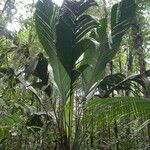
Manicaria saccifera
Sea Coconut
Description
Source: leafsnapManicaria saccifera, commonly referred to as the "giant water tank bromeliad," is a substantial tropical plant native to the Amazon basin in South America. This species belongs to the Bromeliaceae family and can grow up to 15 meters tall, with leaves extending up to 5 meters in length. One of the plant's most remarkable features is its large, water-holding rosette, capable of storing up to 1,000 liters of water. This adaptation allows it to thrive in areas with low rainfall and provides a habitat for various aquatic organisms, including fish and insects. Manicaria saccifera holds cultural significance for indigenous communities, who utilize its leaves for weaving baskets and other crafts. Additionally, some indigenous groups traditionally consume the plant's fruit as food. Despite its ecological and cultural importance, Manicaria saccifera is threatened by deforestation and habitat loss due to human activities such as logging and agriculture. In summary, Manicaria saccifera is an impressive plant with unique adaptations that play a critical role in Amazonian ecosystems while also holding cultural value for local communities.
Care Guide
💧 Water Every 7 days
The Troolie palm thrives in moist and humid conditions, but it can also endure short periods of dryness. To maintain its lush foliage, it requires moderate watering every 2 to 3 weeks. As an evergreen plant, the Troolie palm needs consistently moist soil to ensure continual growth and vitality all year round.
☀️ Light Full sun
The troolie palm flourishes with abundant sunlight, obtaining most of its nourishment from the sun's rays. It can, however, tolerate reduced light and accept some shade. The condition of its roots in very sunny locations indicates this preference. Excessive shading may impede its growth, while too much sunlight can also cause damage.
What are the sunlight requirements for a Troolie Palm?
The Troolie Palm thrives best in conditions where it can receive plentiful sunlight, typically thriving under full sun exposure (above 6 hours of sunlight) to partial sun (about 3-6 hours of sunlight). However, it's important to monitor your garden's sun exposure patterns closely to choose spots that offer the right balance of light and shade, ensuring your Troolie Palm's growth and happiness.
How does artificial lighting support Troolie Palm growth indoors?
When natural sunlight is insufficient, especially during winter or in less sunny indoor spaces, artificial lighting becomes crucial for the Troolie Palm's growth. Adequate lighting promotes faster, healthier growth. LED lights are a popular choice because they can be customized to provide specific wavelengths needed by plants. Full sun plants need 30-50W/sq ft, partial sun plants need 20-30W/sq ft, and full shade plants need 10-20W/sq ft of artificial light. The light should be placed 12-36 inches above the plant, simulating natural sunlight conditions for 8-12 hours per day.
What are common symptoms of light deficiency in Troolie Palms?
Troolie Palms displaying light deficiency symptoms may exhibit smaller new leaves, leggy or sparse growth, faster leaf drop, slower or halted new growth, lighter-colored or yellow new leaves (chlorosis), damage from intense sunlight exposure such as sunscald, leaf curling, wilting, and leaf scorching. These symptoms indicate the plant's struggle with either too little or too much light.
What solutions exist for Troolie Palms experiencing light deficiencies?
For Troolie Palms lacking sufficient light, gradually moving them to sunnier locations can help, aiming for at least 6 hours of direct sunlight daily. Indoors, using artificial lights like desk or ceiling lamps, or investing in professional plant grow lights for at least 8 hours daily can provide necessary light. Outdoors, ensuring plants are gradually acclimated to sunnier spots can prevent sunburn. If physical obstructions block sunlight, consider pruning or transplanting to better-lit areas. Remember, although parts of the plant affected by insufficient light may not recover, new growth post-adjustment should be healthy.
🌡️ Temperature 20–37.8°C
The Troolie palm grows best in warm conditions, with temperatures ranging from 68 to 100 °F (20 to 38 °C). Native to those environments, it favors somewhat higher temperatures. Depending on the regional climate, seasonal temperature adjustments may be necessary.
What are the ideal growing conditions for Troolie palm?
The Troolie palm, or Manicaria saccifera, thrives in warm environments with temperatures ranging between 68 to 100°F (20 to 38°C). These conditions naturally favor the Troolie palm, highlighting its preference for slightly higher temperatures. Given its heat-loving nature, the Troolie palm suffers harm from cold temperatures. To ensure its health, during autumn, it's advised to bring any outdoor Troolie palms indoors, placing them near a bright window but away from direct heat sources like heaters. Over the winter, maintaining temperatures above 20°C is beneficial for the plant's growth, while temperatures nearing 10°C can be detrimental.
How do you care for a Troolie palm during low temperature or frost?
To care for a Troolie palm during low temperatures or frost, it's crucial to keep the temperature above 20°C and definitely above 10°C, as the palm prefers warmth. Should temperatures fall below 5°C, the leaves may lighten in color, and frost damage may cause the leaves to turn brown or black and exhibit wilting or drooping. If frost damage occurs, trim off the damaged parts and immediately move the plant indoors to a warm environment to prevent further cold damage. Positioning the palm near a south-facing window can ensure ample sunlight, but it's also important to avoid placing it near heaters or air conditioning vents to prevent the air around it from becoming excessively dry.
What should you do if your Troolie palm experiences high temperature?
For a Troolie palm experiencing high temperatures, especially during summer when temperatures should ideally be kept below 38°C, immediate care is necessary when temperatures exceed 43°C as the plant's leaves may lighten and become more susceptible to sunburn. In such cases, trim away the sunburned and dry parts of the plant. Relocate the palm to a spot where it can enjoy shade during the midday and afternoon sun, possibly a location that avoids the direct, intense sunlight of those hours. Additionally, watering the plant in the morning and evening will help keep the soil sufficiently moist, aiding in cooling and maintaining the plant's health during hot periods.
💨 Humidity
🪴 Soil 6-7
🌱 Fertilizer
Fertilization is essential for the care of the Troolie palm. Regular feeding during the growing season keeps up the energy needed for its showy leaves and supports overall growth. Neglecting fertilization can lead to unhealthy leaves, reduced ornamental appeal, and stunted or weak growth that is more prone to breakage.
🪴 Pot & Repot
✂️ Pruning
To help your Troolie palm thrive, perform early spring pruning by removing dead fronds to stimulate growth. When pruning, cut close to the trunk but be careful not to damage the tissue. It's best to prune outside the rainy season to prevent the growth of fungi. Always use sharp tools to maintain the plant's health and improve ventilation, which helps reduce pest habitats.
🌿 Propagating
🐛 Diseases & pets
☠️ Toxicity
Characteristics
- Plant Type
- Tree
- Life Cycle
- Perennial
- Genus
- Manicaria
- Family
- Arecaceae
- Hardiness Zone
- 11-12
- Mature Height
- 10.06 m
- Mature Spread
- 10.06 m
- Leaf Color
- Dark Green
- Leaf Type
- Evergreen
- Flower Color
- White
- Flower Size
- 2.03 cm to 3.05 cm
- Bloom Time
- All year round
- Planting Time
- Spring, Summer, Autumn
- Harvest Time
- All year round
- Native Area
- Colombia, Belize, Honduras, Guatemala, Venezuela, Peru, Guyana, Brazil, Nicaragua, Costa Rica, Panama