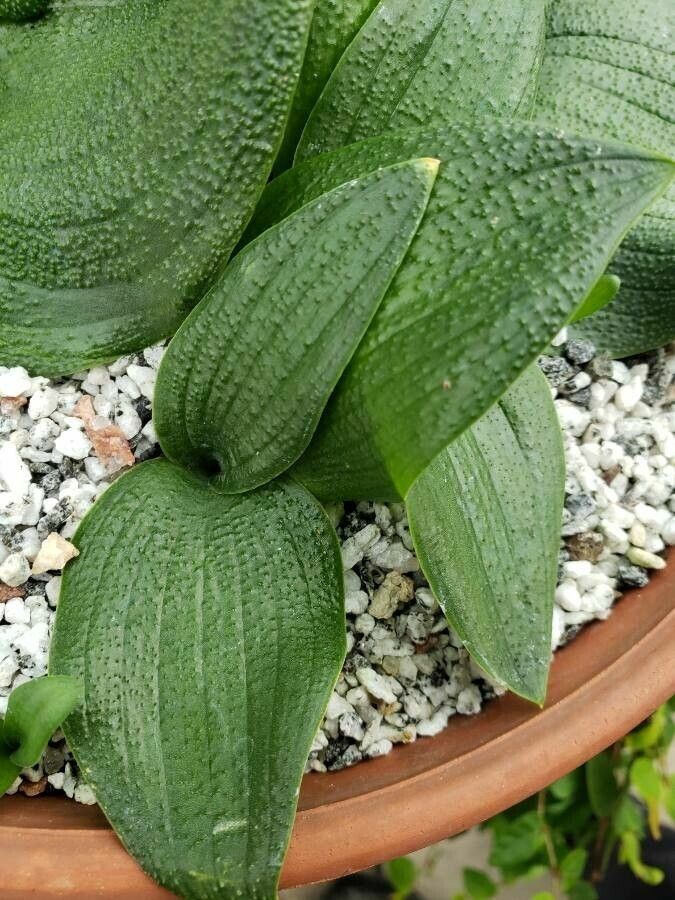
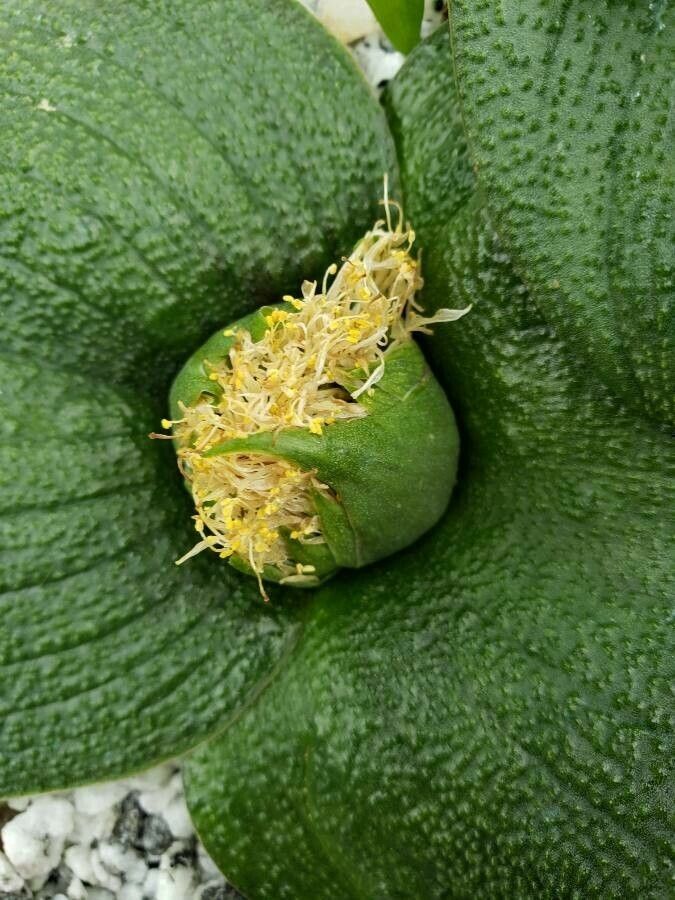
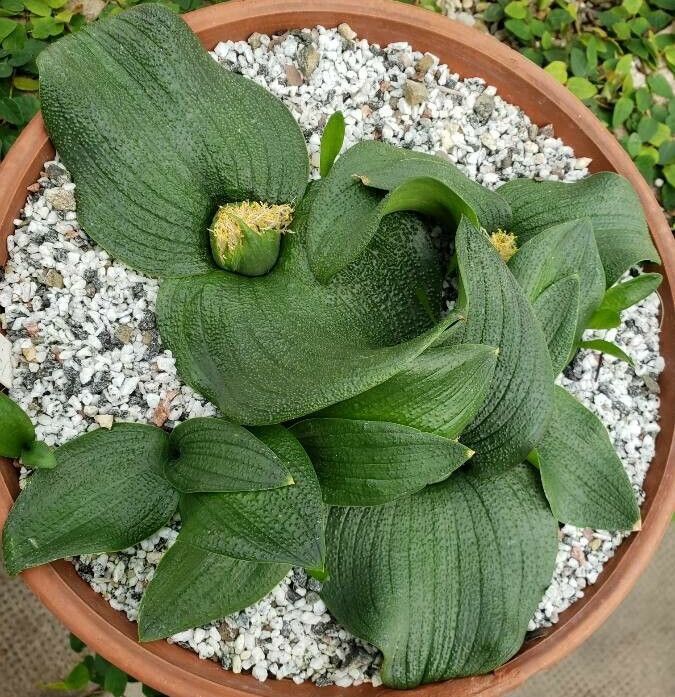
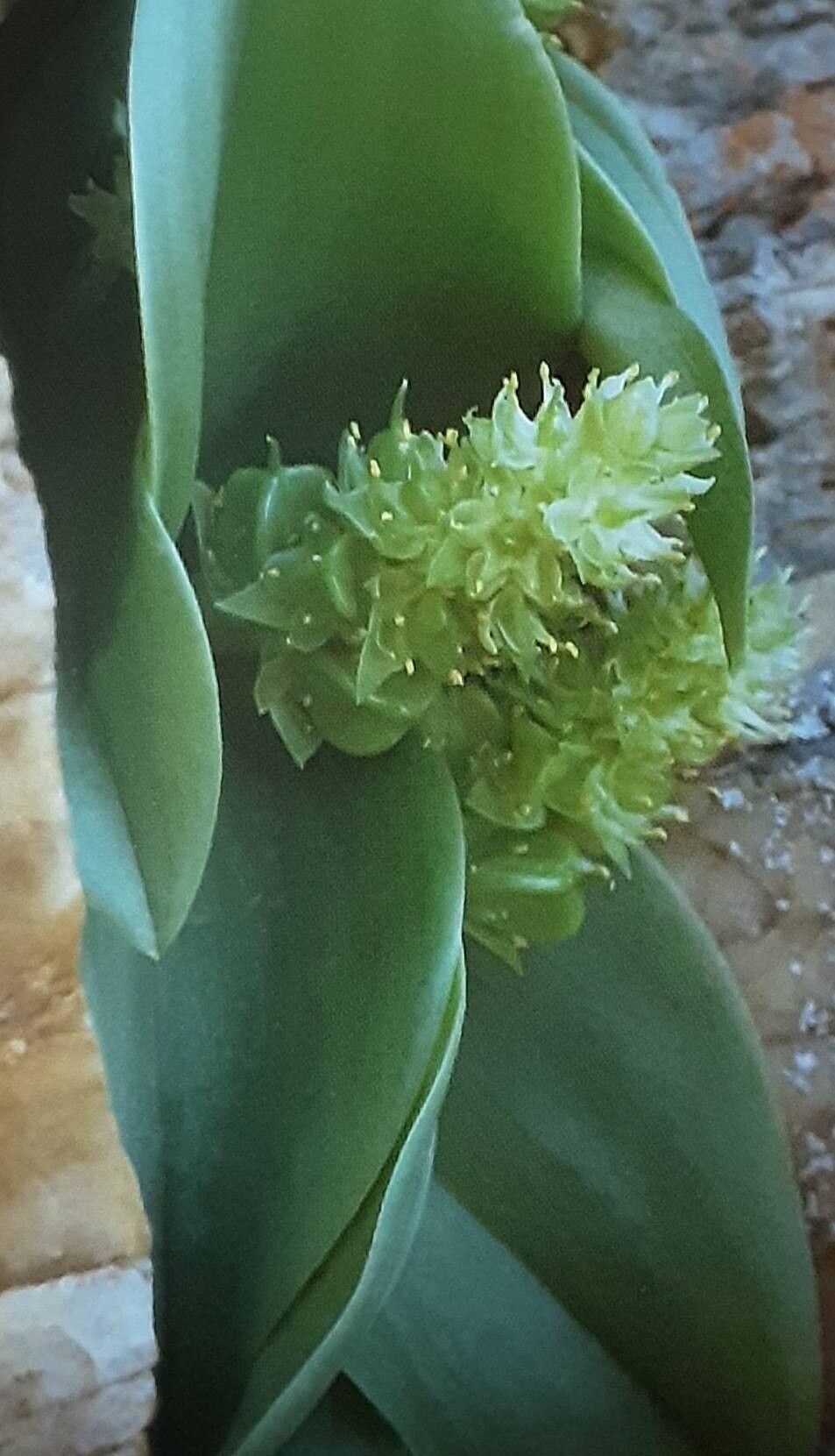
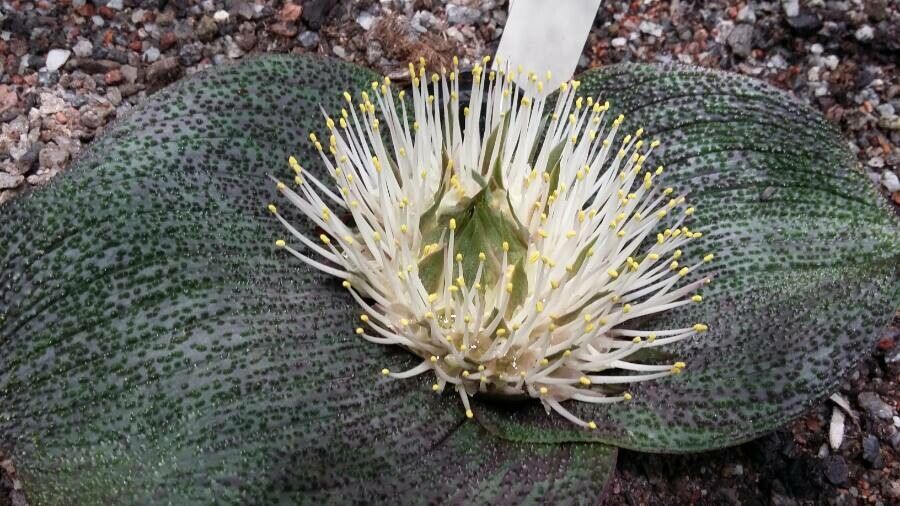
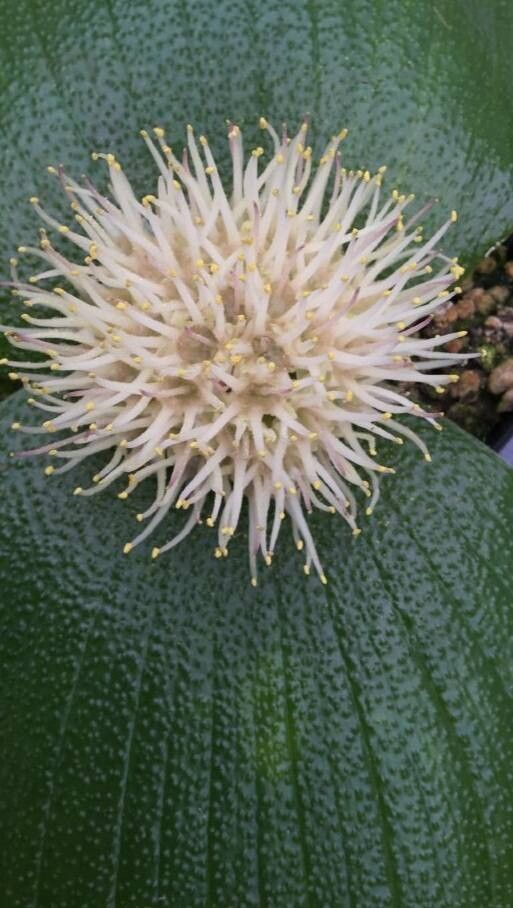
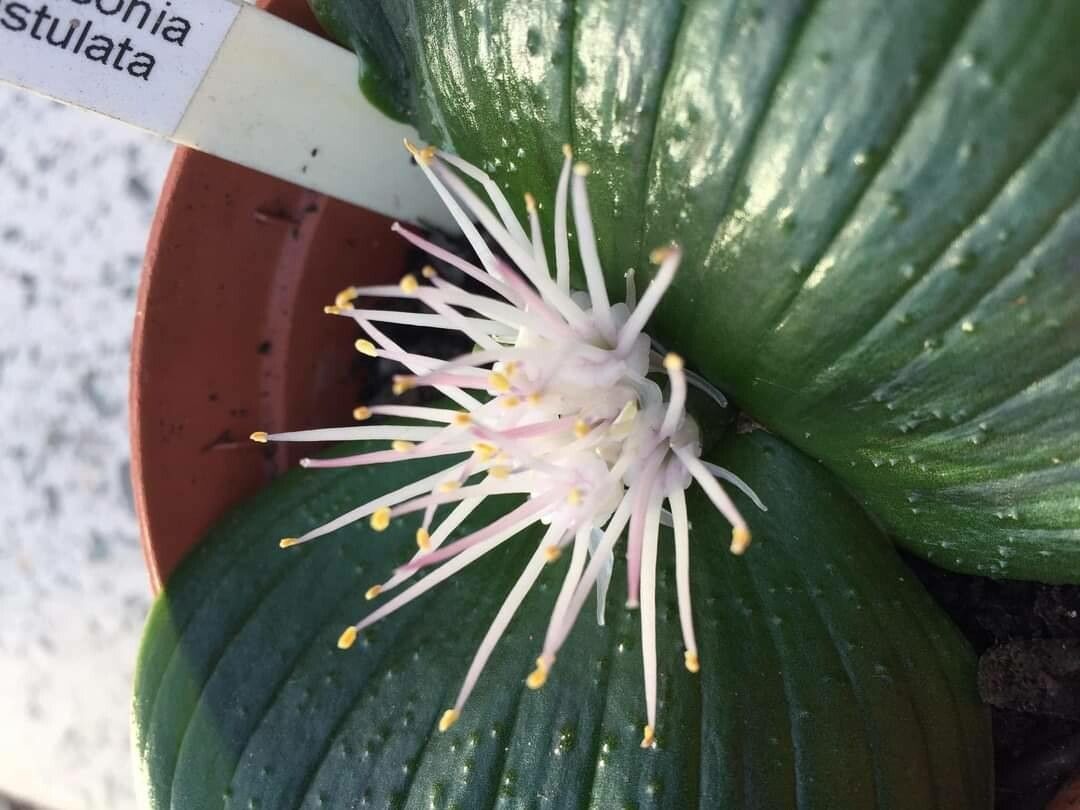
Massonia depressa, the hedgehog lily, is a species of flowering plant in the family Asparagaceae, that is native to South Africa. Growing to 10 cm (3.9 in) tall by 50 cm (20 in) broad, it is a bulbous perennial with two opposite leaves lying flat on the ground. A spiky cluster of white, yellow or brown flowers appears at the centre of the plant in winter. The flowers are uniquely scented like yeast, to attract pollination by gerbils and other rodents. The anther is exceptionally long - up to 2mm. The seed capsules are inflated, enabling them to be wind-borne. This species has been observed to be variable in the wild, and numerous attempts have been made to resolve its true relationships within the genus Massonia, so far without success.The Latin specific epithet depressa means “having a flattened appearance”, a feature common to all in this genus.When cultivated in a temperate environment, M. depressa does not tolerate freezing temperatures, so must be grown under glass in a cold greenhouse or similar. It requires full sun, and dry conditions during the dormant season (starting in spring). It has been given the Royal Horticultural Society’s Award of Garden Merit.
Hedgehog lily is fairly disease-resistant and typically does not suffer from illnesses. That said, it can be vulnerable to pests and diseases present in its environment, though such infections are generally mild. In terms of care, this plant requires moderate maintenance. Regular pruning is needed to keep a neat appearance and promote healthy growth. Fertilizing can also help encourage flowering. Hedgehog lily is suitable for anyone with outdoor space, such as a garden or patio, and does not demand much prior gardening experience. It may need more attention when cultivated indoors.
How to keep Massonia Depressa.
Light
The hedgehog lily originates from habitats like woodland undergrowth or stony regions, where it is naturally shaded. This plant favors semi-sunlight conditions but has the resilience and adaptability to survive in either total sunlight or complete shade, showing its robust and flexible characteristics.
Water
The Hedgehog lily thrives in arid climates due to its excellent drought tolerance, needing water only once every three weeks. It is best suited for outdoor growth, allowing it to take advantage of rainwater during its active growth phase while keeping water levels balanced.
Temperature
The Hedgehog lily is a plant that hails from tropic areas characterized by warm and moist climates. Consequently, it has acclimated to deal effectively with situations of high humidity and temperatures. This plant does not favor abrupt alterations in temperature and is inclined towards a consistently steady thermal setting. Thus, it is crucial to prevent indoor temperature changes. It generally does not thrive in cold conditions and necessitates elevated temperatures for its growth. If the surrounding temperature plunges too much, this may halt the plant's growth or result in its demise.
Fertilizer
It's essential to correctly fertilize the Hedgehog lily for its health and looks. Administer fertilizer to the Hedgehog lily in the summer, and continue this process on a monthly basis throughout this season. Nutrients help facilitate growth and upkeep the different parts of the plant. The act of fertilization improves the Hedgehog lily's showcase of flowers, guaranteeing the most impressive blossoms.
Pruning
The Hedgehog lily flourishes with minimal pruning. Concentrate on removing dead leaves from early to late spring and cutting off old flower stalks after they have bloomed. Avoid heavy pruning, as it can cause stress to the plant. Instead, regular light trimming encourages growth and vitality, helping the plant maintain a healthy and vibrant appearance.
Pot & Repot
Repot the hedgehog lily every 2 to 3 years, ideally in early spring. Choose a wider container to accommodate its leaves and ensure it has good drainage. After repotting, keep the soil moist and place the plant in bright, indirect light. This will help the hedgehog lily acclimate and thrive.
Botanical profile.
- Plant Type
- Herb
- Life Cycle
- Perennial
- Genus
- Massonia
- Family
- Asparagaceae
- Hardiness Zone
- 9-11
- Mature Height
- 5 cm to 10 cm
- Mature Spread
- 10 cm to 20 cm
- Leaf Color
- Green
- Leaf Type
- Deciduous
- Flower Color
- White
- Flower Size
- 2.03 cm to 3.05 cm
- Bloom Time
- Mid winter, Late winter
- Planting Time
- Autumn
- Harvest Time
- Early spring, Mid spring
- Native Area
- South Africa
Other names.