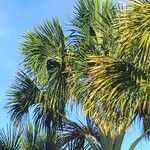
Mauritia flexuosa
Muriti · Tree-of-life · Buriti palm
Description
Source: leafsnapMauritia flexuosa, commonly known as the Moriche palm or the Buriti palm, is a species of palm tree native to South America. It thrives in tropical regions of Brazil, Colombia, Venezuela, Peru, and Bolivia. This tree can grow up to 35 meters tall and boasts a trunk diameter of up to 50 centimeters. The Moriche palm is renowned for its various uses in traditional medicine and local cuisine. Its fruit is rich in vitamins A and C, as well as antioxidants. The fruit can be eaten raw or used to make juice or jam. The leaves are employed for thatching roofs, while the trunk yields wood for construction. The oil extracted from the fruit is also highly valued for its cosmetic properties, owing to its high vitamin E content and essential fatty acids that help moisturize the skin. Beyond its practical applications, Mauritia flexuosa holds significant cultural importance. Many indigenous communities regard it as a sacred plant with spiritual significance. Despite being a crucial resource for local communities, Mauritia flexuosa faces threats from deforestation due to logging activities. These threats have led to its classification as vulnerable by the International Union for Conservation of Nature (IUCN). Conservation efforts are currently underway to protect this valuable plant species from further decline.
Care Guide
💧 Water Every 7 days
The Tree-of-Life flourishes in high humidity and benefits from occasional abundant watering, needing moderate watering every 2-3 weeks. Although it prefers steady moisture, it can withstand short periods of drought. To maintain its lush foliage and structural integrity, it's important to provide sufficient water during the growing season.
How should I water my Tree-of-life so it grows well?
Your Tree-of-life is not particular about how you water it. You can use any common watering tool, such as watering cans, hoses, or even cups. Regardless of the tool you choose, it is recommended to directly water the soil. Make sure to evenly moisten all areas of the soil to provide adequate water to the entire root system. Using filtered water is beneficial as tap water may contain harmful particles. Additionally, it is best to use water that is at or slightly above room temperature, as extreme temperatures can be shocking to the Tree-of-life. However, the plant typically responds well to any type of water you give it.
What should I do if I give my Tree-of-life plant too much or too little water?
Outdoor plants, especially newly planted ones or seedlings, are often susceptible to lack of watering. It is important to ensure adequate watering for a few months while the tree is small or recently planted. Once the roots are established, the Tree-of-life can usually rely on rain for most of its water supply. When the Tree-of-life is planted in pots, overwatering can be a common issue. If you accidentally overwater your plant, it is important to take immediate action to address the problem. First, stop watering the plant right away to minimize the impact of overwatering. Then, consider removing the Tree-of-life from its pot to inspect the roots. If there are no signs of root rot, you can return the plant to its container. However, if root rot is present, trim any affected roots and apply a fungicide to prevent further damage. Finally, repot the Tree-of-life in well-draining soil. In the case of underwatering, simply water the Tree-of-life more frequently. Underwatering is often easy to fix as the plant's leaves will droop, dry out, and fall off. After sufficient watering, the leaves will quickly regain their fullness. It is important to adjust your watering frequency as soon as you notice signs of underwatering.
How often do I need to water my Tree-of-life?
Most plants grow naturally outdoors with rainfall. If your area lacks rainfall, water your plants every 2 weeks in spring and fall, more frequently in summer, and less in winter. You may not need to water at all during winter. Young or newly planted Tree-of-life plants need more frequent watering to establish themselves. For potted plants, you can set a predetermined watering schedule, but it may not always work for your specific plant. Consider adjusting watering frequency based on soil moisture, waiting for the top few inches of soil to dry out before watering again.
How much water does my Tree-of-life require?
When watering your Tree-of-life, it's important to note that it doesn't always require a lot of water. If only a few inches of soil have dried since the last watering, giving it about five to ten ounces of water will promote healthy growth. You can also gauge the water volume based on the moisture of the soil. Pay attention to how many inches of soil have dried out between waterings. To ensure the Tree-of-life gets enough moisture, water until all the dry soil layers have been moistened since the previous watering. If more than half of the soil is dry, it's advisable to provide more water than usual. In such cases, continue watering until you see excess water draining from the pot's drainage holes. If your Tree-of-life is planted in an area that receives sufficient rain outdoors, additional watering might not be necessary. For young or newly established trees, ensure they receive 1-2 inches of rain per week. As the tree grows and becomes established, it can rely solely on rainwater, except during hot weather with no rainfall for 2-3 weeks. In those instances, giving the Tree-of-life a thorough watering will help prevent stress.
How do I know if I'm watering my Tree-of-life enough?
Tree-of-life plants commonly suffer from overwatering, which can be identified through yellowing leaves and leaf loss. Overwatering can also cause the plant's structure to shrink and can lead to root rot. Conversely, an underwatered Tree-of-life will start to wilt and may have brown or brittle leaves. In either case, it is important to take action and restore the plant's health.
☀️ Light Full sun
Tree-of-life prefers moderate light. It does well when not exposed to direct, intense sun, but it also does not do well in complete shade. In its native ecotype it receives mottled sunlight that passes through layers of canopy. Excessive or insufficient light can limit its growth or reduce its vigor.
What are the sunlight requirements for the Tree-of-life?
The Tree-of-life (Mauritia flexuosa) thrives in intermediary light exposure, requiring about 3-6 hours of sunlight daily. It prefers conditions where it's not in full direct sunlight but also not in complete shade. Its ideal environment mimics its native habitat, where dappled rays filter through canopy layers. There's a warning to observe how sunlight moves through your garden, suggesting a need for balance to ensure plant well-being. For indoor plants, where natural sunlight might be insufficient, especially during winter or in less sunny spaces, artificial lighting can be a substantial aid. LED lights are recommended due to their ability to provide specific wavelengths needed for optimal plant growth. The amount of artificial light required varies depending on the plant's natural light needs, with recommendations including 30-50W/sq ft for full sun plants, 20-30W/sq ft for partial sun plants, and 10-20W/sq ft for full shade plants.
What are the common symptoms of inadequate or excessive sunlight in the Tree-of-life?
The Tree-of-life may exhibit several symptoms in response to inadequate or excessive sunlight. Insufficient light may lead to smaller new leaves, leggy or sparse growth, faster leaf drop, reduced or halted growth, and lighter-colored or irregularly patterned new leaves, indicating a lack of chlorophyll and essential nutrients. Excessive sunlight can cause chlorosis (yellowing of leaves), sunscald (damage manifested as pale or bleached areas on the plant), leaf curling (as a defense mechanism to minimize surface area exposed to sunlight), wilting (loss of turgor pressure), and leaf scorching (brown, dry, crispy edges or patches on leaves). These conditions reflect the plant's struggle to adapt to its lighting environment, either conserving resources under low light or managing damage under intense light.
How can I address and improve conditions for a Tree-of-life with inadequate or excessive sunlight exposure?
Improving conditions for the Tree-of-life with challenges related to light exposure involves several strategies. For indoor plants, gradually shifting them to sunnier spots each week until they achieve 3-6 hours of direct sunlight can help them adapt. If the plant is large or not easily movable, supplementing with artificial light such as a desk or ceiling lamp for at least 8 hours daily, or professional grow lights, is recommended. For outdoor plants, it's crucial to move them gradually to more suitable spots to prevent sunburn, making slight adjustments weekly. Reducing obstructions that block sunlight, like pruning branches or leaves from trees, can help. Additionally, transplanting smaller plants during their dormant period to a location with better sunlight and drainage offers a long-term solution. Note that parts of the plant already affected by insufficient light might not recover, but new growth should be healthy with improved light exposure.
🌡️ Temperature 20–37.8°C
Tree-of-life is native to warm climates and prefers temperatures of 68 to 100 °F (20 to 38 ℃). In colder seasons, make sure the temperature does not fall below that preferred range. Raising indoor warmth may be helpful.
What is the best temperature range for the Tree-of-life?
The Tree-of-life thrives in warm climates, preferring temperatures between 68 to 100 °F (20 to 38 °C). It's important to ensure the temperature does not drop below this preference, especially during colder seasons. To support its growth, keeping the indoor warmth above 20°C during winter is beneficial, while ensuring temperatures do not approach 10°C as this can be detrimental to the plant.
How should I care for my Tree-of-life during the autumn and winter?
In the autumn, it is recommended to bring outdoor-grown Tree-of-life plants indoors to protect them from the cold. Place them near a bright window to ensure they get enough light, but keep them at a certain distance from heaters to avoid excessive dryness. During winter, maintaining temperatures above 20°C is crucial for the plant's growth.
What are the symptoms of low temperature exposure in Tree-of-life plants, and how can I remedy it?
Exposure to low temperatures can lead to the leaves of the Tree-of-life lightening in color. When temperatures fall below 5°C, leaves may turn brown or black after frost damage, accompanied by wilting and drooping. To remedy this, trim off the frost-damaged parts and move the plant indoors to a warmer environment, near a south-facing window for ample sunlight. It's also important to avoid placing the plant near heaters or air conditioning vents.
How does high temperature affect Tree-of-life plants, and what solutions are available?
During summer, it's important to keep the Tree-of-life below 38°C. Temperatures above 43°C can cause the leaves to lighten and increase the plant's susceptibility to sunburn. In such cases, trim away the sunburned and dried-up parts and move the plant to a shaded location, particularly from the midday and afternoon sun. Water the plant in the morning and evening to maintain soil moisture.
What is the botanical name of the Tree-of-life?
The botanical name of the Tree-of-life is Mauritia flexuosa.
💨 Humidity
🪴 Soil 5-7
🌱 Fertilizer
Use organic fertilizers (e.g., fish emulsion, compost) rather than chemical ones for Tree-of-life. Give young plants higher nitrogen and phosphorus in spring. Incorporate compost or fertilizer before or after planting. For mature plants, apply a balanced fertilizer or one aimed at specific deficiencies in spring. Nutrient deficiency produces small leaves, short branches, yellow or bronze leaves, acidic fruits, premature fruit fall, and splitting.
🪴 Pot & Repot
✂️ Pruning
Pruning tree-of-life trees annually in early spring is essential for promoting healthy growth. Removing dead foliage prevents disease and improves airflow. This process not only enhances the tree's appearance but also supports strong regeneration as the plant enters its active growth phase.
🌿 Propagating
🐛 Diseases & pets
☠️ Toxicity
Characteristics
- Plant Type
- Tree
- Life Cycle
- Perennial
- Genus
- Mauritia
- Family
- Arecaceae
- Hardiness Zone
- 11-12
- Mature Height
- 35.05 m
- Mature Spread
- 7.92 m to 11.89 m
- Leaf Color
- Dark Green
- Leaf Type
- Evergreen
- Flower Color
- Yellow
- Flower Size
- 1.02 cm to 2.03 cm
- Bloom Time
- All year round
- Planting Time
- Spring, Autumn, Winter
- Harvest Time
- All year round
- Native Area
- Colombia, Bolivia, Venezuela, Peru, Guyana, Brazil, Ecuador