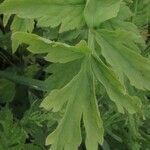
Meconopsis cambrica
Welsh Poppy · Welch Poppy
Description
Source: leafsnapMeconopsis cambrica, commonly known as the Welsh poppy, is a herbaceous perennial plant that belongs to the Papaveraceae family. Native to the United Kingdom and Ireland, it thrives in damp woodland areas, along riverbanks, and in meadows. The plant typically reaches a height of up to 60 cm, with a spread of around 30 cm. The leaves of Meconopsis cambrica are lobed and hairy, exhibiting a bluish-green hue. The flowers, which can be bright yellow or orange, feature four petals that form a cup-shaped bloom up to 5 cm wide. These vibrant flowers bloom from late spring through summer. Meconopsis cambrica is an easy-to-grow plant that prefers moist soil in partial shade but can also tolerate full sun as long as the soil remains moist. It can be propagated by seeds or by dividing clumps in autumn or spring. The Welsh poppy has been used for medicinal purposes for centuries due to its alkaloid content, which possesses pain-relieving properties. However, it should not be consumed without medical supervision, as ingestion in large quantities may be toxic to humans. Overall, Meconopsis cambrica is an attractive garden plant that adds color and interest to any landscape design, while also boasting a history of medicinal use.
Care Guide
💧 Water Every 7 days
☀️ Light Partial sun
Reflecting the conditions of its native habitat, the Welsh poppy requires moderate sunlight to maintain healthy growth. Excessive sun exposure can cause wilting, while insufficient light may prevent flowering and impede overall development. At every stage of growth the plant consistently needs and thrives in ambient light conditions rather than harsh sunlight.
🌡️ Temperature 0–35°C
Welsh poppy originates from habitats where temperatures range from 32 to 95 °F (0 to 35 ℃). It handles these conditions naturally, but if grown in areas outside this preferred temperature range it may need mitigation during extreme seasonal shifts.
💨 Humidity
🪴 Soil 6-7
🌱 Fertilizer
The best time to fertilize a Welsh poppy is in early spring, as it comes out of dormancy and begins active growth. Fertilizing supplies essential nutrients needed for healthy development. Although the Welsh poppy has relatively low fertilizer requirements, applying fertilizer annually can improve its survival and encourage better, longer-lasting blooms.
🪴 Pot & Repot
✂️ Pruning
🌿 Propagating
🐛 Diseases & pets
☠️ Toxicity
Characteristics
- Plant Type
- Herb
- Life Cycle
- Perennial
- Genus
- Meconopsis
- Family
- Papaveraceae
- Hardiness Zone
- 3-9
- Mature Height
- 30 cm to 61 cm
- Mature Spread
- 30 cm to 46 cm
- Leaf Color
- Green
- Leaf Type
- Deciduous
- Flower Color
- Yellow, Orange
- Flower Size
- 5.08 cm
- Bloom Time
- Late spring, Early summer, Mid summer
- Planting Time
- Autumn, Winter
- Harvest Time
- Early summer, Mid summer
- Native Area
- Spain, Ireland, United Kingdom, France