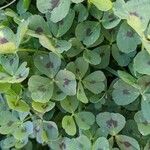
Medicago arabica
یونجه گرمسیری، · Spotted Burclover · Spotted medick · Spotted bur-clover · Spotted medic
Description
Source: leafsnapMedicago arabica, the spotted medick, spotted burclover, heart clover, is a flowering plant in the pea and bean family Fabaceae. It is native to the Mediterranean basin but is found throughout the world, usually on clifftop grasslands and grassy places. It forms a symbiotic relationship with the bacterium Sinorhizobium medicae, which is capable of nitrogen fixation.
💡 Medick is often mistaken for clover. According to a story, while Napoleon was once marching across a grassland, he noticed a medick. Intrigued, he bent down to pick it up. At that moment, a bullet was fired, and by bending down, Napoleon avoided it and survived. Because of this incident, medick has come to be recognized as a symbol of luck.
🌳 Because spotted medick can grow in a variety of soils, it is a useful forage crop for livestock, supplying key nutrients and proteins that support animal health. Its hardiness and nutritional makeup point to potential for broader agricultural adoption, especially in sustainable farming systems that prioritize soil enrichment and livestock nutrition.
Care Guide
💧 Water Every 7 days
Spotted medick, a plant native to moderate climates, requires consistent moisture and does not tolerate drought well. It thrives in humid conditions and needs weekly watering to maintain adequate soil moisture. In temperate zones, when grown outdoors, spotted medick benefits from natural rainfall, which supports its growth cycle.
What should I do if I give my Spotted medick too much or too little water?
Underwatering Spotted medick is easily remedied by watering it more regularly when you notice it lacks moisture. On the other hand, overwatering can be a serious problem that may lead to diseases and the eventual decline and death of the plant. To prevent this, it's important to choose a growing location with ample sunlight to dry the soil and good drainage to avoid waterlogged soil. If you overwater a potted Spotted medick, consider repotting it into a new container with proper drainage holes and loose soil for efficient drainage.
How often do I need to water my Spotted medick?
Spotted medick needs regular watering during the growing season. In spring, water it once a week. As the season gets warmer, increase watering to two to three times a week. However, be cautious not to overwater the plant. Keep the soil moist but not wet. Watering is different for potted Spotted medick. Due to faster drying of pot soil, water container-grown plants a few times a week, rather than just once a week for plants in the ground.
How much water does my Spotted medick plant need?
Determining the proper amount of water for your Spotted Medick can be approached in a few different ways. One method is to gauge the moisture level of the soil by feeling it. In this case, you would want the top six inches of soil to be moist before stopping watering. Another approach is to use a specific measurement, such as about two gallons per week, adjusted based on factors like temperature and soil dryness. However, it's important to be cautious with this method as it may lead to overwatering if your plant actually requires less water. When growing the Spotted Medick in a container, the process is slightly different. To determine the water amount, you should water the soil until all layers are moist and not just rely on the top layer. This can be checked by feeling the soil with your finger or observing a small amount of excess water trickling out of the pot's drainage holes.
How can I know if I'm giving enough water to my Spotted medick?
Avoiding overwatering your Spotted medick can be challenging due to their deep roots requiring regular soil moistening. However, these plants are highly prone to root rot as a result of overwatering, which can cause browning. Underwatering is less of a concern as these plants can endure periods without supplemental watering, but prolonged water deprivation may result in wilting and dry leaves.
How do I water my Spotted medick at different times of the year?
As the seasons progress, the water needs of your Spotted medick will change. During spring, watering once per week is sufficient. However, as the summer heat arrives, you may need to increase watering to about three times per week, particularly if your Spotted medick is in a container. Containers tend to dry out faster than ground soil in warm weather. In autumn, while the plant is still blooming, it will likely require less water due to cooler temperatures and less intense sun.
☀️ Light Full sun
When given plenty of sunlight, spotted medick thrives, supporting healthy growth and optimal development. Native to areas with abundant sun, it does not tolerate settings with inadequate light. Excessive sun exposure can cause spotted medick to wilt or wither, while insufficient light can impede its growth and vigor.
What are the sunlight requirements for Spotted Medick?
Spotted Medick requires above 6 hours of sunlight daily to thrive properly. It is essential to observe your garden's sun exposure closely and choose locations that offer a good balance of light and shade. This balance encourages the plant's health and happiness, leveraging sunlight optimally while preventing potential overexposure risks.
How does Spotted Medick respond to different light conditions?
Spotted Medick, originating from sunny habitats, flourishes when generously exposed to sunlight. It does not perform well in environments with insufficient sunlight, leading to potential wilting or growth hindrance. Conversely, overexposure to sunlight can also damage the plant. For indoor plants, artificial lighting such as LED lights can be used to supplement natural light, especially in less sunny spaces or during winter. The general guideline is to provide 30-50W/sq ft for full sun plants, 20-30W/sq ft for partial sun plants, and 10-20W/sq ft of artificial light for full shade plants.
What symptoms indicate Spotted Medick is not receiving enough light?
Insufficient light exposure results in several symptoms for Spotted Medick. These include smaller new leaves, leggy or sparse growth, faster leaf drop than normal, slower or no new growth, and pale or lighter-colored new leaves. Additionally, excessive sunlight can lead to chlorosis (yellowing leaves), sunscald (pale, bleached areas on leaves or stems), leaf curling (to minimize surface area exposure), wilting (from water loss), and leaf scorching (brown, dry edges on leaves). These symptoms show the plant's struggle with either too little or too much sunlight.
How can I manage light conditions for an indoor and outdoor Spotted Medick plant?
To manage light conditions effectively for Spotted Medick: Indoor: Gradually move your plant to sunnier spots until it gets at least 6 hours of direct sunlight, utilizing south-facing windows. If moving the plant is not feasible, consider using artificial light sources like desk lamps or plant grow lights for at least 8 hours a day. Outdoor: Gradually acclimate your plant to sunnier locations to prevent sunburn, avoiding abrupt changes in sunlight exposure. Ground: Reduce any obstructions to sunlight, such as pruning trees that cast shade, and consider transplanting to sunnier spots during the plant's dormant period for ample sunlight and good drainage. Note that parts of the plant that have already been damaged by poor light may not recover, but new growth will be healthy with adjusted light conditions.
🌡️ Temperature 10–25°C
Spotted medick is native to temperate climates, growing best in temperatures of about 68 to 95°F (20 to 35℃). It prefers stable conditions and may need protective measures during extreme weather.
What is the indigenous climate for Spotted Medick?
Spotted medick thrives in moderate climates, particularly flourishing in temperatures ranging from 68 to 95°F (20 to 35°C). It prefers environments with a consistent climate and may need protective measures in place during periods of extreme weather to ensure its well-being.
Does Spotted Medick need frost protection?
Spotted medick exhibits a high tolerance to cold temperatures and does not require additional measures for frost protection during winter months. Nevertheless, it's advisable to water the plant abundantly before the first freeze in autumn. This preparation helps keep the soil moist and in a frozen state throughout the winter and early spring, aiding in the prevention of drought and water scarcity for the plant.
What should be done if the temperature falls below -25°C for Spotted Medick?
Although Spotted medick is extremely cold-tolerant, temperatures dipping below -25°C can hinder its ability to sprout during the spring. In such conditions, it's important to observe the plant and, in spring, remove any parts that have failed to sprout, which could indicate damage from the excessively cold weather.
How can Spotted Medick be protected against high temperatures?
Spotted medick is vulnerable to high temperatures above 35°C, leading to halted growth and an increased risk of rot. To protect it, trimming away sunburned and dried-up parts is necessary. It's also beneficial to relocate the plant to a shaded area or utilize a shade cloth for protection against the midday and afternoon sun. Ensuring the soil remains moist through watering in the morning and evening can also help mitigate the impact of high temperatures.
💨 Humidity
🪴 Soil 6-7
🌱 Fertilizer
Spotted medick benefits from regular, light applications of fertilizer to encourage healthy leaf development. You should feed Spotted medick about once a month during the summer. Nitrogen is important for foliage, and providing nitrogen-rich sources helps Spotted medick thrive.
🪴 Pot & Repot
✂️ Pruning
Prune spotted medick from early to late spring to remove any dead or damaged stems. This encourages healthy growth and improves the plant's shape. Proper pruning enhances foliage density, prevents legginess, reduces the risk of disease, and maintains an attractive appearance while helping to control its spread.
🌿 Propagating
🐛 Diseases & pets
☠️ Toxicity
Characteristics
- Plant Type
- Herb
- Life Cycle
- Annual, Perennial
- Genus
- Medicago
- Family
- Fabaceae
- Hardiness Zone
- 6
- Mature Height
- 40 cm to 61 cm
- Mature Spread
- 15 cm to 30 cm
- Leaf Color
- Green, Blue
- Leaf Type
- Deciduous
- Flower Color
- Yellow
- Flower Size
- 2.54 cm
- Bloom Time
- Mid spring, Late spring, Early summer
- Planting Time
- Spring, Summer, Autumn
- Harvest Time
- Early summer, Mid summer
- Native Area
- Libya, Egypt, Turkey, Tunisia, Montenegro, Cyprus, Bulgaria, Greece, Morocco, Ukraine, Lebanon, Russia, Serbia, Hungary, Iraq, Syria, Italy, Spain, Netherlands, France, Albania, Azerbaijan, United Kingdom, Romania, Algeria, Belgium, Portugal