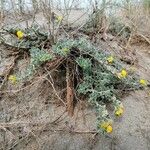
Medicago marina
Sea medick
Description
Source: leafsnapMedicago marina, commonly known as sea medick or saltwater alfalfa, is a flowering plant in the legume family. This perennial herb thrives in saline and alkaline soils found along coastal regions and salt marshes. Its deep taproot system enables it to endure harsh environmental conditions, such as drought and high salinity. Sea medick features small yellow flowers that bloom from May to September. Its trifoliate leaves consist of oval-shaped leaflets, each measuring up to 2 cm in length. The plant can grow as tall as 50 cm. Medicago marina plays a crucial role in coastal ecosystems. It helps stabilize soil and prevent erosion along shorelines, while also providing habitat for various wildlife, including birds, insects, and small mammals. Additionally, it holds agricultural potential due to its ability to thrive in saline soils where other crops cannot. In summary, Medicago marina is an essential component of coastal environments. Its unique adaptations allow it to survive under harsh conditions while offering numerous benefits to both wildlife and humans.
💡 Medick is frequently mistaken for clover. There's a story that says once, while Napoleon was marching across a grassland, he noticed a medick plant. His interest led him to bend down to pick it. By doing so, he inadvertently dodged a bullet that could have struck him, thus saving his life. Because of this tale, medick has come to be regarded as a symbol of luck.
Care Guide
💧 Water Every 7 days
Sea medick, a plant native to coastal regions, flourishes in salty, dry, and sandy environments. It thrives in dry conditions and is highly drought-tolerant, requiring only weekly watering. When placed outdoors, it benefits from natural rainfall and the well-draining soil characteristic of its habitat.
How should I water my Sea medick plant?
To properly water the Sea medick, it is recommended to use filtered water at room temperature. Tap water may contain harmful particles, so filtered water is preferable. The Sea medick is accustomed to warm environments, so using cold water can be a shock to its system. Additionally, overhead watering should be avoided as it can cause issues with the foliage. Instead, water the plant by applying filtered room temperature water directly to the soil until it is fully saturated. This helps to keep the roots moist and allows them to spread and gather necessary nutrients.
What do I need to do if I give my Sea medick too much or too little water?
Overwatering is a common issue that can harm your Sea medick plant, causing wilting and yellowing of the stems and leaves. It can also lead to diseases like root rot, mold, and mildew, which can be fatal. Underwatering is less common but still possible, resulting in brittle and brown leaves. It is important to recognize the signs of overwatering early on to prevent irreversible damage. If you notice early signs, reduce your watering schedule and check the soil's drainage. Replace poorly draining soil with a loose, well-draining potting mix. If your plant is not receiving enough water, simply water it more regularly until the signs improve.
How often should I give water to my Sea medick plant?
If your Sea medick plant is in a pot, the most precise way to determine if it needs water is by checking the soil. Simply plunge your finger into the soil and if you find the first two to three inches dry, it's time to water it. Similarly, if you have your Sea medick plant outdoors in the ground, you can follow a similar method to test the soil. Once the top few inches of soil have dried out, it's time to water the plant. Typically, during spring and early fall, watering once a week is sufficient. However, during extremely hot weather, you may need to increase the watering frequency to twice a week or more. It's worth noting that mature and well-established Sea medick plants have an impressive ability to withstand drought.
How much water should I give my Sea medick plant?
When watering your Sea medick, don't be afraid to give it plenty of water. Make sure the first two to three inches of soil are dry before watering. Give the plant a thorough watering so that the soil is completely soaked. You'll know you've added enough water when it starts to drain out of the bottom of the pot. If you don't see any excess water draining, you may not have given enough water. Be careful not to let water accumulate in the soil, as this can harm the plant. Additionally, if water isn't draining properly from the pot, it could mean you have poorly draining soil, which is not good for the plant's health. If the plant is outside, it will only need about 1 inch of rain per week.
How should I water my Sea medick as it grows?
The water needs of the Sea medick can vary depending on its growth stages. When it is in its early years or has just been transplanted, it requires more water than usual. During these stages, the Sea medick focuses on growing new roots, which need extra moisture to support future growth. However, as the Sea medick matures, it requires less water. Another stage in which it may need more water is during the bloom period, as the development of flowers requires a significant amount of moisture.
☀️ Light Full sun
Sea medick is a sun-loving, herbaceous perennial that comes from open habitats and is frequently found in meadows and grasslands. It prefers full sun but can also tolerate partial sun conditions.
What are the sunlight requirements for Sea medick?
Sea medick, a perennial herbaceous plant, thrives best in full sun, requiring more than 6 hours of sunlight daily. However, it can also tolerate partial sun conditions, which means about 3-6 hours of sunlight. Keeping an eye on the movement of sunlight through your garden helps in determining the perfect spots that offer the right balance of light and shade, ensuring the plants’ well-being.
How can artificial lighting support Sea medick's growth indoors?
Indoor Sea medick plants can benefit significantly from artificial lighting, especially when natural sunlight is scarce, like during winter or in less sunny spaces. Optimal growth is achieved by providing adequate lighting through artificial means. LED lights are recommended due to their customization options to suit specific plant needs. The amount of artificial light required varies by plant type: full sun plants need 30-50W/sq ft, partial sun plants 20-30W/sq ft, and full shade plants 10-20W/sq ft. The light source should be positioned 12-36 inches above the plant to mimic natural sunlight conditions, ensuring the plants receive 8-12 hours of light per day.
What symptoms indicate inadequate lighting for Sea medick?
Symptoms of inadequate lighting in Sea medick include smaller new leaves compared to mature ones, leggy or sparse growth, faster leaf drop, slower or halted new growth, and the development of lighter-colored or irregularly patterned leaves. Additionally, symptoms like chlorosis, sunscald, leaf curling, wilting, and leaf scorching may occur due to too much sunlight. These symptoms highlight either an excessive or insufficient amount of light, potentially harming the plant’s health and growth.
What solutions can help Sea medick thrive in different lighting conditions?
Ensuring Sea medick receives optimal light involves gradual adjustments and utilizing artificial light when necessary. For indoor plants, gradually increase sunlight exposure by moving the plant to a sunnier spot each week, aiming for at least 6 hours of direct sunlight. Utilizing south-facing windows and keeping curtains open can help. If moving the plant is not feasible, providing artificial light for at least 8 hours daily is beneficial. Outdoors, avoid sudden changes in sunlight exposure by moving plants gradually to sunnier spots. Prune trees or obstructions to improve sunlight access, and for smaller plants, consider transplanting during the dormant period to a location with ample sunlight. It's important to note that parts of the plant damaged by insufficient light may not recover, but new growth will be healthy with improved lighting conditions.
🌡️ Temperature 15–35°C
Sea medick shows good adaptability to temperature, tolerating high heat and considerable temperature fluctuations. In hot weather, attention should be paid to watering and providing proper shade to avoid sunburn. However, Sea medick is relatively sensitive to low temperatures. While it can endure some cold, very low temperatures can cause frost damage.
What is Sea Medick?
Sea Medick is known botanically as Medicago marina. However, specific details about its essentials, content, and symptoms related to it haven't been provided.
💨 Humidity
🪴 Soil 6-8
🌱 Fertilizer
A single fertilizer application in spring is usually enough for Sea medick, though multiple feedings can increase growth. Feed once every month to six weeks. Fertilizing improves the leaves' appearance and function, helping maintain even color and a healthy texture. It also encourages root development and nutrient uptake, supporting long-term plant health.
🪴 Pot & Repot
✂️ Pruning
Sea medick, which flourishes in coastal areas, is known for its trailing stems and yellow flowers. To promote healthy growth and maintain its shape, prune the plant from early to late spring. Avoid making heavy cuts to reduce stress on the plant. Always use clean tools to maintain the plant's health, ensuring good airflow and preventing disease. Adjust your pruning techniques according to the plant's overall health.
🌿 Propagating
🐛 Diseases & pets
☠️ Toxicity
Characteristics
- Plant Type
- Herb
- Life Cycle
- Perennial
- Genus
- Medicago
- Family
- Fabaceae
- Hardiness Zone
- 8-10
- Mature Height
- 20 cm to 49 cm
- Mature Spread
- 20 cm to 61 cm
- Leaf Color
- Silver, Gray
- Leaf Type
- Semi-evergreen
- Flower Color
- Yellow
- Flower Size
- 0.51 cm to 1.27 cm
- Bloom Time
- Late spring, Early summer, Mid summer
- Planting Time
- Spring, Summer
- Harvest Time
- Mid summer, Late summer, Early fall
- Native Area
- Libya, Egypt, Turkey, Tunisia, Montenegro, Cyprus, Bulgaria, Greece, Croatia, Morocco, Lebanon, Russia, Portugal, Syria, Italy, Spain, Albania, Algeria, Romania, France