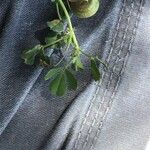
Medicago orbicularis
یونجه دکمهای · Burless clover · Burless trefoil · Snail trefoil · Button medic
Description
Source: leafsnapMedicago orbicularis, commonly known as Button Clover, is a species of flowering plant in the legume family (Fabaceae). Native to Europe and Western Asia, it has also been introduced to North America. The plant typically grows up to 30 cm in height and features small yellow flowers that bloom from May to August. The leaves are trifoliate with rounded leaflets, which are hairy on both sides. Button Clover thrives in dry, sandy soils and is commonly found in grasslands, meadows, pastures, roadsides, and disturbed areas. It is an important forage crop for livestock due to its high protein content. Traditionally, the seeds of Button Clover have been used for medicinal purposes, particularly for treating respiratory problems such as coughs and bronchitis, thanks to its expectorant properties. Overall, Medicago orbicularis plays a significant role in maintaining biodiversity by providing food sources for livestock and serving as a habitat for various insects, such as bees, which aid in the pollination of nearby plants.
💡 Medick is often mistaken for clover. According to a story, while Napoleon was once marching across a grassland, he noticed a medick. Intrigued, he bent down to pick it up. At that moment, a bullet was fired, and by bending down, Napoleon avoided it and survived. Because of this incident, medick has come to be recognized as a symbol of luck.
Care Guide
💧 Water Every 7 days
Blackdisk medick thrives in well-drained soils and can withstand moderate drought. It does best with weekly watering. Indoors, it flourishes in bright light, which mimics its natural Mediterranean habitat. This lighting condition aids in better water uptake and retention during its active growth phases.
How should I water my Blackdisk medick?
To water Blackdisk medick, you have a few options. You can use a garden hose with a spray nozzle, a watering can, or any other common watering tool. The good news is that Blackdisk medick isn't too fussy about the type of water it gets. Rainwater, tap water, or filtered water will all do just fine. Just be careful not to water from above, as this can harm the leaves and flowers and potentially lead to disease. Instead, it's often best to use a drip irrigation system. This system will evenly and directly water the soil, which is ideal for Blackdisk medick. If you have a container-grown Blackdisk medick, you can follow a similar approach but adjust the tools. A cup, watering can, or even your tap can be used to apply water directly to the soil.
What should I do if I give my Blackdisk medick too much or too little water?
To fix the problem of underwatering Blackdisk medick, all you need to do is water it more frequently when you see that it's lacking moisture. However, overwatering can be much more serious. If you don't catch it early on, your plant may get sick and eventually die. To prevent this, it's important to choose a good location for your Blackdisk medick. Find a spot that gets plenty of sunlight to dry out the soil and has good drainage to prevent water from pooling. If your Blackdisk medick is in a pot and you've overwatered it, you may need to change to a new pot. The old container might have had poor drainage or not enough holes. When repotting, use loose soil and a pot that drains well.
How frequently should I water my Blackdisk medick?
Blackdisk medick requires regular watering throughout the growing season. In spring, water it once a week. As the season progresses and it gets warmer, increase watering to two or three times a week. However, be careful not to exceed this rate as it can harm the plant. Regardless of watering frequency, make sure the soil remains moist but not wet. Watering Blackdisk medick in a pot is different. Potted plants dry out faster than those in the ground, so increase the watering frequency. Generally, water a container-grown Blackdisk medick a few times per week, compared to just once a week for a plant in the ground.
How much water does my Blackdisk medick require?
To determine how much water to give your Blackdisk medick, you have a few options. One method is to feel the soil for moisture and water until the top six inches are moist. Another approach is to follow a general guideline of giving about two gallons of water per week, adjusting based on temperature and soil dryness. However, be mindful not to overwater if your plant needs less. When growing in a container, you can check for moisture by sticking your finger in the soil or water until you see a bit of excess water draining out.
How can I know if I'm giving enough water to my Blackdisk medick?
Taking care of your Blackdisk medick can be challenging when it comes to watering. While their deep roots need to be moistened weekly, they are also highly prone to root rot. Overwatering can lead to browning and other issues. Underwatering is less of a concern as these plants can survive without much water for a while. However, be careful not to go too long without watering, as the plant may wilt and develop dry leaves.
☀️ Light Full sun
Blackdisk medick grows best in full, unshaded sunlight and can tolerate conditions with moderately reduced illumination. This inclination stems from its native habitat, which is rich in sunlight. However, too much or too little light can negatively impact its healthy growth.
What are the sunlight requirements for Blackdisk medick?
Blackdisk medick thrives in areas with abundant sunlight, requiring full sun, which is above 6 hours of direct sunlight daily, or partial sun, about 3-6 hours of sunlight. Its preference for unobstructed sun exposure stems from its natural habitat, which is rich in sunlight. However, it's important to watch how sunlight moves through your garden to find spots that provide the right balance of light and shade, ensuring the plant's well-being. Both excess and insufficient light can negatively impact its growth.
How does artificial lighting support Blackdisk medick's growth indoors?
When natural sunlight is not adequate, especially during winter or in less sunny indoor areas, artificial lighting can be a crucial solution for Blackdisk medick's growth. Adequate artificial lighting promotes faster and healthier plant growth. LED lights are recommended due to their ability to provide specific wavelengths needed by plants. For full sun plants, 30-50W per square foot is ideal, partial sun plants require 20-30W per square foot, and full shade plants need 10-20W per square foot. The light source should be placed 12-36 inches above the plant to simulate natural sunlight, and most plants benefit from 8-12 hours of light per day.
What are the symptoms of inappropriate lighting conditions for Blackdisk medick?
Inadequate lighting can lead to several symptoms in Blackdisk medick, including small and poorly developed new leaves, leggy or sparse growth due to long spaces between leaves or stems, quicker leaf drop as a conservation measure, halted or no new growth as the plant enters survival mode, lighter-colored new leaves indicating a lack of chlorophyll, chlorosis characterized by yellowing leaves, sunscald resulting in damaged leaves or stems from intense exposure, leaf curling as a defense against excessive sunlight, wilting due to increased water loss, and leaf scorching with brown, dry edges caused by too much sunlight.
How can I address Blackdisk medick's light-related growth issues?
To mitigate light-related growth issues in Blackdisk medick, gradual adjustment to the lighting environment is crucial. For indoor plants, moving them to a location with at least 6 hours of direct sunlight daily or using artificial light for plants that are large or hard to move can help. Keep indoor lighting on for a minimum of 8 hours daily. Outdoors, it's essential to transition plants gradually to sunnier spots to prevent sunburn. Reducing obstructions like trees by pruning can increase sunlight exposure. Transplanting smaller plants during their dormant period to a location with ample sunlight and good drainage can also promote healthier growth. Note that parts of the plant already affected by light deficiency may not recover, but new growth should be healthy with improved light conditions.
🌡️ Temperature 15–35°C
Blackdisk medick can tolerate a wide range of temperatures, but its distribution may still be restricted by different combinations of moisture and heat. It performs best in warm summer climates with sufficient rainfall or watering. Extended periods of cloudy, rainy weather, as well as prolonged high temperatures, can raise the chance of Blackdisk medick dying. In winter, appropriate protection from cold can increase the plant's survival rate.
💨 Humidity high (>60%)
This plant needs special care because it loves high humidity levels of 60-80% or more. The best way to achieve this is by placing a humidifier near the plant. Daily misting is also essential! Make sure the room has good ventilation.
🪴 Soil 6-7
🌱 Fertilizer
Blackdisk medick responds well to regular, diluted fertilizer applications to encourage healthy leaf development. Fertilize Blackdisk medick about once a month during the summer. Nitrogen is important for foliage, and adding nitrogen-rich sources helps Blackdisk medick thrive.
🪴 Pot & Repot
✂️ Pruning
Blackdisk medick is known for its distinctive disk-like seed pods and thrives with regular pruning. To promote new growth, prune the plant in early spring. Later in the season, prune again in late spring to control its size and remove any damaged branches. Focus on thinning the plant to improve airflow and light penetration, which enhances its vigor and reduces the risk of disease.
🌿 Propagating
🐛 Diseases & pets
☠️ Toxicity
Characteristics
- Plant Type
- Herb
- Life Cycle
- Annual
- Genus
- Medicago
- Family
- Fabaceae
- Hardiness Zone
- 7-10
- Mature Height
- 30 cm to 61 cm
- Mature Spread
- 30 cm to 76 cm
- Leaf Color
- Light Green
- Leaf Type
- Deciduous
- Flower Color
- Yellow
- Flower Size
- 2.54 cm
- Bloom Time
- Mid spring, Late spring, Early summer
- Planting Time
- Autumn
- Harvest Time
- Summer
- Native Area
- Libya, Egypt, Turkey, India, Montenegro, Pakistan, Morocco, Uzbekistan, Russia, Iraq, Romania, France, Portugal, Saudi Arabia, Tajikistan, Tunisia, Cyprus, Bulgaria, Armenia, Greece, Lebanon, Afghanistan, Syria, Kyrgyzstan, Kazakhstan, Italy, Spain, Iran, Albania, Azerbaijan, Algeria, Hungary, Turkmenistan