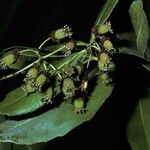
Medusagyne oppositifolia
Jellyfish tree
Description
Source: wikipedia (CC BY-SA)Medusagyne oppositifolia, the jellyfish tree, is a species of tree endemic to the island of Mahé, of the Seychelles. It is the only member of the genus Medusagyne of the tropical tree and shrub family Ochnaceae. The plant, thought to be extinct until a few individuals were found in the 1970s, gets its common name from the distinctive jellyfish-like shape of its dehisced fruit.
Care Guide
💧 Water
The jellyfish tree thrives in consistent moisture and regular humidity, reflecting its tropical origins. It should be watered weekly, though it can tolerate moderate drought conditions. As a rare outdoor plant, the jellyfish tree adapts to seasonal rainfall, which influences its growth cycles and watering needs.
☀️ Light Partial sun
The Jellyfish tree thrives naturally in habitats like forest understories and rocky terrains, where it's exposed to natural shade. While it favors conditions of partial sunlight, it's also capable of adjusting to complete sun exposure or total shade, displaying its adaptable and resilient characteristics.
🌡️ Temperature 20–37.8°C
The jellyfish tree has its roots in tropical zones, which are typically characterized by a hot and moist climate. As such, it thrives in high heat and moisture levels. It's not fond of sharp temperature shifts and prefers an environment with consistent temperatures, thus, abrupt indoor temperature changes should be prevented. This species generally doesn't do well in cold conditions and needs a warmer atmosphere for growth. In an event where the temperature in its surroundings falls excessively, the tree's growth can stop, or it could even perish.
💨 Humidity
🪴 Soil 6-7
🌱 Fertilizer
The best period to apply fertilizer to a Jellyfish tree is in the initial stages of spring when it is breaking out of its dormant state. This action furthers overall growth and promotes flower development. Fertilizing the tree enriches the leaves, stems, and branches, and fosters the production of big, radiant flowers that have a prolonged lifespan. This process also supports the transfer of nutrients from the roots to the flowers, strengthening the plant's health and its ability to resist diseases.
🪴 Pot & Repot
✂️ Pruning
Pruning a jellyfish tree in early spring can significantly improve its health and shape. Start by removing dead branches and thinning out dense areas to improve air circulation. Light pruning also encourages flowering. Be sure to use sharp, clean tools to prevent disease, and monitor the plant’s response to ensure optimal growth.
🌿 Propagating
🐛 Diseases & pets
☠️ Toxicity
Characteristics
- Plant Type
- Tree
- Life Cycle
- Perennial
- Genus
- Medusagyne
- Family
- Ochnaceae
- Hardiness Zone
- 10-12
- Mature Height
- 4.88 m to 10.06 m
- Mature Spread
- 3.05 m to 4.88 m
- Leaf Color
- Dark Green
- Leaf Type
- Evergreen
- Flower Color
- White
- Flower Size
- 1.02 cm to 2.03 cm
- Bloom Time
- Late spring, Early summer, Mid summer
- Planting Time
- Spring, Summer
- Harvest Time
- Mid summer, Late summer, Early fall