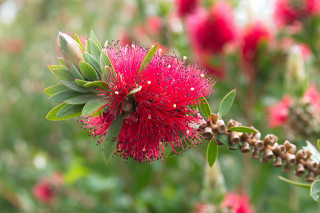
Melaleuca citrina
Crimson Bottlebrush · Lemon bottlebrush · Bottlebrush · Lemon-scented bottlebrush · Callistemon
Description
Source: leafsnapThe plants get their name from the spikes of flowers that bloom at the ends of the stems, bearing a strong resemblance to a bottle brush. It is widely used as a landscaping plant due mostly to its adaptability.
🌳 Crimson bottlebrush is both visually striking and practically versatile. Its leaves contain plentiful essential oils that give off a pleasant lemon scent. Recognized as a fast grower, crimson bottlebrush is also becoming useful in bioenergy because its high lignocellulose content could be converted into ethanol. Beekeepers may be interested since its nectar-rich blossoms can produce premium honey.
🎭 Plenty, laughter, happiness, birth celebration
Care Guide
💧 Water Every 3-7 days
☀️ Light Full sun
The crimson bottlebrush thrives with ample sunlight for best growth, though it can tolerate slightly lower light levels. Its native habitat favors abundant sun exposure. Adequate light encourages healthier growth, while too little leads to reduced development. Conversely, excessive light can be damaging.
🌡️ Temperature 20–37.8°C
Crimson bottlebrush prefers a warm, temperate growing environment with temperatures between 68 to 100 ℉ (20 to 38 ℃). It tolerates high heat in summer but favors cooler conditions in winter. In hotter areas, planting or keeping crimson bottlebrush in partial shade is recommended to prevent heat stress.
💨 Humidity
🪴 Soil 5-6
🌱 Fertilizer
Timing is important when fertilizing Crimson bottlebrush. Apply fertilizer in early spring and then monthly through early summer. Fertilizer encourages attractive blooms and supplies energy during both dormant and active growth periods.
🪴 Pot & Repot 2-3 years
When you repot a Crimson bottlebrush, choose a pot 1–2 inches (2.5–5.1 cm) larger that has ample drainage. Use a well-draining potting mix. Repot in spring or fall, making sure the root ball sits slightly lower than the rim of the flower pot. Water thoroughly after repotting and place the plant in a warm spot with indirect sunlight.
✂️ Pruning
You will need to train it to a tree form so it will exhibit the weeping shape. Otherwise, it can turn into a shrub that can be used as a hedge.
🌿 Propagating
🐛 Diseases & pets
☠️ Toxicity
Characteristics
- Plant Type
- Shrub
- Life Cycle
- Perennial
- Genus
- Melaleuca
- Family
- Myrtaceae
- Hardiness Zone
- 9-11
- Mature Height
- 0.91 m to 4.88 m
- Mature Spread
- 2.44 m
- Leaf Color
- Green
- Leaf Type
- Evergreen
- Flower Color
- Red
- Flower Size
- 0.51 cm to 0.51 cm
- Bloom Time
- Late spring, Early summer, Mid summer
- Planting Time
- Spring, Autumn
- Harvest Time
- Early summer, Mid summer
- Native Area
- Australia