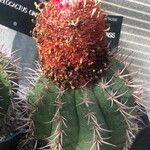
Melocactus salvadorensis
Care Guide
💧 Water Every 3 weeks
Turk's cap thrives in dry climates, showing remarkable resistance to drought. To mimic its natural environment, it should be watered every three weeks using well-draining soil. Its thick stem helps conserve water, making Turk's cap an excellent choice for xeriscaping.
☀️ Light Full sun
Turk's cap grows vigorously when provided with abundant sunlight for most of the day, though it can endure intervals of reduced light. Native to areas with extended daylight, it prospers in bright conditions. Too little sun can impede healthy growth, while overly intense exposure may lead to leaf scorch.
What are the sunlight requirements for Turk's cap?
Turk's cap requires ample sunlight for most of the day to flourish robustly, though it can tolerate periods with less light. Originating from environments with extended day-length, it thrives in strong light, needing above 6 hours of sunlight for 'full sun' conditions and about 3-6 hours for 'partial sun'. Insufficient sunlight may hinder the plant's healthy growth, while excessive exposure could cause foliage scorch. It's essential to observe how sunlight moves through your garden to choose spots that ensure the perfect balance of light and shade for Turk's cap, nurturing its happiness.
How can artificial lighting support indoor Turk's cap plants?
Indoor Turk's cap plants require adequate lighting for optimal growth, especially when natural sunlight is insufficient, like in winter or less sunny spaces. Artificial lighting offers a vital solution, promoting faster, healthier growth. LED lights are popular for indoor plant lighting, as they can be customized to provide specific wavelengths needed by plants. For 'full sun' plants, 30-50W/sq ft of artificial light is recommended, 'partial sun' plants need 20-30W/sq ft, and 'full shade' plants require 10-20W/sq ft. The artificial light source should be placed 12-36 inches above the plant, mimicking natural sunlight. Moreover, most plants need 8-12 hours of light per day to mimic the length of natural daylight hours.
What are the signs of light deficiency or excessive exposure in Turk's cap?
Turk's cap may exhibit several symptoms when faced with suboptimal lighting, indicating either light deficiency or excessive light exposure. Signs of light deficiency include smaller new leaves, leggy or sparse growth, faster leaf drop, slower or no new growth, and lighter-colored or pale new leaves. Excessive sunlight can cause chlorosis, where leaves turn yellow due to chlorophyll breakdown, sunscald (pale, bleached areas on plant tissue), leaf curling as a defense mechanism, wilting from increased water loss, and leaf scorching characterized by brown, dry edges on leaves. Monitoring these symptoms can help in diagnosing and remedying light-related issues.
What solutions can be applied to resolve light-related issues in indoor and outdoor Turk's cap plants?
To address light-related issues in Turk's cap, gradually moving plants to a sunnier spot each week until they receive at least 6 hours of direct sunlight daily is key. For indoor plants, using a south-facing window and keeping curtains open during the day maximizes sunlight exposure. If the plant is large or not easily movable, considering additional artificial light, like a desk or ceiling lamp for at least 8 hours daily, or investing in professional plant grow lights, can provide ample light. Outdoors, gradual relocation helps plants adapt to sunlight without the risk of sunburn. Minimizing obstructions like pruning trees or transplanting smaller plants during their dormant period to sunnier locations with good drainage are effective for ground-planted Turk's caps. While parts of the plant affected by insufficient sunlight may not recover, new growth after adapting to better light conditions will be healthy.
🌡️ Temperature 20–37.8°C
Turk's cap is native to tropical habitats where temperatures range from 68 to 100°F (20 to 38℃). It does best in warm climates. Because of its tropical origins, it's recommended to keep indoor temperatures above 68°F (20℃) year-round to keep it healthy.
What are the ideal temperature conditions for growing Turk's cap?
Turk's cap, scientifically known as Melocactus salvadorensis, flourishes in warm, tropical habitats where the temperature ranges between 68 to 100°F (20 to 38°C). It's essential to maintain indoor temperatures above 68°F (20°C) year-round to keep the plant healthy. The plant is heat-loving and enters a dormant state during winter if it gets too cold, especially when outdoor temperatures fall below 50°F (10°C). During these colder months, it's advised to move the plant indoors and provide it with ample sunlight, ideally near a south-facing window, and reduce or stop watering to prevent root rot.
How should I care for my Turk's cap during low temperatures?
In low temperatures, Turk's cap requires special attention due to its sensitivity to cold. The plant thrives when temperatures are above 68°F (20°C), and during winter, it should be kept above 50°F (10°C). If temperatures drop below 41°F (5°C), the plant may become weak, wilt, and be at risk of root rot. If frost damage occurs, you should trim off the frostbitten areas, checking for root rot. If found, cut off the rotting roots, and consider propagation through cuttings. To protect and recover the plant, move it to a warm environment indoors and place it near a south-facing window for sufficient sunlight. Use supplemental lighting if natural light is inadequate.
What are the symptoms and solutions for Turk's cap in high temperatures?
During high temperatures, specifically above 100°F (38°C), Turk's cap's growth will halt, and the plant may suffer from water loss, wilting, and become prone to sunburn. If temperatures exceed 109°F (43°C), the symptoms worsen. To manage these conditions, remove any sunburned or rotten parts of the plant. Protect the plant from direct afternoon sunlight until it recovers and resumes growth. In instances of root rot, watering should be ceased until new roots appear. By implementing these solutions, Turk's cap can recuperate from heat stress.
💨 Humidity
🪴 Soil 6-7
🌱 Fertilizer
For Turk's cap, apply light amounts of fertilizer once or twice a year during the growing season. Do not fertilize in winter or summer when the plant is dormant. Use less fertilizer for repotted plants and wait a couple of months after repotting before feeding. Fertilizing helps maintain healthy growth and promotes flowering.
🪴 Pot & Repot 2-3 years
Repot Turk's cap in spring or summer, choosing a pot slightly larger than the current one that has good drainage. Use a sandy or gritty cactus mix that drains well. Handle the plant carefully to avoid its spines. Allow the cactus to dry out before repotting to help prevent root rot. After repotting, wait one week before watering so the roots can heal.
✂️ Pruning
Turk's cap requires very little pruning. Simply remove the withered flowers and branches to help the plant direct nutrients towards healthy growth.
🌿 Propagating
🐛 Diseases & pets
☠️ Toxicity
Characteristics
- Plant Type
- Succulent
- Life Cycle
- Perennial
- Genus
- Melocactus
- Family
- Cactaceae
- Hardiness Zone
- 11
- Mature Height
- 49 cm
- Mature Spread
- 15 cm to 25 cm
- Leaf Color
- Green
- Leaf Type
- Evergreen
- Flower Color
- Red
- Flower Size
- 1.27 cm
- Bloom Time
- Mid summer
- Planting Time
- Spring, Summer, Autumn
- Harvest Time
- Mid summer, Late summer, Early fall