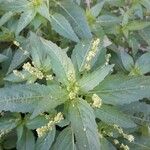
Mercurialis perennis
Dog's Mercury · Dog mercury · Wild mercury · Skogsbingel (S) · Bingelurt
Description
Source: leafsnapMercurialis perennis, commonly known as dog's mercury, is a perennial herbaceous plant belonging to the Euphorbiaceae family. Native to Europe and Asia, this plant thrives in shady areas such as woodlands, hedgerows, and riverbanks. The plant can grow up to 50 cm tall, featuring a smooth stem with leaves arranged oppositely. The leaves are dark green with slightly toothed edges. The flowers of Mercurialis perennis are small, greenish-yellow, and have no petals or sepals. Mercurialis perennis blooms from February to May, often flowering before other plants begin to grow for the year. It is dioecious, meaning that male and female flowers grow on separate plants. Historically, Mercurialis perennis has been used for its diuretic properties to increase urine production. However, caution is advised as improper handling can cause skin irritation. Overall, Mercurialis perennis is an interesting herbaceous perennial that enhances the beauty of shady areas. It possesses medicinal properties when used correctly under the guidance of a professional herbalist or a medical practitioner knowledgeable about its uses and potential side effects.
Care Guide
💧 Water Every 3 days
Dog's mercury thrives in the shaded areas of European woodlands. It prefers consistently moist soil and shows moderate tolerance to drought once it is established. For optimal growth, it needs to be watered weekly. This plant adapts well to its native environment and is less dependent on rainfall compared to other woodland species.
How should I water my Dog's mercury plant?
To properly water the Dog's mercury plant, it is recommended to use filtered water at room temperature. Tap water should be avoided since it may have harmful particles. The plant prefers slightly warm water as it is adapted to warmer environments and cold water can be a shock to its system. Instead of overhead watering, it is best to apply filtered room temperature water directly to the soil until it is completely saturated. This helps to moisten the roots and allows them to spread and absorb necessary nutrients.
What do I do if I give my Dog's mercury too much water or too little water?
Overwatering and underwatering can harm your Dog's mercury. However, overwatering is more common and can lead to wilted and yellow leaves, as well as diseases like root rot, mold, and mildew that can kill the plant. Underwatering is less likely, but it can cause brittle and brown leaves. It's important to identify signs of overwatering early and reduce watering immediately. Check the soil for poor drainage and replace it if necessary. If your Dog's mercury is not getting enough water, simply increase the watering frequency until the signs improve.
How often do I need to water my Dog's mercury plant?
To determine if your plant needs water, there are different methods depending on whether it is in a pot or in the ground. For plants in pots, the most accurate way is to stick your finger into the soil. If the top two to three inches of soil are dry, it is time to water. If your plant is in the ground, you can also use this method. When the first few inches of soil have dried out, it is time to water. Typically, in the spring and early fall, watering once a week is sufficient. However, during hot weather, you may need to water twice or more per week. It is worth noting that mature and well-established Dog's mercury plants have a good ability to tolerate drought.
How much water does my dog's mercury require?
When watering your Dog's mercury, don't be afraid to give it a generous amount of water. Make sure the top two to three inches of soil are dry before watering, and then give it a thorough soaking. You want to water it enough so that excess water flows out of the drainage holes at the bottom of the pot. If you don't see any excess water draining, it means you haven't watered it enough. However, be careful not to let the water accumulate in the soil, as this can harm the plant. On the other hand, if water doesn't drain out of the pot, it could mean that the soil doesn't drain well, which can also be harmful to the plant. If the plant is outdoors, receiving 1 inch of rainfall per week will be enough.
How should I water my Dog's mercury as it grows?
The water needs of the Dog's mercury plant vary depending on its growth stages. In the first few years of its life or after being transplanted to a new location, it requires more water than usual. During these stages, the plant focuses on developing new roots, which require additional moisture for optimal growth. However, after a few seasons, the plant's water requirements decrease significantly. Another stage that may require increased watering is during the bloom period when the flower development utilizes a substantial amount of moisture.
☀️ Light Partial sun
Dog's mercury favors locations with steady, filtered sunlight. It can still flourish in spots where the light is weak or blocked. Too much direct sun can damage the plant, while too little light may limit its growth and impede healthy development.
How much sunlight does Dog's mercury need to grow?
In order for Dog's mercury to thrive, it needs 3-6 hours of direct sunlight every day. However, it also requires some shade during the hottest parts of the day to prevent sun damage. The best time for Dog's mercury to receive sunlight is in the morning, but it can handle some afternoon sun as long as it is not too hot. To provide the ideal amount of sunlight, consider planting Dog's mercury in an area that receives partial sun, like under a tree or on the east side of a building.
What happens if Dog's mercury doesn't get enough sunlight?
Dog's mercury is sensitive to excessive direct sunlight, which can cause its leaves to turn yellow, dry out, or even burn. Additionally, you may observe wilting or stunted growth in the plant. To safeguard against sun damage, it's important to provide some shade for Dog's mercury during the hottest times of the day. This can be accomplished using a shade cloth or by planting it near taller plants that can provide natural shade.
What will happen if Dog's mercury is exposed to excessive sunlight?
Dog's mercury can become tall and lanky with sparse foliage if it doesn't receive sufficient sunlight. Yellow or pale green leaves are indicators that the plant is not producing enough chlorophyll because of sunlight deficiency. To solve this problem, consider relocating Dog's mercury to a sunnier location or trim surrounding foliage to create more light exposure for the plant.
🌡️ Temperature 5–32.2°C
Dog's mercury is naturally suited to moderate environments where temperatures range from 41 to 90 °F (5 to 32 ℃). It prefers mild climates. Seasonal temperature adjustments may be necessary for optimal growth.
What is the ideal temperature range for Dog's mercury?
Dog's mercury thrives in moderate environments, ideally where the temperature ranges from 41 to 90 °F (5 to 32 °C). This plant is adapted to mild climates and has a strong cold resistance, indicating that it does not usually require special frost protection measures during the winter. However, if temperatures are expected to drop below -30°C, it's important to provide additional cold protection by covering the plant with soil or straw. Additionally, abundant watering before the first freeze in autumn helps the soil stay moist and prevents drought and water scarcity during winter and early spring.
How does Dog's mercury respond to low temperatures?
Dog's mercury is quite cold-tolerant, best thriving when temperatures are above 5°C. During the winter, it's advisable to ensure the temperature remains above -25°C. Should the temperature drop below -30°C, while there may not be immediate noticeable changes, the plant might experience a decrease in sprouting or fail to sprout altogether come spring. To manage this, any parts of the plant that have failed to sprout by spring should be removed to encourage new growth.
What should I do if Dog's mercury experiences high temperatures?
During the summer, it's crucial to keep Dog's mercury's environment below 32°C. Exposure to temperatures above 35°C can cause the leaves to lighten in color, curl, become susceptible to sunburn, and in severe cases, lead to the wilting and drying of the entire plant. To combat these issues, sunburned and dried-up parts of the plant should be trimmed away. Moving the plant to a shaded location or employing a shade cloth can protect it from the midday and afternoon sun. Additionally, watering the plant in the morning and evening helps maintain soil moisture and supports the plant's well-being during high temperatures.
What is Dog's mercury's botanical name?
The botanical name of Dog's mercury is Mercurialis perennis. This detail is important for gardeners and horticulturists seeking to accurately identify the plant for care and cultivation purposes.
💨 Humidity
🪴 Soil 6-6
🌱 Fertilizer
Applying fertilizer once in spring is typically adequate for Dog's mercury, though repeated feedings can maximize growth. Fertilize every one to one-and-a-half months. Fertilization improves the leaves' appearance and function, encouraging even color and a healthy texture. It also promotes root development and nutrient uptake, supporting the plant's long-term health.
🪴 Pot & Repot
✂️ Pruning
🌿 Propagating
🐛 Diseases & pets
☠️ Toxicity
All parts of Mercurialis perennis are poisonous. It can induce jaundice, diarrhoea, vomiting and even death.
Characteristics
- Plant Type
- Herb
- Life Cycle
- Perennial
- Genus
- Mercurialis
- Family
- Euphorbiaceae
- Hardiness Zone
- 4-8
- Mature Height
- 25 cm to 40 cm
- Mature Spread
- 30 cm to 91 cm
- Leaf Color
- Dark Green
- Leaf Type
- Deciduous
- Flower Color
- Green
- Flower Size
- 0.20 cm to 0.25 cm
- Bloom Time
- Spring
- Planting Time
- Spring, Summer
- Harvest Time
- Late spring, Early summer, Mid summer
- Native Area
- Turkey, Sweden, Austria, Slovakia, Croatia, Slovenia, Belarus, Russia, Germany, Estonia, Romania, Belgium, Portugal, Netherlands, France, Czech Republic, Bulgaria, Poland, Greece, Ukraine, Serbia, Norway, Italy, Spain, Switzerland, Denmark, Finland, Iran, Albania, Ireland, United Kingdom, Hungary, Algeria, Azerbaijan