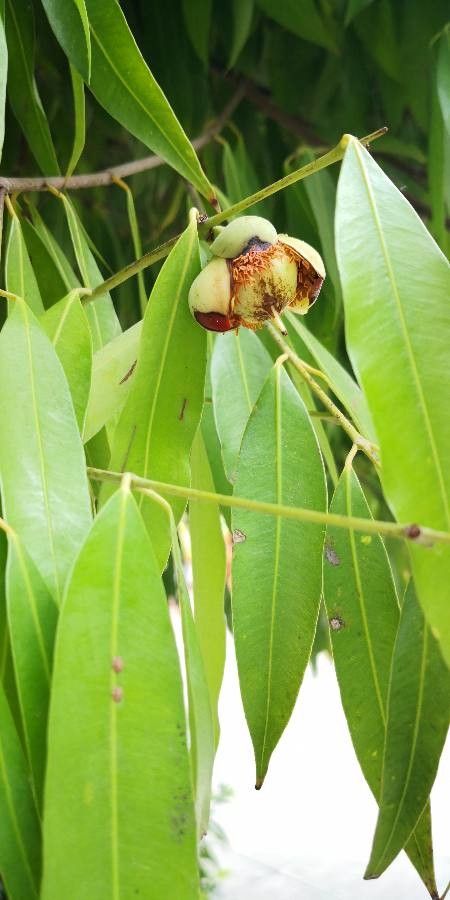
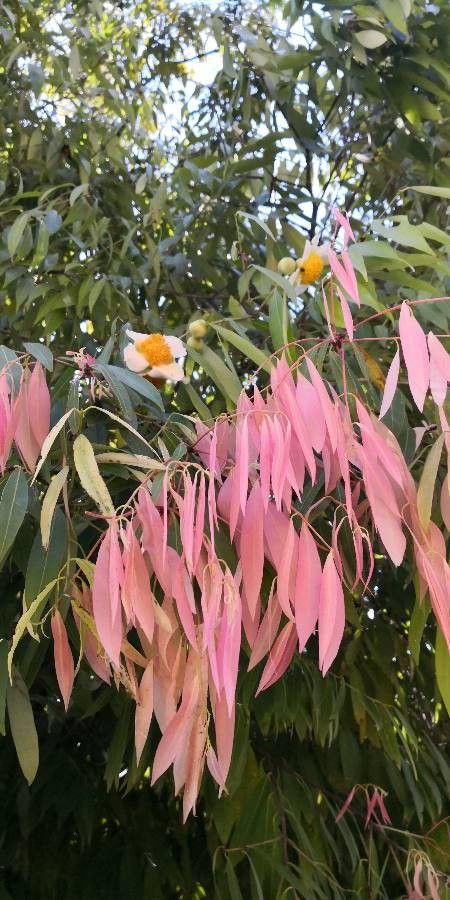
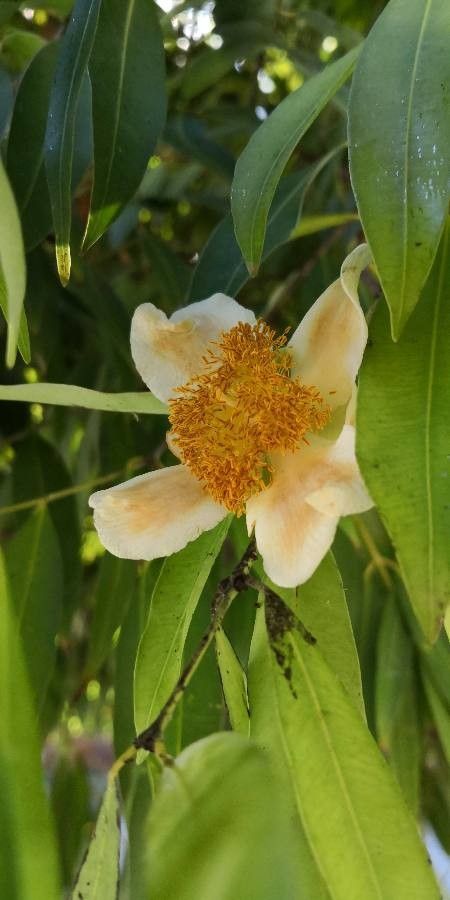
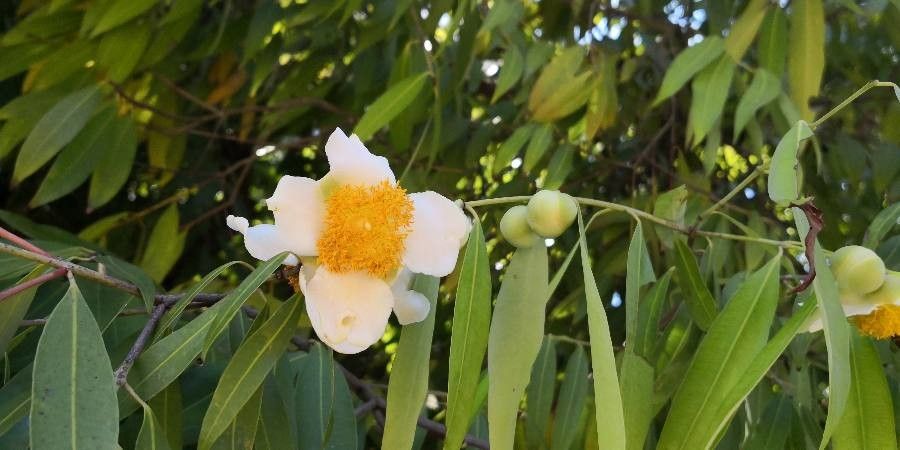
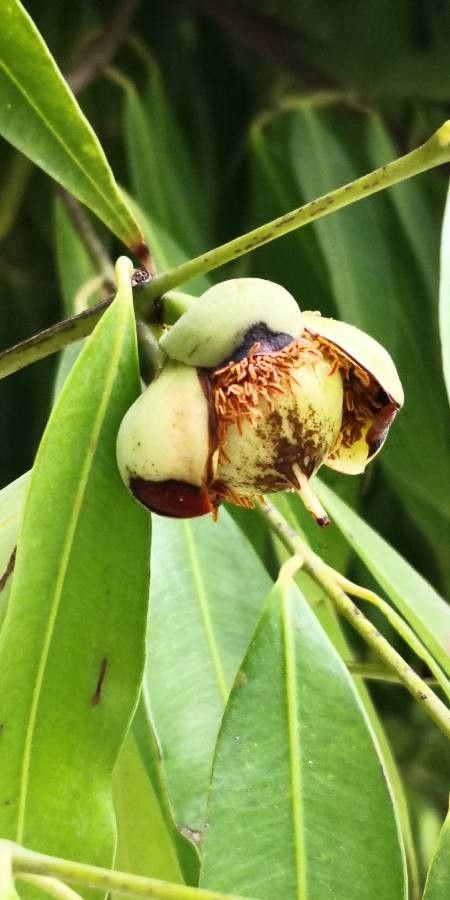
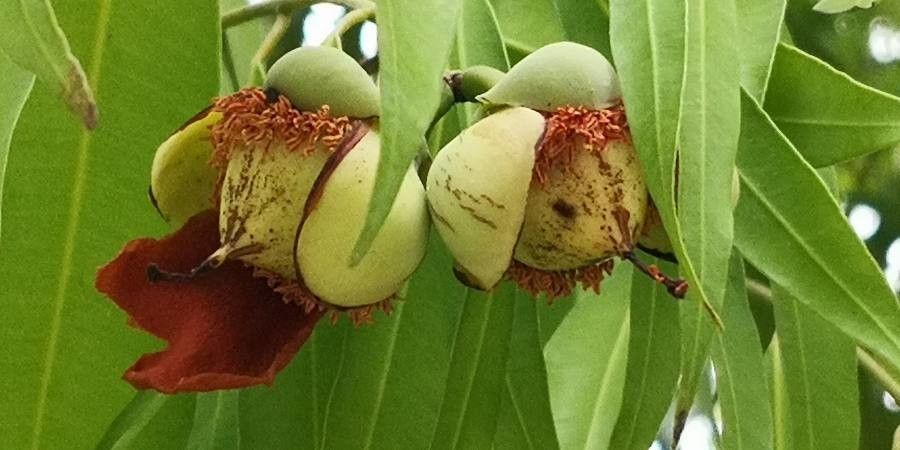
Mesua ferrea, the Ceylon ironwood, or cobra saffron, is a species in the family Calophyllaceae. This slow-growing tree is named after the heaviness and hardness of its timber. It is widely cultivated as an ornamental due to its graceful shape, grayish-green foliage with a beautiful pink to red flush of drooping young leaves, and large, fragrant white flowers. It is native to wet, tropical parts of Sri Lanka, India, southern Nepal, Burma, Thailand, Indochina, the Philippines, Malaysia and Sumatra, where it grows in evergreen forests, especially in river valleys. In the eastern Himalayas and Western Ghats in India it grows up to altitudes of 1,500 m (4,900 ft), while in Sri Lanka up to 1,000 m (3,300 ft). It is national tree of Sri Lanka, state tree of Mizoram and state flower of Tripura.
The Indian rose chestnut is fairly disease-resistant and is usually not susceptible to illnesses. As for upkeep, this plant is fairly low-maintenance. When grown outdoors it needs little watering, and larger specimens typically do not require pruning. Smaller plants, however, should be pruned after they finish blooming. The Indian rose chestnut is suitable for anyone with an outdoor area, such as a garden or deck, and does not demand much gardening experience.
How to keep Mesua Ferrea.
Light
Indian rose chestnut prefers a setting with abundant light to promote robust growth. Although it can tolerate moderate shade, it does best with unrestricted light. Its native environments are generally exposed, which contributes to its hardiness. However, excessive prolonged sunlight can hinder its growth.
Water
The Indian rose chestnut thrives in humid and consistently moist environments, such as tropical rainforests. It needs to be watered every two weeks and can tolerate moderate drought conditions. As an evergreen, it retains its foliage throughout the year and requires adequate water to support growth, especially when grown outdoors.
Temperature
Indian rose chestnut is usually found in climates with temperatures between 68 and 100 °F (20 to 38 ℃). Since it comes from temperate areas, it can tolerate a range of temperatures. In various seasons, small temperature adjustments can be made if needed to preserve its optimal growth.
Fertilizer
The best time to fertilize an Indian rose chestnut is in early spring, as it breaks dormancy. This supports overall growth and flower development. Fertilizing improves the foliage, stems, and branches, while encouraging large, vibrant, long-lasting flowers. It also helps move nutrients from the roots to the flowers and boosts the plant’s health and resistance to disease.
Pruning
To encourage a healthy and robust Indian rose chestnut, prune it from early to late winter. Focus on removing dead branches and thinning out crowded areas to improve air circulation. Shaping the plant helps promote growth and maintain its structure. Always use sharp, sterilized tools to ensure the plant is ready for the growing season.
Botanical profile.
- Plant Type
- Tree
- Life Cycle
- Perennial
- Genus
- Mesua
- Family
- Calophyllaceae
- Hardiness Zone
- 10-12
- Mature Height
- 9.14 m to 27.43 m
- Mature Spread
- 6.1 m to 11.89 m
- Leaf Color
- Green
- Leaf Type
- Evergreen
- Flower Color
- White
- Flower Size
- 7.62 cm to 10.16 cm
- Bloom Time
- Late spring, Summer
- Planting Time
- Spring, Summer
- Harvest Time
- Late summer, Fall
- Native Area
- Nepal, Sri Lanka, India, Malaysia, Indonesia, Cambodia, Vietnam, Myanmar, Bangladesh, Laos, Thailand, China
Other names.
Reader questions.
How should I water my Indian rose chestnut plant?
Your Indian rose chestnut doesn't have strict requirements for how you water it. Any common watering tool, such as a watering can, hose, or even a cup, will work fine. When you water your Indian rose chestnut, it's best to apply the water directly to the soil. Make sure to evenly moisten all areas of the soil to provide water to all parts of the root system. Using filtered water is recommended to avoid harmful particles found in tap water. It's also beneficial to use water that is at or slightly above room temperature, as extremely cold or hot water can be a bit too much for the plant. However, the Indian rose chestnut generally responds well to any type of water you use.
Why should I put fertilizer on my Indian rose chestnut plant?
Fertilization is crucial for the overall health and wellbeing of an Indian rose chestnut. It provides the necessary energy and nutrients for the plant to grow a healthy foliage, develop strong stems and branches, and produce beautiful flowers. The flowers of the Indian rose chestnut are particularly prized by gardeners, and fertilization plays a key role in ensuring that they are large, vibrant, and long-lasting. The right fertilizer helps the plant transfer fuel from its roots to its flowers more efficiently, resulting in better flower production. In addition, proper fertilization maintains the overall health of the plant, making it more resistant to diseases.
What are the sunlight requirements for Indian rose chestnut?
Indian rose chestnut requires full sun, defined as above 6 hours of sunlight daily, to thrive but can also tolerate partial sun, about 3-6 hours of sunlight. The plant appreciates plentiful light exposure to ensure vigorous growth, originating from typically exposed native habitats that bolster its resilience. However, excessively prolonged exposure to sunlight may negatively affect its growth. It's beneficial to observe how sunlight moves through your garden, selecting spots that provide a perfect balance of light and shade for the plants to ensure their happiness and health.
What is the ideal temperature range for Indian rose chestnut?
The Indian rose chestnut thrives in temperatures ranging from 68 to 100 °F (20 to 38 °C). Originating from temperate regions, this plant can adapt to various temperatures, but it requires slight adjustments during different seasons to maintain optimal growth. It is extremely fond of heat and can be adversely affected by cold. To protect it during colder months, it's advised to move it indoors near a bright window, ensuring it's not too close to heaters, and keeping temperatures above 20°C is beneficial for its winter growth. Temperatures nearing 5°C can be harmful to the plant.
What should I do if I give my Indian rose chestnut plant too much or too little water?
For outdoor plants, especially newly planted ones or seedlings, lack of watering can be a problem. It's important to water them consistently for a few months until they are established. Once the roots have set, they will usually rely on rainwater. If you have an Indian rose chestnut planted in a pot, you are more likely to overwater it. If you accidentally overwater, take immediate action to fix the situation. Stop watering the plant right away to minimize the impact. Check the roots by removing the plant from the pot. If there is no root rot, you can put it back in the pot. However, if you find signs of root rot, trim the affected roots and apply a fungicide to prevent further damage. Repot the Indian rose chestnut in well-draining soil. In the case of underwatering, simply water the plant more frequently. It's usually easy to fix the issue. If you see the plant's leaves drooping, drying out, or falling off, water it until the leaves regain their fullness. Correct the watering frequency as soon as you notice underwatering.
When should I fertilize my Indian rose chestnut tree?
To properly fertilize an Indian rose chestnut, the best time is in early spring when the plant is exiting its dormant phase and about to bloom. This will provide ample energy for growth and flower development. However, there is another opportunity to feed the plant in the fall, although a smaller amount is sufficient. Some gardeners opt to fertilize while planting, but this may not always be required.
How to manage artificial lighting for Indian rose chestnut indoors?
For indoor Indian rose chestnut plants, adequate lighting is crucial, especially when natural sunlight is insufficient, such as during winter or in less sunny spaces. Artificial lights, particularly LED lights tailored to provide specific wavelengths, are a viable solution. For full sun plants, aim for 30-50W/sq ft of artificial light, 20-30W/sq ft for partial sun plants, and 10-20W/sq ft for full shade plants. Place the artificial light source 12-36 inches above the plant to mimic natural sunlight and ensure it remains on for about 8-12 hours per day to simulate natural daylight hours, promoting faster and healthier plant growth.
How should you care for Indian rose chestnut in low temperatures?
Indian rose chestnut prefers warm climates and does not fare well in low temperatures, thriving best above 20°C and requiring temperatures to remain above 5°C during winter. Exposure to temperatures below 1°C may cause the leaves to lighten in color, and frost damage could lead to leaves turning brown or black, accompanied by wilting and drooping. To care for Indian rose chestnut in low temperatures, trim off any frost-damaged parts and immediately move the plant to a warm indoor environment. Placing it near a south-facing window ensures it gets enough sunlight without the drawbacks of being near heaters or air conditioning vents, which could cause excessive dryness.
How often should I water my Indian rose chestnut plant?
To help your outdoor plants grow properly, it's important to consider their water needs. If your area doesn't get much rainfall, you should water your plants adequately every 2 weeks in the spring and fall. In the summer, you'll need to water more frequently. During the winter, when growth slows down and plants require less water, you can water less often or not at all. For young or newly planted Indian rose chestnut plants, more frequent watering is necessary to help them establish and become more adaptable to drought conditions. When it comes to potted plants, there are two main approaches to determine watering frequency for your Indian rose chestnut. The first is to stick to a set schedule, such as watering once a week or once every other week. However, this may not always be suitable as it doesn't consider the unique growing conditions of your Indian rose chestnut. Alternatively, you can adjust the watering frequency based on the moisture level of the soil. It's generally best to wait until the top two to four inches of soil, about ⅓ to ½ depth of the pot, have dried out completely before watering again. This method takes into account the plant's seasonal water needs, as watering requirements are higher during summer.
When is it not a good time to fertilize my Indian rose chestnut?
You do not need to fertilize your Indian rose chestnut during the winter, as it is in a dormant phase and does not need much energy from the soil for new growth. Fertilizing in the winter increases the chances of overfertilization problems. The main feeding times for an Indian rose chestnut are in early spring and fall, so it does not need fertilizer during most of spring and summer. It is also advisable to avoid feeding if the plant is experiencing excessively hot or dry conditions.
What are some symptoms of poor lighting conditions in Indian rose chestnut?
Inadequate lighting can cause various symptoms in Indian rose chestnut. New leaves may grow smaller, and the plant may exhibit leggy or sparse growth, with longer spaces between leaves or stems. Faster leaf drop can occur as the plant sheds older leaves early to conserve resources. Growth may also slow or halt, and newer leaves might develop lighter colors or show irregular patterns, indicating insufficient chlorophyll. Other symptoms include chlorosis, where leaves lose their green color; sunscald with damaged leaves or stems; leaf curling as a defense mechanism; wilting from increased water loss; and leaf scorching, characterized by dry, crispy leaf edges.
How does high temperature affect Indian rose chestnut and how can you mitigate it?
Indian rose chestnut should ideally be kept below 38°C during summer to avoid stress from high temperatures. When temperatures soar above 43°C, the plant's leaves may lighten, indicating stress, and make it more prone to sunburn. To mitigate the effects of high temperatures, trim away sunburned and dried parts of the plant. It is also beneficial to move the plant to a location where it can enjoy shade during the midday and afternoon sun. Ensuring the soil remains moist by watering in the morning and evening can further help the plant cope with high temperatures.