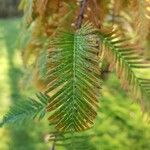
Metasequoia glyptostroboides
Dawn Redwood · Water Cypress · Hubei Sequoia
Description
Source: leafsnapMetasequoia glyptostroboides, commonly known as dawn redwood, is a deciduous conifer native to China. Thought to be extinct, it was rediscovered in the 1940s. This tree can grow up to 70 meters tall and features a conical shape with a straight trunk and reddish-brown bark that peels off in strips. Its needle-like leaves are arranged in opposite pairs on the branches and turn yellow-brown before falling off in autumn. The dawn redwood is notable for its rapid growth rate and adaptability to various soil types and climates. It has become a popular ornamental tree due to its unique appearance, particularly in autumn when its leaves turn golden brown before falling during winter dormancy. Additionally, the tree’s straight trunk and minimal branching make it ideal for timber production, including furniture making and construction materials such as flooring or decking boards. Overall, Metasequoia glyptostroboides is an interesting addition to both aesthetic and economic landscapes. Its rapid growth rate makes it a prime candidate for timber production, while its ornamental beauty enhances gardens and commercial landscapes. Additionally, its bark extracts have been used traditionally in Chinese medicine and are currently being studied for potential health benefits, including cancer treatment and relief from other ailments. In conclusion, Metasequoia glyptostroboides offers both aesthetic and economic benefits. It is worth considering for home gardens and commercial landscapes depending on one's needs and preferences. This tree also contributes to environmental conservation efforts, making it an even more valuable addition to diverse planting projects.
🌳 The dawn redwood is not just a majestic sight but also a climate champion. Because it grows quickly and becomes large, dawn redwood trees are very good at sequestering carbon dioxide, an important part of combating climate change. As a result, they are increasingly planted for use in carbon offset projects. They are also used in landscape architecture and as a source of rot-resistant lumber.
🎭 Health, safety, long life, wisdom, and communication, vigor and long life
Care Guide
💧 Water Every 7 days
The dawn redwood, which naturally grows in humid environments, thrives with moderate moisture. It generally needs watering every 1-2 weeks. During the active growing season in spring and summer, its water requirements increase. However, as it enters dormancy in the fall, these needs decrease. This pattern reflects the tree's balance between drought tolerance and its preference for regular hydration.
How should I water my Dawn redwood tree?
Watering your Dawn redwood is a simple task. To do it, just turn on your garden hose and slowly soak the soil. This method works well for mature trees that require a lot of water. However, if you have a smaller tree, you can use a watering can or another smaller tool. It's important to avoid overhead watering, especially for young trees, as it can cause disease due to excessive moisture on the leaves.
What should I do if I give my Dawn redwood tree too much water or too little water?
Overwatering can happen when the soil doesn't drain well. If your Dawn redwood is in soil that doesn't allow for proper drainage, the plant will start to decline. To fix this, you can either improve the soil's drainage or move your Dawn redwood to a better spot. If your tree is in a pot, you may need to repot it with looser soil and a container that drains well. Overwatered plants can also get diseases, so you should treat them as soon as possible. If your Dawn redwood is underwatered, it's simple - water it more frequently and it will recover. To determine if your Dawn redwood is overwatered, check its foliage. New growth that is discolored or easily breakable is a sign of too much moisture. If there's standing water or slow drainage in the plant's growing area, the soil may be too moist. Underwatered Dawn redwoods have sparse, brown leaves. Take into account recent heavy rainfall or constant high temperatures if you see these symptoms, as they could be contributing factors.
How often do I need to water my Dawn redwood tree?
A mature Dawn redwood is drought tolerant and usually only needs rainfall to survive. During the hottest months of the year, watering once per week may be necessary, but in other seasons, watering may not be needed at all. However, newly planted Dawn redwoods require regular watering to help the roots establish themselves. It's important to avoid overwatering, as standing water is not tolerated by this species. When unsure, it's better to not water the Dawn redwood than to risk overwatering it.
How much water does my Dawn redwood tree need?
During the height of summer, you will need to water your Dawn redwood. It is recommended to give the plant about one inch of water per week, but this can change if there has been rain. If it has rained one inch or more in a week, you don't need to water your Dawn redwood. However, newly planted Dawn redwoods will need more water during the establishment period. Usually, this means watering once every one to two weeks for the first few growing seasons.
How should I make sure my Dawn redwood gets enough water all year round?
The Dawn redwood tree needs the most water during the hot summer months. You should water it once a week if there is no rain. It can often survive without water during other times of the year. In spring and fall, you may need to give it some water if it's exceptionally hot, but this is rare. Unlike other plants, the Dawn redwood does not go into full dormancy in the winter, so it continues to grow during the coldest months. However, its water needs are still low during winter because the cool temperatures do not dry out the soil quickly.
☀️ Light Full sun
Dawn redwood does best when it receives a generous amount of sunlight regularly. It can grow under a canopy with reduced light or even in very low light, though its overall health may suffer. Native to regions with abundant sunlight, dawn redwood has become resilient to various light conditions. However, too much or too little light can affect its growth and vitality.
What are the sunlight requirements for dawn redwood?
Dawn redwood (Metasequoia glyptostroboides) thrives in full sun, requiring more than 6 hours of direct sunlight daily for optimal growth. It can also grow in partial sun or full shade, which is about 3-6 hours of sunlight. However, the plant's health may be compromised in less than ideal light conditions. It is essential to observe how sunlight moves through your garden to select the best spots that offer a balance of light and shade. Dawn redwood is adaptable to different sunlight conditions, thanks to its origin from regions with abundant sunlight. Although it can tolerate some variation in light exposure, both overexposure and insufficient light can negatively impact its growth and vitality.
How does artificial lighting affect dawn redwood growth?
Artificial lighting can be a great solution for dawn redwood when natural sunlight is inadequate, especially in winter or less sunny spaces. Adequate lighting is crucial for optimal growth of indoor plants. LEDs are recommended for their ability to be customized to provide specific wavelengths of light needed by plants. Full sun plants require 30-50W/sq ft, partial sun plants need 20-30W/sq ft, and full shade plants need 10-20W/sq ft of artificial light. The light source should be placed 12-36 inches above the plant, and the plant should be exposed to artificial light for 8-12 hours per day to mimic natural sunlight conditions.
What are the symptoms of insufficient sunlight in dawn redwood?
When dawn redwood doesn't receive enough sunlight, it may show several symptoms indicating light deficiency. New leaves might grow smaller than older ones, and the plant can exhibit leggy or sparse growth as the distance between leaves or stems increases. There might be faster leaf drop as the plant tries to conserve resources, leading to a halt in growth or no new growth at all. Leaves may develop irregular color patterns or appear paler, indicating insufficient chlorophyll. Chlorosis can occur with leaves turning yellow due to excessive light, while sunscald reveals as bleached areas. Other symptoms include leaf curling as a defense against excess sunlight, wilting from water loss, and leaf scorching from direct, excessive sunlight.
How can you provide optimal light conditions for dawn redwood?
To ensure dawn redwood receives optimal sunlight, gradually acclimate the plant to increased light if it's been under low light. Indoors, move the plant closer to a south-facing window, keeping curtains open during the day, or use artificial light for at least 8 hours daily if the plant is large. Outdoors, transition your plants to brighter spots gradually to prevent sunburn. Reduce obstructions like overhanging branches to allow more sunlight through. For smaller plants, consider transplanting during their dormant period in late winter or early spring to a location with better sunlight and drainage. Note that while parts of the plant affected by low light might not recover, new growth should be healthy once light exposure improves.
🌡️ Temperature 5–35°C
The dawn redwood grows best in temperatures from 41 to 95 ℉ (5 to 35 ℃), a range characteristic of temperate woody plants. It tolerates a wide span of temperatures and can acclimate to varied conditions, but it may need temperature adjustment during hot or cold seasons to keep growing healthily.
What is the preferred temperature range for Dawn Redwood?
Dawn Redwood, or Metasequoia glyptostroboides, thrives in a temperature range of 41 to 95°F (5 to 35°C), which is typical for temperate woody plants. It exhibits a flexible temperature tolerance, allowing it to adapt to a wide range of temperatures. Although it has strong cold resistance and usually does not require special frost protection measures, in regions where winter temperatures are expected to drop below -25°C, it's important to provide cold protection by wrapping the trunk and branches with materials like non-woven fabric or cloth. Additionally, watering the plant abundantly before the first freeze in autumn to keep the soil moist helps in preventing drought and water scarcity during winter and early spring.
How should Dawn Redwood be cared for in low temperatures?
Dawn Redwood is cold-tolerant and thrives best when temperatures are above 5°C. During winter, it's important to ensure that temperatures do not fall below -20°C. If temperatures drop below -25°C, while there may not be noticeable changes during winter, the branches can become brittle and dry, and no new shoots will emerge by springtime. To address this, any dead branches that have failed to produce new leaves should be pruned away in spring.
What are the symptoms and solutions for Dawn Redwood exposed to high temperatures?
During the summer months, it is crucial to keep the Dawn Redwood's environment below 35°C. Exposure to temperatures exceeding 41°C can result in the leaves becoming lighter in color, tips drying and becoming withered, and an increased susceptibility to sunburn. To mitigate these issues, trim away the sunburned and dried parts of the plant. It may also be necessary to move the plant to a location that offers shade during the midday and afternoon sun, or to use a shade cloth. Ensuring the soil remains moist by watering in the morning and evening is also beneficial.
💨 Humidity
🪴 Soil 6-7
🌱 Fertilizer
Dawn redwood has particular nutrient needs and doesn't require heavy fertilization. Spring is the best time to fertilize for optimal growth. Supplying nutrients improves its health, increases resistance to pests and diseases, and helps sustain its long lifespan.
Why do I have to add fertilizer to my Dawn redwood?
To promote healthy growth for Dawn redwood trees, it is advisable to fertilize them in the spring. As these trees have a long lifespan, they require support to thrive. Additionally, enriching the soil with nutrients can enhance their overall health and make them more resistant to typical pests and diseases that can impede growth or decrease their lifespan.
When should I fertilize my Dawn redwood tree?
The growing medium may not provide sufficient nutrients for healthy growth. But Dawn redwood is unique compared to your garden annuals and perennials because it doesn't need a lot of extra nutrients. For Dawn redwood, the best time to fertilize is in the spring, before new growth begins.
When is it not a good idea to fertilize my Dawn redwood tree?
Dawn redwood is a plant that doesn't need frequent fertilization like some other plants. It doesn't require a lot of extra nutrients, so too much fertilizer can actually harm it and cause it to die back. The best time to apply fertilizer is in the spring, and it's important to skip fertilizing during the summer, fall, and winter seasons. Avoid adding any fertilizer or organic matter to the soil during those times.
What kind of fertilizer does my Dawn redwood tree need?
When choosing fertilizer for your Dawn redwood plant, keep in mind its age and the nutrient needs. Although it doesn't require excessive nutrients, a balanced plant food can aid in healthy root growth without using fertilizers high in nitrogen.
How should I add nutrients to my Dawn redwood?
When fertilizing a Dawn redwood, it's crucial to consider both the timing and application method. To properly nourish the tree, apply the fertilizer once in the spring. Focus on the area around the base of the plant, being careful not to get any fertilizer on the trunk. If you're using granulated fertilizer, make sure to cover the pellets with a thin layer of soil. This will help guarantee that the fertilizer is effectively absorbed into the soil.
🪴 Pot & Repot 2-3 years
When repotting a Dawn redwood, select a container about 1-2 inches (2.5–5.1 cm) larger that provides ample drainage. Use a well-draining potting mix. Repot in spring or fall, ensuring the root ball sits slightly below the pot's rim. Water thoroughly after repotting and keep it in a warm spot with indirect sunlight.
✂️ Pruning
Pruning dawn redwood trees in early spring offers several benefits, such as improving air circulation, preserving their conical shape, and reducing overcrowded branches. This practice promotes healthier growth, prevents disease, and enhances the tree's structural integrity. The best time to prune is just before new growth begins, which ensures quicker recovery and minimizes stress on the tree.
🌿 Propagating
🐛 Diseases & pets
☠️ Toxicity
Dawn redwood trees are usually not toxic to humans or pets. However, they may cause some discomfort or infection if you get a splinter from the tree’s needles.
Characteristics
- Plant Type
- Tree
- Life Cycle
- Perennial
- Genus
- Metasequoia
- Family
- Cupressaceae
- Hardiness Zone
- 5-10
- Mature Height
- 35.05 m
- Mature Spread
- 7.92 m to 9.14 m
- Leaf Color
- Green, Yellow
- Leaf Type
- Deciduous
- Flower Color
- Green, Yellow, Brown
- Bloom Time
- Early spring, Mid spring
- Planting Time
- Spring, Autumn
- Harvest Time
- Mid summer, Late summer
- Native Area
- China