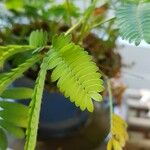
Mimosa pudica
گل قهر · Touch-me-not · Sensitive-plant · Shame Lady · Sensitive-weed
Description
Source: leafsnapMimosa pudica, commonly known as the sensitive plant or touch-me-not, is a fascinating member of the Fabaceae family. This small shrub can grow up to 50 cm in height and features delicate, fern-like leaves. Its leaves are remarkable because they are highly sensitive, responding to touch or movement by folding up and drooping down. Native to South America, Mimosa pudica has been introduced to many other parts of the world as an ornamental plant. It thrives in warm climates with plenty of sunlight but can also grow well indoors with proper care. In addition to its unique leaf movements, Mimosa pudica produces small, pinkish-purple flowers that bloom throughout the year. These flowers are followed by seed pods that contain several seeds. Various parts of this plant have been used in traditional medicine to treat conditions like skin diseases, respiratory problems, and digestive issues. However, it's important to note that these medicinal uses have not been scientifically validated. Overall, Mimosa pudica is an intriguing and attractive addition to any garden or indoor space, thanks to its unique leaf movements and delicate appearance.
💡 The small shame plant opens and closes on its own. While it isn't boastful, it carries a beautiful sentiment. Its pink flowers add a whimsical charm reminiscent of a little girl's playful nature.
🌳 The sensitive plant is more than a curiosity; it acts as an ecological tool. Its dense root network is very effective at preventing soil erosion and is frequently used in restoration ecology. Also, because it tends to take up heavy metals, the plant can function as a bioindicator, indicating the presence of certain contaminants in the soil.
🎭 Bashful, sensitive, and courteous.
Care Guide
💧 Water Every 7 days
The shame plant thrives in tropical conditions, preferring consistent moisture and high humidity. While it has moderate drought tolerance, it does best in slightly damp soil. Watering it weekly helps maintain its evergreen foliage. This is especially important indoors, where environmental control is essential for its continuous growth.
How should I water my Shame plant?
There are various ways to water a Shame plant, such as using a garden hose with a spray nozzle, a watering can, or any other regular watering tool. The plant is not too particular about the type of water it receives and can thrive with rainwater, tap water, or filtered water. It is best to avoid watering the plant from above, as this can harm the leaves and flowers and may possibly lead to disease. Instead, using a drip irrigation system is often the most effective method for providing water evenly and directly to the soil. When watering a Shame plant that is grown in a container, you can follow a similar approach but change the tools used, such as a cup, watering can, or your tap to apply water directly to the soil.
What should I do if I give my Shame plant too much water or too little water?
To help an underwatered Shame plant, simply water it more regularly when you notice it needs moisture. However, overwatering can lead to more severe issues, like disease and decline. To prevent this, choose a well-lit spot with good drainage so excess water can drain properly. If you overwater a potted Shame plant, consider changing the pot to one with better drainage and loose soil.
How often should I water my Shame plant?
The Shame plant requires regular watering throughout the growing season. In the spring, watering once a week is recommended. As the season progresses and temperatures rise, you may need to increase watering to two or three times a week. However, it's important not to exceed this rate as it can harm the plant. It's also important to keep the soil relatively moist but not overly wet, regardless of watering frequency. When it comes to Shame plants in pots, they may need more frequent watering due to the soil heating up and drying out faster. Typically, watering a potted Shame plant a few times a week is necessary, compared to just once a week for a plant in the ground.
How much water does my plant called Shame need?
Determining how much water to give your Shame plant can be approached in a few different ways. Some gardeners prefer to assess the soil's moisture level by feeling it, suggesting that watering should continue until the top six inches of soil feel moist. Another option is using a specific measurement, such as about two gallons of water per week, taking into account factors like temperature and soil dryness. However, it's important to avoid overwatering if your plant needs less than two gallons per week. When growing Shame plant in a container, a different method is necessary. You should provide enough water to wet all layers of dry soil, which can be evaluated by touching the soil with your finger or allowing excess water to trickle out through the pot's drainage holes.
How do I know if I'm giving enough water to my Shame plant?
Avoiding overwatering your Shame plant can be somewhat difficult. On one hand, these plants have deep roots that need weekly soil moisture. On the other hand, Shame plants are highly prone to root rot and may also develop browning when overwatered. Underwatering is less likely as these plants can survive without additional watering for a period of time, but if they go too long without water, they will likely wilt and develop dry leaves.
☀️ Light Full sun
The sensitive plant flourishes with plentiful sunlight, reflecting its origins in open habitats. Its vigor and growth are enhanced by ample sun exposure, particularly during its main growth periods. Conversely, insufficient sunlight can inhibit its development. Nevertheless, the sensitive plant can also tolerate areas with more moderate sun exposure.
What are the sunlight requirements for the Shame Plant (Mimosa pudica)?
The Shame Plant thrives under full sunlight, necessitating more than 6 hours of sunlight daily for optimal growth, reflecting its adaptation to open habitats. It can also grow in partial sun, which means about 3-6 hours of sunlight a day. However, the plant's growth may be hindered without adequate sunlight. Despite this, the Shame Plant has a certain level of resilience and can survive in moderately sunlit areas. It's important to observe the movement of sunlight through your garden to identify the ideal location for your plants, balancing the right amount of light and shade to ensure their well-being.
How can artificial lighting support Shame Plants indoors?
Indoor Shame Plants require sufficient lighting to thrive, especially in conditions where natural sunlight is scarce, like during winter or in less sunny spaces. Artificial lighting, such as LED lights, can be a valuable solution to supplement sunlight, promoting healthier and faster growth. These lights should be customized to offer the specific wavelengths needed by the plants, with full sun plants requiring 30-50 watts per square foot, partial sun plants 20-30 watts per square foot, and full shade plants 10-20 watts per square foot. Proper placement involves setting the light source 12-36 inches above the plants and ensuring they receive 8-12 hours of light daily to mimic the natural daylight hours.
What are common symptoms of inadequate light in Shame Plants, and how can they be addressed?
Shame Plants may showcase various symptoms when subjected to inadequate light, including smaller new leaves, leggy or sparse growth, early leaf drop, slower or halted growth, paler new leaves, and discoloration such as chlorosis. Other symptoms under intense sunlight exposure include sunscald, leaf curling, wilting, and leaf scorching. To mitigate these issues indoors, gradually increasing sunlight exposure by moving plants to sunnier locations or using artificial lighting can be effective. For outdoor plants, a gradual adjustment to more sunlight is recommended to prevent sunburn. Addressing obstructions to sunlight and, when feasible, transplanting the plant to a sunnier location with good drainage can also help improve light access.
🌡️ Temperature 20–41.1°C
The sensitive plant plant grows best in a temperature range of 68 to 105 ℉ (20 to 41 ℃) and is indigenous to tropical and sub-tropical areas. During summer it can endure slightly higher temperatures but might need shading to avoid leaf scorching. In colder months, keep it away from cold drafts and ensure the temperature stays at or above 50 ℉ (10 ℃).
What temperature conditions are preferred by the Shame Plant (Mimosa pudica)?
The Shame Plant (Mimosa pudica) thrives in a temperature range of 68 to 105°F (20 to 41°C) and is native to tropical and sub-tropical regions. During the summer, it can tolerate slightly higher temperatures but may need shading to prevent leaf scorching. In the colder months, it's crucial to protect the plant from cold drafts and ensure the temperature remains above 50°F (10°C) to avoid damage. The plant is extremely heat-loving, so cold temperatures can cause harm. Indoor care during autumn and winter involves placing it near a bright window but away from heaters, maintaining indoor temperatures above the minimum suitable growth temperature for optimal health.
How does low temperature affect the Shame Plant and what can be done?
Low temperatures are not tolerated well by the Shame Plant. It prefers to be kept in warmer conditions, ideally above the minimum suitable growth temperature. When exposed to temperatures below the lower limit for growth, the plant's leaves may lighten in color and, following frost damage, turn brown or black, exhibiting wilting and drooping. To salvage a plant affected by low temperatures, trim off the frost-damaged parts and move it indoors to a warmer environment. It is suggested to place it near a south-facing window for ample sunlight while avoiding proximity to heaters or air conditioning vents, which could cause air dryness.
What should be done if the Shame Plant is exposed to high temperatures?
During the summer, the Shame Plant should ideally be kept below the maximum suitable growth temperature. Exposure to temperatures above the maximum tolerable level can lighten the color of the leaves and increase susceptibility to sunburn. In such cases, trim the sunburned and dried-up parts of the plant. To protect the plant, move it to a shaded location during the intense midday and afternoon sun. It's also beneficial to water the plant in the morning and evening to maintain soil moisture, helping the plant to cope with high temperatures.
💨 Humidity high (>60%)
This plant needs special care because it loves high humidity levels of 60-80% or more. The best way to achieve this is by placing a humidifier near the plant. Daily misting is also essential! Make sure the room has good ventilation.
🪴 Soil 6-7
🌱 Fertilizer
The Sensitive plant does well with regular, dilute fertilizer applications to encourage healthy leaf development. You should feed the Sensitive plant about once a month during the summer. Nitrogen is essential for foliage, so providing nitrogen-rich sources helps the Sensitive plant thrive.
Why should I give plant food to my Shame plant?
Plants require nutrients for growth, but some can obtain them naturally without additional fertilizer. Shame plants, like other plants, rely on nutrients for growth and internal processes. Nitrogen, phosphorus, and potassium are the main nutrients that plants need, with nitrogen being vital for foliage growth. Shame plants often struggle to obtain enough nitrogen from the soil, so many gardeners choose to provide additional nitrogen through fertilizers.
When should I fertilize my Shame plant?
To help Shame plant thrive, it's recommended to fertilize it about once a month during its active growth period, which is typically spring and summer. It's important to avoid fertilizing during fall and winter when the plant is less active. Simply look out for signs of new growth as an indication that it's time to start fertilizing. Whether your Shame plant is grown outside or indoors in a container, the fertilization schedule remains the same. However, if it's in a container, you may not need to fertilize for the first one to two months. Container plants usually have sufficient nutrients in the potting soil, so it's best to start fertilizing after the plant has been in the same soil for a while.
When should I not add fertilizer to my Shame plant?
- Avoid fertilizing a Shame plant that is not healthy, such as when it has a disease or insect pests. - Don't fertilize a dehydrated plant, as it will worsen the problem. - Only apply fertilizer to healthy plants. - When watering, avoid splashing fertilizer onto the leaves or stem, as it can cause burned spots. - Unless you're using a specialized foliage fertilizer, ensure it doesn't directly touch the plant.
What kind of plant food does my Shame plant need?
Fertilizers are important for promoting growth in the Shame plant. They contain high levels of nitrogen, potassium, phosphorus, and other essential nutrients like iron, manganese, and zinc. A balanced fertilizer with a 10-10-10 NPK number is recommended for Shame plants. Natural alternatives like blood meal or worm castings are also effective. If you want to focus on leaf growth, a fertilizer high in nitrogen, like fish fertilizer, is a good choice. However, if you're not interested in promoting flowers or seeds, it's unnecessary to provide additional supplements for that purpose.
How do I give nutrients to my Shame plant?
To properly fertilize your Shame plant, follow the instructions provided on the fertilizer you purchased. To avoid over-fertilizing, it's recommended to start with half-strength fertilizer. Many people often accidentally over-fertilize this plant since it requires frequent fertilization. Keep in mind that adding more fertilizer is easier than trying to rescue an over-fertilized plant. Ensure that the soil is at least somewhat moist before applying fertilizer; avoid fertilizing dry soil. This will aid in the absorption of the fertilizer and prevent fertilizer burn. Additionally, water the soil after applying dry fertilizers. There are two methods of applying fertilizers: mixing them into the soil during planting or applying them on top and watering the plant afterwards. For Shame plants, water-soluble fertilizers are generally the simplest option. Just mix the fertilizer solution into your watering can following the recommended dosage, and water the plant normally. If you prefer not to remember monthly fertilization, slow-release granules or fertilizer spikes can be an effective alternative.
🪴 Pot & Repot Every 12 months
When repotting Sensitive plant, choose a pot 1–2 inches (2.5–5.1 cm) larger in diameter and ensure it has good drainage. Use a well-draining potting mix and consider adding perlite for extra drainage. Repot in spring or early summer, water thoroughly afterward, and place it in a shady spot at first.
✂️ Pruning
Pruning the shame plant from early to late spring encourages bushier growth and improves air circulation. Use sharp pruners to remove dead stems and shape the plant, which helps prevent it from becoming leggy. Regular pruning keeps the plant compact and promotes healthy new growth. Handle the plant gently, as its foliage is quite sensitive.
🌿 Propagating
🐛 Diseases & pets
☠️ Toxicity
Characteristics
- Plant Type
- Herb
- Life Cycle
- Annual, Perennial, Biennial
- Genus
- Mimosa
- Family
- Fabaceae
- Hardiness Zone
- 10-13
- Mature Height
- 91 cm
- Mature Spread
- 49 cm
- Leaf Color
- Green
- Leaf Type
- Deciduous
- Flower Color
- Pink
- Flower Size
- 1.02 cm
- Bloom Time
- All year round
- Planting Time
- Spring
- Harvest Time
- All year round
- Native Area
- Belize, Honduras, Guatemala, Dominican Republic, Panama, Colombia, Bahamas, Haiti, Bolivia, Myanmar, Venezuela, Guyana, El Salvador, Nicaragua, Brazil, Ecuador, Suriname, Costa Rica