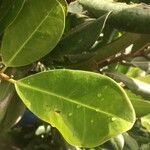
Mimusops coriacea
Mimusops · Mars's Sapota · Are they edebols
Description
Source: leafsnapMimusops coriacea, commonly known as the Green Milkwood, is a small to medium-sized evergreen tree native to the coastal regions of South Africa. Belonging to the Sapotaceae family, it can reach up to 10 meters in height. The tree features a dense, rounded crown with glossy, leathery green leaves. The Green Milkwood produces small, fragrant flowers that are greenish-yellow in color, blooming from September through November. Its fruit is a fleshy berry that changes from green to yellow when ripe. For centuries, the bark of Mimusops coriacea has been used medicinally by indigenous people. It contains compounds with anti-inflammatory properties, making it useful as an analgesic for toothaches and other ailments. This plant prefers well-drained soils and can thrive in both full sun and partial shade. While it is drought-tolerant once established, it requires regular watering during its initial growth period. Overall, Mimusops coriacea is an attractive ornamental tree with medicinal properties, making it a valuable addition to any garden or landscape design project.
Care Guide
💧 Water Every 7 days
Mimusops is native to arid regions, showing impressive drought tolerance and resilience to a range of temperatures. It thrives with minimal moisture and needs watering only every 2-3 weeks to mimic its natural dry environment. This makes it an excellent choice for xeriscaping.
☀️ Light Full sun
Mimusops is native to open habitats, such as sunny meadows and forest margins, which provide abundant light. It does best in Full Sun but can also tolerate Partial Sun, adjusting well to different sunlight levels.
🌡️ Temperature 20–37.8°C
Mimusops comes from tropical areas where the climate is usually warm and humid. Therefore it is well suited to high temperatures and humidity. It does not tolerate sudden temperature changes and prefers a stable thermal environment, so avoiding temperature fluctuations indoors is important. It generally cannot withstand cold and needs warmer conditions to grow. If the surrounding temperature falls too low, the plant may stop growing or even die.
💨 Humidity
🪴 Soil 6-7
🌱 Fertilizer
Use organic fertilizers (e.g., fish emulsion, compost) instead of chemical fertilizers for Mimusops. Supply higher levels of nitrogen and phosphorus to young plants in spring. Incorporate compost or fertilizer into the soil before or after planting. For mature plants, top up in spring with a balanced fertilizer or one formulated for specific nutrient deficiencies. Nutrient deficiency causes small leaves, short branches, yellow or bronze foliage, acidic/sour fruits, premature fruit drop, and fruit splitting.
🪴 Pot & Repot
✂️ Pruning
Mimusops trees feature a dense canopy and evergreen foliage. To keep them in optimal condition, prune them from early to late winter. Focus on removing dead or overcrowded branches to improve air circulation and allow more sunlight to penetrate. Regular pruning not only enhances the tree's health and stimulates new growth but also maintains its aesthetic appeal in gardens.
🌿 Propagating
🐛 Diseases & pets
☠️ Toxicity
Characteristics
- Plant Type
- Tree
- Life Cycle
- Perennial
- Genus
- Mimusops
- Family
- Sapotaceae
- Hardiness Zone
- 10-12
- Mature Height
- 14.94 m to 20.12 m
- Mature Spread
- 10.06 m to 14.94 m
- Leaf Color
- Dark Green
- Leaf Type
- Evergreen
- Flower Color
- White
- Flower Size
- 1.02 cm to 1.52 cm
- Bloom Time
- Summer, Early fall
- Planting Time
- Spring, Summer, Autumn
- Harvest Time
- Late summer, Fall
- Native Area
- Madagascar