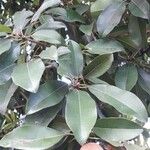
Mimusops elengi
Bakul tree · Medlar · Tanjongtree · Spanish-cherry · Indian medlar
Description
Source: leafsnapMimusops elengi, commonly known as the Spanish cherry or bullet wood, is a tropical evergreen tree belonging to the Sapotaceae family. Native to Southeast Asia and India, this tree can reach heights of up to 20 meters. It features a straight trunk with smooth gray bark and dense foliage composed of glossy, dark green, oval-shaped leaves. During the summer months, Mimusops elengi produces fragrant white flowers that bloom in clusters. These flowers emit a sweet scent akin to jasmine or orange blossom and are traditionally used in medicine for their anti-inflammatory properties. The tree bears small, round fruit that is green when unripe and turns yellow-orange as it ripens. While the fruit has a sweet taste, it contains latex that can cause skin irritation. Mimusops elengi has a variety of uses. The tree's hard wood is prized for furniture making, while its bark, rich in tannins, is used in dyeing processes. The leaves have medicinal properties, and the pleasantly fragrant flowers are commonly used in perfumes. Overall, Mimusops elengi serves both ornamental and medicinal purposes, making it an invaluable tropical tree species with significant economic importance.
Care Guide
💧 Water Every 7 days
The Spanish cherry plant thrives in environments that resemble the tropics, characterized by high humidity and consistent moisture. It prefers to be watered every two weeks. Although it can withstand short periods of drought, this evergreen plant remains vibrant throughout the year and adapts well to different temperatures.
How should I water my Spanish cherry tree?
Watering your Spanish cherry should not be too complicated. You can use any common watering tool like watering cans, hoses, or even cups to moisten the soil. It's important to water directly onto the soil, ensuring that all areas receive equal moisture to meet the needs of the entire root system. Using filtered water is recommended to avoid any harmful particles from tap water. Additionally, it's best to use water at or slightly above room temperature as extreme temperatures could shock your Spanish cherry. However, rest assured that the Spanish cherry usually responds well to any type of water it receives.
What should I do if I give too much or too little water to my Spanish cherry?
Outdoor plants, especially newly planted ones or seedlings, can easily suffer from lack of watering. It's important to remember to water them consistently for a few months while they are still small or newly planted. Once the roots are established, Spanish cherry plants can usually rely on rain for hydration. However, when Spanish cherry plants are in pots, it is more likely to overwater them. If you accidentally overwater your Spanish cherry, there are steps you can take to remedy the situation. First, stop watering the plant immediately to minimize the negative effects. Then, inspect the roots by removing the plant from its pot. If there is no sign of root rot, you can return the plant to its container. But if root rot is present, trim away the affected roots and consider applying fungicide to prevent further damage. Lastly, repot the Spanish cherry in well-draining soil. On the other hand, if your Spanish cherry is underwatered, simply increase the frequency of watering. This is usually an easy fix, as the plant's leaves will droop and dry out, but they will quickly recover and become full again after sufficient watering. Make sure to adjust your watering schedule promptly when underwatering occurs.
How often do I need to water my Spanish cherry tree?
Most outdoor plants can grow naturally with rainfall. However, if your area lacks rainfall, you need to water your plants adequately every 2 weeks in spring and fall. In summer, you need to water them more frequently. In winter, when plants grow slower and need less water, you should water them sparingly or not at all. If your Spanish cherry plant is young or newly planted, you should water it more often to help it establish and grow to be more adaptable and drought tolerant. For potted plants like the Spanish cherry, there are two main ways to determine watering frequency. The first is to follow a set schedule, such as watering once every week or every other week. However, this may not always work as it doesn't account for the unique conditions of your plant's environment. Watering frequency can also change depending on the season. For example, a set schedule may not be enough during summer when the plant needs more water. Alternatively, you can gauge watering based on soil moisture. It's generally best to wait until the top two to four inches of soil, about ⅓ to ½ depth of the pots, have dried out completely before watering again.
How much water does my Spanish cherry tree need?
Watering your Spanish cherry plant may not require a large amount of water. If only a few inches of soil have dried since your last watering, give it about five to ten ounces of water. Assess the soil moisture to determine how much water to provide. Keep track of how many inches of soil have dried between waterings. To ensure adequate moisture, water enough to moisten all the dry soil layers since your last watering. If over half of the soil is dry, give more water until there is excess water draining from the pot's drainage holes. If your Spanish cherry receives plenty of rain outdoors, it may not need additional watering. For a young or newly established plant, provide 1-2 inches of rain per week. As the plant grows and establishes, it can rely solely on rainwater. Only during hot weather with no rainfall for 2-3 weeks, consider watering thoroughly to prevent stress.
How can I know if I am giving enough water to my Spanish cherry plant?
The Spanish cherry is often overwatered, which leads to various signs. Typically, an overwatered Spanish cherry will have yellowing leaves and may lose some leaves. Overwatering can also cause the plant's structure to shrink and encourage root rot. Conversely, an underwatered Spanish cherry will start to droop and develop brown or brittle leaves. Regardless of whether you notice signs of overwatering or underwatering, it is important to take action and revive the health of your Spanish cherry.
☀️ Light Full sun
Spanish cherry does best in full sun, although it can survive in places with reduced light or even very low light. Native to an environment accustomed to full sun, for healthy growth too much sunlight can scorch the foliage while too little may lead to sparse growth.
What are the sunlight requirements for a Spanish cherry?
Spanish cherry plants thrive best under full sun exposure, requiring more than 6 hours of sunlight daily. However, they can also accommodate partial sun to full shade conditions, with about 3-6 hours of sunlight. It's essential to observe your garden's sunlight patterns to find the optimal balance for your plant's health. Excessive sunlight might lead to foliage burn, while insufficient light can cause the plant to grow sparsely.
How does artificial lighting support Spanish cherry growth indoors?
For indoor Spanish cherry plants, especially when natural sunlight is inadequate, like during winter or in less sunny locations, artificial lighting becomes crucial. Optimal growth is supported by ensuring plants receive enough light. LED lights are recommended because they can mimic the specific wavelengths of light needed by plants. The required intensity varies with the plant's needs: 30-50W/sq ft for full sun, 20-30W/sq ft for partial sun, and 10-20W/sq ft for full shade plants. The artificial light should be placed 12-36 inches above the plant and kept on for 8-12 hours daily to mimic natural daylight conditions.
What are the symptoms of light deficiency in Spanish cherry plants?
Spanish cherry plants showing light deficiency might exhibit several symptoms, including smaller new leaves, leggy or sparse growth, premature leaf drop, halted growth, lighter-colored new leaves, and general signs of distress like chlorosis, sunscald, leaf curling, wilting, and leaf scorching. These symptoms indicate that the plant is not receiving adequate sunlight, which can hinder its ability to photosynthesize and maintain healthy growth.
How can I address light deficiency in indoor and outdoor Spanish cherry plants?
To counteract light deficiency in Spanish cherry plants, gradually increase exposure to sunlight by moving them closer to sunnier spots every week until they get at least 6 hours of direct sunlight daily. For indoor plants that are large or difficult to move, supplement with artificial lighting for at least 8 hours a day. For outdoor plants, ensure they are gradually adapting to sunnier locations to prevent sunburn. If plants are located where sunlight is obstructed, such as by trees, consider pruning to allow more light through or transplanting smaller plants to sunnier spots. While some damage may be irreversible, new growth should be healthy with improved light conditions.
🌡️ Temperature 20–37.8°C
Spanish cherry is native to regions where temperatures typically range from 68 to 100.4 °F (20 to 38 ℃). It favors these warmer conditions, so care must be taken to adjust its surroundings to maintain those temperatures through changing seasons.
What is the ideal temperature range for growing Spanish cherry?
The Spanish cherry thrives in environments where temperatures range between 68 to 100.4 °F (20 to 38 °C). It is a heat-loving plant that requires warmer conditions to grow well. During seasonal changes, care should be taken to adjust the surroundings of the Spanish cherry to maintain these temperatures. In the colder months, it is advised to bring outdoor-grown Spanish cherry indoors and place it near a bright window, ensuring it is not too close to heaters to avoid damage. Keeping the temperature above 20°C during winter is crucial for the plant’s growth, as temperatures approaching 5°C can be harmful.
How does low temperature affect Spanish cherry and what are the solutions?
Spanish cherry is sensitive to low temperatures and thrives best when the temperature is above 20°C, needing to be kept above 5°C during winter. Exposure to temperatures below 1°C may cause the leaves to lighten in color. Following frost damage, the leaves may turn brown or black, and the plant might show symptoms of wilting and drooping. To mitigate these effects, it's recommended to trim off the frost-damaged parts and move the plant indoors to a warm environment for cold protection. Placing the plant near a south-facing window ensures ample sunlight, but it should be kept away from heaters and air conditioning vents to avoid air dryness.
What measures should be taken when Spanish cherry experiences high temperature?
During summer, it's important to guard Spanish cherry against temperatures exceeding 38°C to prevent heat stress. Should the temperature rise above 43°C, the plant's leaves may lighten in color, making it more susceptible to sunburn. To address this, trim away the sunburned and dried-up parts, and move the plant to a shaded area away from the intense midday and afternoon sun. Additionally, watering the plant in the morning and evening can help keep the soil adequately moist, providing further relief from the heat.
What is the botanical name of Spanish cherry?
The botanical name of Spanish cherry is Mimusops elengi.
💨 Humidity
🪴 Soil 6-7
🌱 Fertilizer
The best time to fertilize a Spanish cherry is in early spring, when it comes out of dormancy. This supports overall growth and flowering. Fertilizing improves the foliage, stems, and branches, and encourages flowers that are large, vibrant, and long-lasting. It helps transfer nutrients from the roots to the flowers and enhances the plant’s health and resistance to disease.
🪴 Pot & Repot
✂️ Pruning
The Spanish cherry tree is known for its dense, glossy leaves and fragrant blossoms. To maintain its health and appearance, prune the tree from early to late winter. Focus on removing dead branches, thinning crowded areas, and shaping the tree for better structure. Regular pruning not only improves the tree's appearance but also promotes healthy growth. Be sure to use clean, sharp tools to prevent infections.
🌿 Propagating
🐛 Diseases & pets
☠️ Toxicity
Characteristics
- Plant Type
- Tree
- Life Cycle
- Perennial
- Genus
- Mimusops
- Family
- Sapotaceae
- Hardiness Zone
- 10-12
- Mature Height
- 9.14 m to 17.98 m
- Mature Spread
- 10.06 m
- Leaf Color
- Dark Green
- Leaf Type
- Evergreen
- Flower Color
- White, Cream
- Flower Size
- 1.27 cm
- Bloom Time
- Late spring, Summer, Early fall, Mid fall
- Planting Time
- Spring, Summer, Autumn
- Harvest Time
- Fall, Winter
- Native Area
- India, Malaysia, Indonesia, Cambodia, Vietnam, Myanmar, Vanuatu, Bangladesh, Laos, Thailand