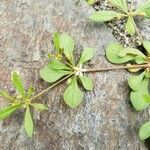
Mollugo verticillata
Green carpetweed · Carpetweed · Indian chickweed · Green Carpet-weed · Common Carpetweed
Description
Source: leafsnapMollugo verticillata, commonly known as green carpetweed, is a small annual herb that belongs to the family Molluginaceae. Native to North America, it is commonly found in various habitats including fields, lawns, and disturbed areas. The plant exhibits a prostrate growth habit, with stems that can extend up to 30 cm in length. Its small leaves are arranged in whorls of 3 to 6 around the stem. From June to September, tiny white flowers with five petals bloom. Green carpetweed is often considered a weed due to its rapid spread facilitated by numerous seeds that can remain viable in the soil for up to five years. Despite its weedy nature, it has historically been used for medicinal purposes by Native Americans as an herbal remedy for ailments such as fever and stomach problems. In summary, while Mollugo verticillata may be viewed as an unremarkable plant because of its weedy characteristics, it holds ecological and medicinal value.
🌳 Although green carpetweed may look ordinary, it is a nutrient-dense plant high in vitamin C. Consuming it delivers considerable health benefits, making it an excellent choice for developing vitamin-focused superfoods.
Care Guide
💧 Water Every 7 days
Green carpetweed thrives in well-drained soils and prefers consistent moisture. Although it can withstand dry spells, it flourishes with weekly watering. As an adaptable ground cover, green carpetweed benefits from natural rainfall, which reduces the need for additional watering during the growing season.
How should I water my Green carpetweed effectively?
To water Green carpetweed, you have several options. You can use a garden hose with a spray nozzle, a watering can, or any other common watering tool. This plant is not too particular about the type of water it receives, as it can survive on rainwater, tap water, or filtered water. It's generally best to avoid watering this plant from overhead to prevent damage to the leaves and flowers and to minimize the risk of disease. A drip irrigation system is often the most effective method for watering Green carpetweed, as it ensures the water is applied evenly and directly to the soil. If you have a Green carpetweed growing in a container, you can use a similar watering approach but change the tools you use. In this case, you can use a cup, watering can, or simply pour water from your tap directly onto the soil.
What should I do if I give too much or too little water to my Green carpetweed?
To prevent underwatering Green carpetweed, simply water it more regularly. Overwatering, on the other hand, can be much more problematic. Overwatered plants may succumb to disease and ultimately die. To avoid overwatering, choose a growing location for your Green carpetweed that has good drainage and receives plenty of sunlight. If you are overwatering a potted Green carpetweed, consider repotting it with well-draining soil and a pot with sufficient drainage holes.
How frequently should I water my Green carpetweed?
Green carpetweed requires regular watering throughout the growing season. In spring, it is best to water this plant once a week. As the season progresses and temperatures rise, you may need to increase watering to two or three times per week. However, it is important not to exceed this rate as it can be harmful to the plant. It is crucial to keep the soil moist but not overly wet, regardless of how often you need to water. Watering green carpetweed in a pot is slightly different. Due to faster drying in pot soil, it is generally necessary to water container-grown plants a few times per week compared to just once a week for plants in the ground.
How much water does my Green carpetweed require?
There are a few ways to decide how much water to give your Green carpetweed. Some gardeners feel the soil to determine its moisture level and water until the top six inches are moist. Alternatively, you can use a specific measurement, like two gallons per week, depending on temperature and soil dryness. However, be cautious not to overwater if your plant needs less water. When growing Green carpetweed in a container, you should water until all soil layers are moist, which can be tested by sticking your finger in the soil or observing water drainage.
How do I know if I'm giving enough water to my Green carpetweed?
Avoiding overwatering your Green carpetweed can be somewhat difficult due to the plant's specific needs. On one hand, moistening the soil weekly is necessary because these plants have deep roots. On the other hand, Green carpetweed is highly susceptible to root rot, which can cause browning. It is less likely to underwater these plants since they can survive without additional watering for a while. However, if you go too long without watering, wilting and dry leaves may occur.
☀️ Light Full sun
Green carpetweed does best when it receives a full day's light, though it can tolerate somewhat lower light levels. This light requirement reflects the plant's native environment — open, unshaded areas. Too little or too much light can inhibit its development and growth.
What are the sunlight requirements for green carpetweed?
Green Carpetweed (Mollugo verticillata) needs a specific amount of sunlight to thrive. It requires full sun, which is above 6 hours of sunlight daily, or partial sun, about 3-6 hours of sunlight. Observing how sunlight moves through your garden helps in choosing spots that provide a balance of light and shade, ensuring the plants' growth and happiness.
What essentials should I know about growing green carpetweed?
Green carpetweed thrives in conditions that mirror its original habitat - open, unshaded areas, requiring a full day's worth of sunlight but can also manage in slightly lesser intense conditions. Insufficient or excessive exposure affects its growth. When natural light is not enough, especially during winter or in less sunny spaces, artificial lighting becomes crucial for indoor plants. LED lights are recommended, providing the specific wavelengths needed. Full sun plants require 30-50W/sq ft, partial sun plants 20-30W/sq ft, and full shade plants 10-20W/sq ft of artificial light. Place lights 12-36 inches above the plant and mimic natural daylight hours, usually 8-12 hours per day.
What are the symptoms of inadequate light for green carpetweed?
When green carpetweed doesn't receive sufficient light, it may show symptoms such as smaller new leaves, leggy or sparse growth, faster leaf drop, slower or ceased growth, lighter-colored new leaves, and chlorosis, where leaves turn yellow due to a breakdown of chlorophyll. Excessive sunlight can cause sunscald, leaf curling, wilting, and leaf scorching, indicating plant stress and reduced health.
How can I address light issues for indoor and outdoor green carpetweed?
For indoor plants, gradually increase sunlight exposure to at least 6 hours daily using a south-facing window or artificial light for 8 hours daily, if the plant is large or not easily movable. For outdoor plants, move them gradually to sunnier spots to avoid sunburn. Pruning obstructions like trees can help increase sunlight. For smaller plants, consider transplanting during their dormant phase to a location with ample sunlight and good drainage. Note that parts of the plant affected by insufficient sunlight may not recover, but new growth will be healthy after correcting light exposure.
🌡️ Temperature 5–37.8°C
Green carpetweed is native to mild climates, preferring temperatures between 68 and 100.4°F (20 and 38°C). When seasons change, temperature adjustments may be needed to mimic its natural thermal environment.
What is the ideal temperature range for Green carpetweed?
Green carpetweed, or Mollugo verticillata, thrives in mild climates and prefers temperatures between 68 to 100.4°F (20 to 38°C). To mimic its native environment, it's important to adjust the surrounding temperatures according to the seasons. Despite its robust cold resistance, in regions where winter temperatures can drop below -25°C, protective measures against frost should be applied by covering the plant with materials such as soil or straw.
How should Green carpetweed be protected against cold weather?
Green carpetweed possesses strong cold resistance and usually doesn't require special frost protection measures. Nonetheless, if winter temperatures are anticipated to plummet below -25°C, it's crucial to safeguard the plant. Before the onset of the first freeze in autumn, it's advised to water the plant thoroughly, ensuring the soil is moist and freezes in that state. This aids in preventing drought and water scarcity throughout the winter and early spring, thereby protecting the plant.
What are the symptoms and solutions for Green carpetweed exposed to low temperatures?
While Green carpetweed can tolerate cold conditions and performs best when the temperature stays above 20°C, it should remain above 0°C through the winter. Exposure to temperatures below -25°C may not lead to noticeable changes during winter but could result in reduced sprouting or lack of sprouting in spring. The recommended solution for spring is to remove any parts of the plant that have failed to sprout, ensuring the health of the remaining plant.
What are the symptoms and solutions for Green carpetweed when exposed to high temperatures?
During summer months, it's essential to keep Green carpetweed's surroundings below 38°C. Temperatures surpassing 43°C may cause the plant's leaves to lighten in color, become prone to curling, suffer from sunburn, and, in severe instances, the entire plant might wilt and dry out. To manage this, trim away sunburned and dried-up parts of the plant. Moving the plant to a shaded area during midday and afternoon or using a shade cloth can help prevent further damage. Additionally, watering the plant in the morning and evening aids in maintaining soil moisture, protecting the plant from heat stress.
💨 Humidity dry (<40%)
This plant prefers dry conditions, so don't mist it. However, watering it less often can also thrive in higher humidity.
🪴 Soil 6-7
🌱 Fertilizer
Green carpetweed responds well to regular, light fertilizer applications to encourage healthy leaf development. Fertilize green carpetweed roughly once a month during the summer. Nitrogen is important for foliage, and providing nitrogen-rich sources helps green carpetweed flourish.
🪴 Pot & Repot
✂️ Pruning
🌿 Propagating
🐛 Diseases & pets
☠️ Toxicity
Characteristics
- Plant Type
- Herb
- Life Cycle
- Annual, Biennial
- Genus
- Mollugo
- Family
- Molluginaceae
- Hardiness Zone
- 5-11
- Mature Height
- 3 cm to 15 cm
- Mature Spread
- 5 cm to 46 cm
- Leaf Color
- Green
- Leaf Type
- Deciduous
- Flower Color
- White
- Flower Size
- 2.54 cm
- Bloom Time
- Early summer, Mid summer
- Planting Time
- Spring
- Harvest Time
- Mid summer, Late summer
- Native Area
- Colombia, Belize, Cuba, Honduras, Mexico, Bolivia, Venezuela, Peru, Guyana, Nicaragua, Ecuador, Costa Rica, Panama