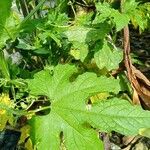
Momordica dioica
Spine gourd · Bristly Balsam Pear · Prickly Carolaho · Spiny gourd · Teasle Gourd
Description
Source: leafsnapMomordica dioica, commonly known as spiny gourd or spine gourd, is a perennial climbing vine in the Cucurbitaceae family. Native to the Indian subcontinent and Southeast Asia, it has been introduced and naturalized in many other parts of the world. The plant has a long history of use in traditional medicine due to its various health benefits. The spiny gourd plant can grow up to 5 meters long and produces large, deeply lobed leaves with toothed edges. Its flowers are yellowish-green with five petals, and the fruit is oblong or cylindrical, covered in sharp spines. The fruit turns from green to yellow-orange when ripe. The fruit of Momordica dioica is edible but bitter due to its high content of momordicin compounds. It is commonly used as a vegetable in Asian cuisines, especially in India, where it is often made into curries or pickles. Besides its culinary uses, Momordica dioica has several medicinal properties. It exhibits anti-inflammatory effects that can help alleviate arthritis pain, regulates blood sugar levels by increasing insulin secretion, and is an excellent source of antioxidants that protect against oxidative stress caused by free radicals. In conclusion, Momordica dioica is an important plant species due to its culinary and medicinal properties. Its unique characteristics make it an interesting addition for gardeners seeking something different from traditional vegetables, while also providing numerous health benefits when consumed regularly.
Care Guide
💧 Water Every 7 days
☀️ Light Full sun
Gac comes from habitats that receive abundant sunlight, for example open fields and sunny meadows. It prefers full sun but can also tolerate partial sun.
🌡️ Temperature 15–32.2°C
Gac naturally occurs in areas where temperatures vary from 59 to 89.6°F (15 to 32 ℃). It grows best in warmer conditions and may need measures to preserve proper temperatures during colder periods.
💨 Humidity
🪴 Soil 6-7
🌱 Fertilizer
Use organic fertilizers (for example, fish emulsion or compost) rather than chemical fertilizers for Gac. Supply higher levels of nitrogen and phosphorus to young plants in spring. Mix compost or fertilizer into the soil before or after planting. For mature plants, apply a balanced fertilizer in spring or use one aimed at specific deficiencies. Nutrient deficiency causes small leaves, short branches, yellow or bronze leaves, acidic fruits, premature fruit drop, and splitting.
🪴 Pot & Repot
✂️ Pruning
🌿 Propagating
🐛 Diseases & pets
☠️ Toxicity
Characteristics
- Plant Type
- Vine
- Life Cycle
- Perennial
- Genus
- Momordica
- Family
- Cucurbitaceae
- Hardiness Zone
- 8
- Mature Height
- 20.12 m
- Mature Spread
- 3.05 m to 4.88 m
- Leaf Color
- Green
- Leaf Type
- Deciduous
- Flower Color
- Yellow
- Flower Size
- 5.08 cm to 10.16 cm
- Bloom Time
- Summer, Early fall, Mid fall
- Planting Time
- Spring, Summer, Autumn
- Harvest Time
- Late summer, Fall, Early winter