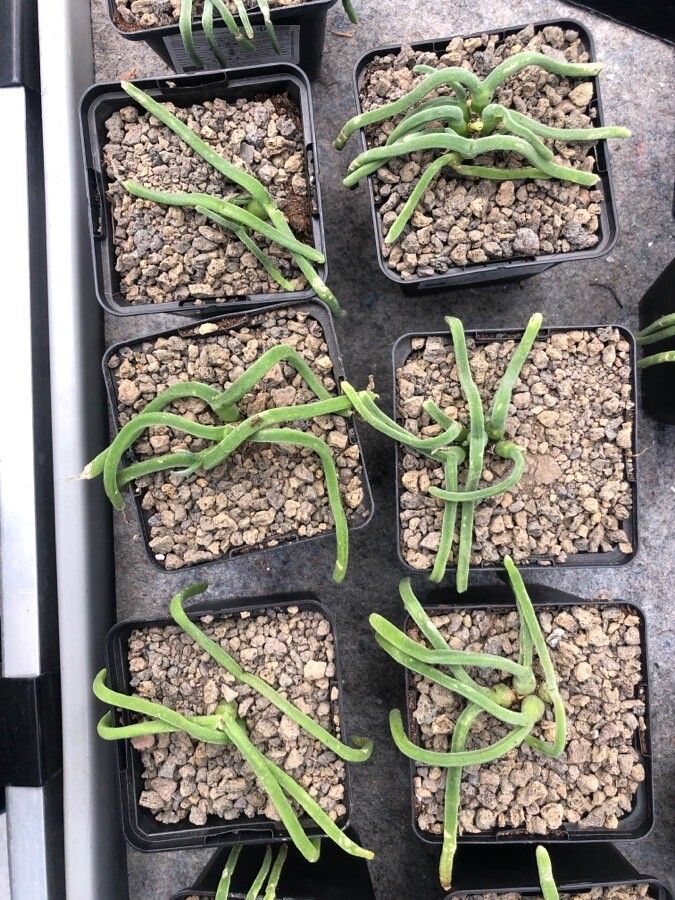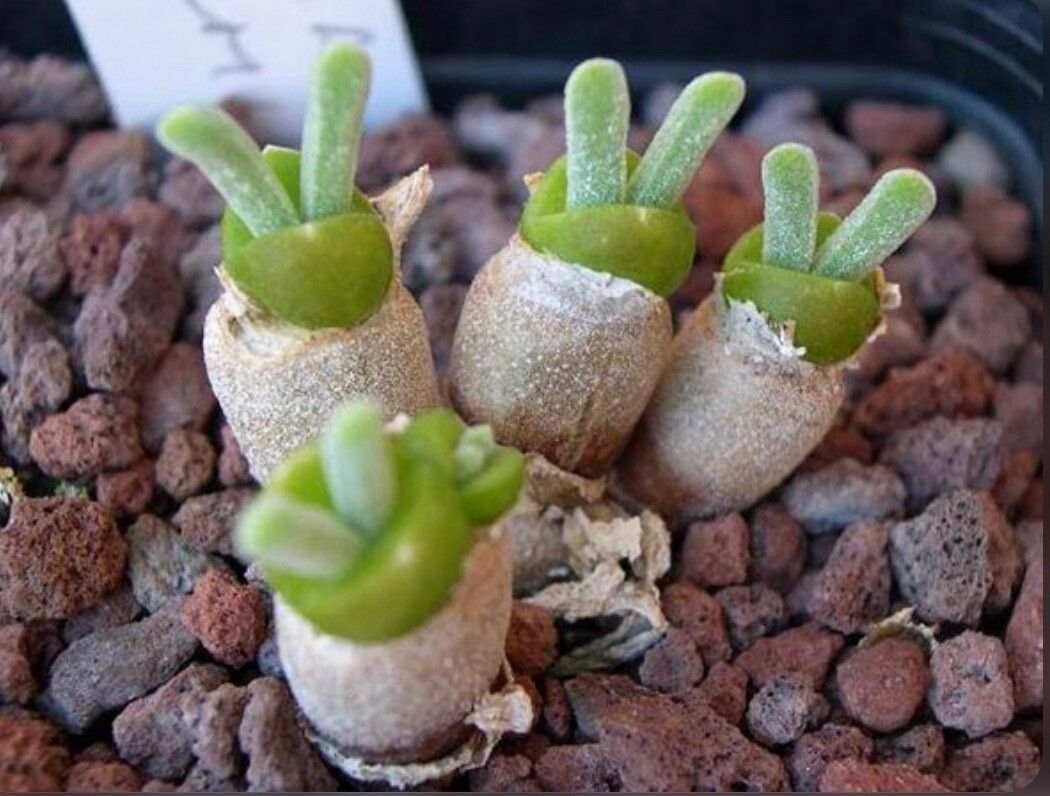
Monilaria obconica is a species from family Aizoaceae first described by H.D. Ihlenfeldt and S. Jorgensen. Monilaria obconica is part of the genus Monilaria. no subspecies are listed in the Catalogue of Life. This species is endemic to Namaqualand region.The resemblance of Monilaria obconica's leaves to bunny ears and its other features facilitated a surge in popularity on Twitter throughout Japan in 2017.
The Bunny succulent has moderate disease resistance but is relatively sensitive to humidity. It becomes vulnerable to illness when humidity is high and is prone to root rot during dormancy. In terms of care, the Bunny succulent tolerates drought but requires more frequent watering during the active growing season. Watering should be sharply reduced or stopped entirely during the dormant period. This succulent is best suited to people with some growing experience, though it can be challenging to care for, particularly during dormancy. It is especially appropriate for those who can dedicate time to its care over the winter months.
How to keep Monilaria Obconica.
Light
The bunny succulent craves significant sunlight, flourishes most when environments replicate their inherent sunny surroundings. Nonetheless, they have the ability to withstand partially shaded settings. Too much exposure could lead to leaf burn, while inadequate light may cause elongated growth or a change in color.
Water
The Bunny Succulent is well-suited for arid conditions, needing very little moisture because of its drought-tolerant nature. You should water it sparingly, about every 2 to 3 weeks, to match its preference for dry spells. As an indoor plant, the Bunny Succulent is ideal for enclosed spaces, which helps prevent overwatering and root rot.
Temperature
The Bunny succulent originates from regions with mild weather conditions. It favors a temperature range of 68 to 100 °F (20 to 38 ℃). To keep within this temperature range, modifications conforming to the season may be required.
Fertilizer
For the Bunny succulent, it is sufficient to administer small amounts of fertilizer 1-2 times annually during its growth period. It's best to steer clear of fertilizing during the winter and summer when the plant is in a dormant state. When repotted, the amount of fertilizer should be decreased, and fertilization should be postponed for a few months post repotting. Fertilization aids in maintaining a healthy growth and promotes blooming.
Pruning
To maintain the shape of a bunny succulent, prune any excess or dense branches in the spring and autumn using a knife or scissors. For propagation, cut 5-6 leaf stems and apply sulfur powder to the wounds. Allow the wounds to heal before planting. During this process, keep the soil lightly moist.
Pot & Repot
For repotting a Bunny succulent, choose a container that is just a bit bigger than the current one and ensures adequate water flow. Utilize a succulent or cactus mix that drains well and is gritty. Gently extract the plant from its former pot, brushing off any surplus dirt, and replant it at an identical depth. Delay watering the plant for several days, thus providing time for any root disturbances to recuperate. The recommended repotting period is either spring or fall, and the plant should be placed in an area with abundant light.
Botanical profile.
- Plant Type
- Succulent
- Life Cycle
- Perennial
- Genus
- Monilaria
- Family
- Aizoaceae
- Hardiness Zone
- 10-11
- Mature Height
- 15 cm to 30 cm
- Mature Spread
- 5 cm to 15 cm
- Leaf Color
- Green, Light Green
- Leaf Type
- Semi-evergreen
- Flower Color
- Pink, Purple
- Flower Size
- 1.02 cm to 2.03 cm
- Bloom Time
- Early spring, Mid spring
- Planting Time
- Spring, Summer
- Harvest Time
- Late spring, Early summer
- Native Area
- South Africa
Reader questions.
What are the sunlight requirements for Bunny Succulent?
Bunny Succulent thrives in full sun conditions, requiring more than 6 hours of sunlight daily, but can also tolerate partial sun, about 3-6 hours of sunlight. It's essential to observe the movement of sunlight through your garden to find spots that offer a perfect balance of light and shade, ensuring your plant's happiness. This is crucial because Bunny Succulent desires ample exposure to mimic their natural, sunny habitat, though they can survive in semi-shaded areas. Overexposure or insufficient light may cause leaf scorch or promote leggy growth and discoloration, respectively.
What is the preferred temperature range for Bunny succulent, and how does it react to extremes?
Bunny succulent, or Monilaria obconica, thrives in environments with moderate climates, favoring a temperature range between 68 to 100°F (20 to 38°C). This heat-loving plant enters a dormant state and stops growing in winter. It's crucial to maintain this temperature range, moving the plant indoors when temperatures drop below 5°C to avoid growth cessation. During cold spells, especially when temperatures fall below 20°C, its growth slows, necessitating reduced watering to prevent root rot. In extreme cold, protection measures such as a temporary greenhouse or wrapping with plastic film or fabric may be needed to insulate outdoor plants. Furthermore, when temperatures exceed 43°C, the Bunny succulent stops growing, suffers water loss, wilting, and becomes prone to sunburn, requiring specific care to recover.
How can artificial lighting be used for Bunny Succulent?
When natural sunlight is insufficient, especially in winter or less sunny spaces, artificial lighting becomes essential for Bunny Succulent's growth. Optimal growth under artificial light can be achieved by selecting the right type of light, such as LED, which can provide specific wavelengths needed by plants. For full sun plants, 30-50W/sq ft of artificial light is needed; partial sun plants require 20-30W/sq ft, and full shade plants, 10-20W/sq ft. The artificial light source should be placed 12-36 inches above the plant, mimicking natural sunlight exposure, with most plants benefiting from 8-12 hours of light per day.
How should Bunny succulent be cared for in low temperatures?
In low temperatures, Bunny succulent, which prefers temperatures above 20°C, requires special attention to thrive. Exposure to temperatures below 5°C should be avoided by moving it indoors, particularly since it is not tolerant of freezing conditions, which may weaken it, cause wilting, and make it prone to root rot. In case of mild frost damage, it is advisable to trim off the frostbitten areas and check for root rot. If the roots have rotted, they should be removed, and the plant can be propagated through cuttings. Ensuring the plant is placed near a south-facing window for ample sunlight or using supplemental lighting if natural light is insufficient is crucial for its recovery and growth.
What are the symptoms of insufficient light for Bunny Succulent?
When Bunny Succulent is placed in inadequate lighting, it may exhibit symptoms like smaller new leaves, leggy or sparse growth, faster leaf drop, halted growth, or lighter-colored leaves indicating a deficiency in sunlight exposure. Extreme sunlight exposure can cause chlorosis, sunscald, leaf curling, wilting, or leaf scorching. Each symptom reflects the plant's reaction to either insufficient or excessive light, impacting its health and growth negatively.
What steps should be taken if a Bunny succulent experiences high temperatures?
During the summer, when temperatures climb above 38°C, care for the Bunny succulent requires mitigating the adverse effects of excessive heat. Should temperatures exceed 43°C, triggering cessation of growth, water loss, wilting, and increased susceptibility to sunburn, it's essential to remove any sunburned or rotten parts of the plant. Protecting the plant from the harsh afternoon sunlight until it recovers and resumes growth is crucial. In instances of root rot, watering should be halted until new roots develop. These steps promote the health and vitality of the Bunny succulent in high temperatures.
What solutions are available for addressing light deficiency in Bunny Succulent?
To combat light deficiency in Bunny Succulent, gradually increasing sunlight exposure is crucial. For indoor plants, move them to a sunnier location weekly until achieving at least 6 hours of direct sunlight, utilizing south-facing windows and keeping curtains open. If moving the plant is not feasible, consider artificial lighting for a minimum of 8 hours daily. Outdoors, gradually shift your plants to sunnier spots, avoiding sudden changes to prevent sunburn. Additionally, ensure there are no obstructions blocking sunlight and consider transplanting smaller plants to brighter locations with good drainage during their dormant period to enhance their health and promote new, healthy growth.