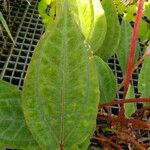
Monolena primuliflora
Description
Source: leafsnapThe ant plant is a rare tropical plant that, as its name suggests, supports ants in its natural habitat. An ant plant can be found growing on the trunk of a host tree in its native tropical climate. The bulbous, tubular base of the ant plant features hollow chambers that ants live in. The ants obtain a safe place to live, the ant plant has ants to fight animals and pests, and the ant plant also gets nutrients from ant waste. Although they can be grown outdoors in USDA zones 10 and higher, ant plants are mostly grown in the United States as houseplants or in greenhouses.
Care Guide
💧 Water Every 2-3 days
☀️ Light Partial sun
Ant plant is native to habitats such as forest understories or rocky sites, where it is subject to natural shade. It prefers partial sun but can tolerate full sun or full shade, illustrating its adaptable and hardy nature.
🌡️ Temperature 20–37.8°C
The ant plant comes from tropical areas, where the climate is usually warm and humid. Consequently, it is adapted to high temperatures and moisture. It does not tolerate sudden temperature changes and prefers a steady temperature, so avoiding indoor temperature swings is important. It generally cannot endure cold and needs warmer conditions to grow. If the surrounding temperature falls too low, the plant may stop growing or even die.
💨 Humidity
🪴 Soil 5-6
🌱 Fertilizer
Proper fertilization is essential for Ant plant's health and appearance. Fertilize Ant plant in summer, repeating the treatment monthly throughout summer. Nutrients provide energy for growth and help maintain the plant's structures. Fertilization improves Ant plant's flower display, ensuring the best blooms.
🪴 Pot & Repot 2-3 years
When repotting Ant plant, choose a pot 1–2 inches (2.5–5.1 cm) larger with ample drainage. Use a well-draining potting mix. Repot in spring or fall, ensuring that the root ball is slightly lower than the rim of the flower pot. Water thoroughly after repotting and place in a warm spot with indirect sunlight.
✂️ Pruning
Every berry that your ant plant produces will contain two ant plant seeds. The berries are ripe and ready for harvesting when they turn red or orange. The ant plant seeds can be sown on coconut husks that have been kept moist, and they will grow quickly. It is best to use fresh seeds because older, dried seeds frequently do not germinate.
🌿 Propagating
🐛 Diseases & pets
☠️ Toxicity
No, this plant is poisonous to animals. Beautiful little plant known as the "Maze plant" (Hydnophytum papuanum) has lovely, new foliage on top of a stout trunk. It's a unique plant that coexists harmoniously with ants. Ants thrive in the hollow, smooth-walled tunnels that grow inside the caudex or trunk.
Characteristics
- Plant Type
- Herb
- Life Cycle
- Perennial
- Genus
- Monolena
- Family
- Melastomataceae
- Hardiness Zone
- 10-11
- Mature Height
- 20 cm to 30 cm
- Mature Spread
- 30 cm to 40 cm
- Leaf Color
- Dark Green, Purple
- Leaf Type
- Evergreen
- Flower Color
- Pink
- Flower Size
- 2.03 cm to 3.05 cm
- Bloom Time
- All year round
- Planting Time
- Spring, Summer, Autumn
- Harvest Time
- All year round
- Native Area
- Colombia, Peru, Brazil, Ecuador, Costa Rica, Panama