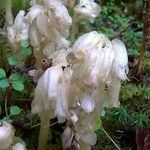
Monotropa hypopitys
Pinesap · Yellow bird's-nest · Yellow Indian Pipe · Dutchman's pipe · Mycoheterotroph
Description
Source: leafsnapMonotropa hypopitys, commonly known as pinesap or Dutchman's pipe, is a remarkable plant in the Ericaceae family. Unlike most plants, it is non-photosynthetic and lacks chlorophyll, deriving its nutrients instead from mycorrhizal fungi associated with tree roots. Pinesap features a striking appearance with its fleshy, yellowish-white stem, which can grow up to 30 cm tall. At the top of the stem, there is a cluster of small, pinkish-white flowers, each with five petals. These flowers bloom from June to September. This plant is found in coniferous forests across North America, Europe, and Asia, where it thrives in shady areas with moist soil conditions. Historically, Native American tribes have utilized pinesap for medicinal purposes. It contains compounds such as monotropin, which possess anti-inflammatory properties. Overall, Monotropa hypopitys is a fascinating non-photosynthetic plant that plays a crucial role in forest ecosystems by forming symbiotic relationships with mycorrhizal fungi, while also offering medicinal benefits to humans.
Care Guide
💧 Water
☀️ Light Full shade
🌡️ Temperature 5–32.2°C
💨 Humidity
🪴 Soil 4-5
🌱 Fertilizer
🪴 Pot & Repot
✂️ Pruning
🌿 Propagating
🐛 Diseases & pets
☠️ Toxicity
Characteristics
- Plant Type
- Herb
- Life Cycle
- Perennial
- Genus
- Monotropa
- Family
- Ericaceae
- Hardiness Zone
- 4-8
- Mature Height
- 30 cm
- Mature Spread
- 5 cm to 10 cm
- Leaf Color
- Tan, Beige
- Leaf Type
- Deciduous
- Flower Color
- White
- Flower Size
- 1.02 cm to 2.03 cm
- Bloom Time
- Early summer, Mid summer
- Harvest Time
- Late summer, Early fall