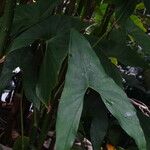
Montrichardia arborescens
Yautia madera
Description
Source: leafsnapMontrichardia arborescens, commonly known as the giant elephant ear or wild taro, is a large aquatic plant belonging to the Araceae family. Native to Central and South America, it thrives in wetlands, swamps, and along riverbanks. This plant features a thick stem that can grow up to 6 meters tall and large leaves reaching up to 1 meter in length. The heart-shaped leaves of Montrichardia arborescens are characterized by prominent veins and a glossy green color. The plant produces white flowers on a spadix, which is surrounded by a white spathe. Its fruit is green when young but turns brown as it matures. Montrichardia arborescens plays a crucial role in its ecosystem by providing habitat for various aquatic animals such as fish, turtles, and birds. Additionally, it helps purify water by absorbing excess nutrients. The giant elephant ear has various uses. Its tubers are edible when properly cooked, its stem sap has been used to treat skin conditions, and its large, attractive leaves make it a popular ornamental plant for gardens. However, caution is required when handling Montrichardia arborescens due to its toxic properties, which can cause skin irritation or even death if improperly ingested. Therefore, it should only be consumed after following proper preparation methods under expert guidance. Overall, Montrichardia arborescens is a fascinating aquatic plant with multiple uses, but it necessitates careful handling due to its toxic nature.
Care Guide
💧 Water Every 7 days
Yautia madera flourishes in high humidity and needs regular moisture. It should be watered every 1-2 weeks to maintain damp, but not waterlogged, soil. This plant is well-suited for outdoor growth and adapts easily to seasonal rainfall, making it perfect for rain gardens or wetland-like environments.
☀️ Light Full sun
Yautia madera prefers sites with full sun exposure. Sufficient light is vital for its healthy growth and greatly supports its development. Coming from habitats that are typically sunlit, a lack of sunlight can slow its growth. However, excessive sun does not harm it, as it can tolerate those conditions.
What are the sunlight requirements for Yautia madera?
Yautia madera requires full sunlight for optimal growth, which means it should receive above 6 hours of sunlight daily. It originates from habitats prevalent with sunlight exposure, and inadequate rays can hinder its growth. However, it can withstand excessive exposure without adverse effects. Watch how sunlight gracefully moves through your garden, and choose spots that provide the perfect balance of light and shade for your plants, ensuring their happiness.
Can artificial lighting be used for Yautia madera?
Yes, artificial lighting can be used for Yautia madera, especially for indoor plants that require adequate lighting for optimal growth. When natural sunlight is insufficient, particularly in winter or in less sunny spaces, artificial lights offer a vital solution, promoting faster, healthier growth. LED lights are recommended as they can be customized to provide specific wavelengths of light needed by the plants. Full sun plants need 30-50W/sq ft, partial sun plants need 20-30W/sq ft, and full shade plants need 10-20W/sq ft of artificial light. The light source should be placed 12-36 inches above the plant and kept on for 8-12 hours per day to mimic natural daylight.
What are common symptoms of inadequate lighting in Yautia madera?
Common symptoms of inadequate lighting in Yautia madera include smaller new leaves, leggy or sparse growth, faster leaf drop, slower or no new growth, lighter-colored new leaves, chlorosis, sunscald, leaf curling, wilting, and leaf scorching. These symptoms can indicate that the plant is not receiving enough sunlight, which is crucial for its healthy growth and development.
How can I address the lighting needs of Yautia madera?
To address the lighting needs of Yautia madera, gradually move plants to sunnier locations each week until they receive at least 6 hours of direct sunlight daily. For indoor plants, keep them near a south-facing window with curtains open during the day or use artificial lighting if the plant is large or not easily movable. For outdoor plants, avoid sudden changes in light intensity to prevent sunburn. Minimize obstructions by pruning trees or moving plants to locations with ample sunlight. Remember that parts of the plant affected by insufficient sunlight may not recover, but new growth after increasing light exposure will be healthy.
🌡️ Temperature 20–37.8°C
Yautia madera comes from tropical areas, where the climate is generally warm and humid. Consequently, it is well suited to high temperatures and humidity. It does not tolerate sudden temperature changes and prefers a steady temperature, so avoiding temperature fluctuations indoors is important. It typically cannot withstand cold and needs warmer conditions to grow. If the ambient temperature falls too low, the plant may stop growing or even die.
💨 Humidity
🪴 Soil 6-7
🌱 Fertilizer
Yautia madera requires the most fertilizer during its active growth period, which occurs mainly in spring, summer, and early fall. Fertilization provides essential nutrients the soil may lack, supporting healthy root and stem development and enhancing the attractive foliage that is a notable characteristic of this plant.
🪴 Pot & Repot
✂️ Pruning
Yautia madera is a fast-growing tropical plant characterized by its broad leaves and woody stems. To encourage growth and improve shape and airflow—which helps to reduce the risk of disease—prune the plant in the spring. For best results, use clean, sharp tools to make precise cuts. Begin by removing any dead or damaged stems to encourage bushier growth.
🌿 Propagating
🐛 Diseases & pets
☠️ Toxicity
Characteristics
- Plant Type
- Herb
- Life Cycle
- Perennial
- Genus
- Montrichardia
- Family
- Araceae
- Hardiness Zone
- 10-12
- Mature Height
- 2.13 m to 3.96 m
- Mature Spread
- 0.91 m to 2.13 m
- Leaf Color
- Green
- Leaf Type
- Evergreen
- Flower Color
- White
- Flower Size
- 10.16 cm to 15.24 cm
- Bloom Time
- All year round
- Planting Time
- Spring, Summer, Autumn
- Harvest Time
- All year round
- Native Area
- Colombia, Belize, Honduras, Mexico, Bolivia, Venezuela, Peru, Guyana, Brazil, Nicaragua, Ecuador, Costa Rica, Panama