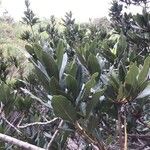
Morella faya
Candleberry-myrtle · Fayatree · Firetree · Firebush · Myrtle candleberry
Description
Source: leafsnapMyrica faya (firetree, faya or haya; syn. Morella faya (Ait.) Wilbur) is a species of Myrica, native to Macaronesia (the Azores, Madeira, and the Canary Islands), and possibly also western coastal mainland Portugal.
Care Guide
💧 Water
The candleberry-myrtle, native to volcanic regions, is drought-tolerant and thrives best when watered every 2-3 weeks to mimic its natural moisture environment. It flourishes in temperate gardens and prefers outdoor settings where it can benefit from natural rain cycles for optimal growth.
How should I water my Candleberry-myrtle plant?
Watering your Candleberry-myrtle is not a complicated process. You can use various common watering tools like watering cans, hoses, or even cups. It's important to water this plant by applying the water directly to the soil, ensuring that all areas of the soil receive equal moisture to support the entire root system. You may consider using filtered water instead of tap water to avoid any harmful particles. It's also best to use water that is at or slightly above room temperature, as extreme temperatures can be a bit shocking to the plant. However, the Candleberry-myrtle generally does well with any type of water you provide.
What should I do if I give my Candleberry-myrtle plant too much water or too little water?
Outdoor plants, especially newly planted ones or seedlings, can be at risk of not getting enough water. It's important to remember to keep watering them adequately for a few months while they are small or newly planted. Once their roots are established, Candleberry-myrtle plants can rely mostly on rain. When growing Candleberry-myrtle in pots, overwatering is often a concern. If you accidentally overwater your Candleberry-myrtle, you should act quickly to fix the problem. First, stop watering the plant immediately to minimize the effects. Then, remove the plant from its pot to check the roots. If there are no signs of root rot, you can put the plant back in its pot. If you do find root rot, trim the affected roots and consider using a fungicide. Finally, repot the Candleberry-myrtle in well-draining soil. On the other hand, underwatering is a simpler issue to address. If you notice drooping, drying out, or falling leaves on your Candleberry-myrtle, it is likely underwatered. Simply water the plant more frequently, and you will see the leaves return to fullness. Make sure to adjust your watering schedule promptly to prevent underwatering.
How frequently should I water my Candleberry-myrtle plant?
When growing plants outdoors, most can be watered naturally with rainfall. However, if you live in an area with little rainfall, you will need to water your plants every 2 weeks in spring and fall, and more frequently in summer. In winter, when plants don't grow as much and require less water, you can water them less often or not at all. If you have a young or newly planted Candleberry-myrtle, water it more frequently to help it establish and grow. For potted plants, there are two ways to determine how often to water your Candleberry-myrtle. The first is to stick to a set watering schedule, such as once a week or every other week. However, this may not always work because it doesn't take into account the unique conditions of your environment. Another approach is to water based on soil moisture. Wait until the top two to four inches of soil have completely dried out before watering again. This method is especially important in summer when the plant's water needs are highest.
How much water does my Candleberry-myrtle plant need?
To water your Candleberry-myrtle effectively, you don't always have to use a lot of water. If only a few inches of soil have dried since the last watering, giving the plant about five to ten ounces of water should be enough for healthy growth. You can also gauge the water volume based on the moisture of the soil. Take note of how many inches of soil have dried out between waterings. To ensure your Candleberry-myrtle gets enough moisture, water the plant until all the dry soil layers are moistened. If more than half of the soil has become dry, you may need to give it more water than usual. In this case, continue watering until excess water drains from the pot's holes. If your Candleberry-myrtle is planted in an area that receives sufficient rainfall, additional watering may not be necessary. However, when the plant is young or newly established, it should receive 1-2 inches of rain per week. As it grows and becomes more established, it can rely solely on rainwater. Only in hot weather with no rainfall for 2-3 weeks should you consider giving it a thorough watering to prevent stress.
How do I know if I am watering my Candleberry-myrtle plant enough?
Candleberry-myrtle plants tend to be overwatered more often, so it's important to know the signs. If your Candleberry-myrtle is overwatered, its leaves will turn yellow and it might lose some. Additionally, overwatering can cause the overall structure of the plant to shrink and can lead to root rot. On the other hand, if your Candleberry-myrtle is underwatered, it will start to droop and its leaves may turn brown or become brittle. Regardless of whether you see signs of overwatering or underwatering, it's important to take action and restore the health of your Candleberry-myrtle.
☀️ Light Full sun
Candleberry-myrtle is native to open habitats, including sunny meadows and forest edges, where abundant light is available. It flourishes in Full Sun but will also tolerate Partial Sun, demonstrating good adaptability to a range of light conditions.
What are the sunlight requirements for Candleberry-myrtle?
Candleberry-myrtle thrives in environments with ample light, originating from sunny meadows and forest edges. It requires full sun, defined as more than 6 hours of sunlight a day, but can also tolerate partial sun, which is about 3-6 hours of sunlight a day. It's important to watch how sunlight moves through your garden to ensure your plants receive the perfect balance of light and shade, ensuring their happiness.
How can I supplement natural light for indoor Candleberry-myrtle plants?
For indoor Candleberry-myrtle plants requiring additional lighting, particularly in winter or less sunny spaces, artificial lights offer a solution. LED lights are recommended for their ability to provide specific wavelengths needed by plants. Full sun plants should receive 30-50W/sq ft of artificial light, partial sun plants 20-30W/sq ft, and full shade plants 10-20W/sq ft of artificial light. The light source should be placed 12-36 inches above the plant, mimicking natural sunlight as closely as possible, and most plants will require 8-12 hours of light per day.
What are the signs of light deficiency in Candleberry-myrtle?
Candleberry-myrtle may show various symptoms when exposed to insufficient light. These include smaller new leaves than previous ones, leggy or sparse growth indicating a stretched-out appearance, faster leaf drop to conserve resources, slower or stopped growth, lighter-colored new leaves due to a lack of chlorophyll, and several conditions related to excessive sunlight like chlorosis, sunscald, leaf curling, wilting, and leaf scorching.
How can I address sunlight deficiency for Candleberry-myrtle?
To counteract sunlight deficiency in Candleberry-myrtle, gradually move the plants to sunnier locations to receive at least 6 hours of direct sunlight daily. For indoor plants, use a south-facing window or artificial light for at least 8 hours daily. Outdoor plants should be moved gradually to avoid sunburn. If sunlight is obstructed, consider pruning or transplanting to a sunnier location. It's important to note that parts of the plant damaged by insufficient light may not recover, but new growth should be healthy with improved light conditions.
🌡️ Temperature 20–37.8°C
Candleberry-myrtle is fairly adaptable to temperature, able to tolerate high heat and considerable temperature swings. In hot weather, care should be taken to water appropriately and provide some shade to avoid sunburn. Conversely, Candleberry-myrtle has limited cold tolerance; it can handle moderate chill but very cold conditions may cause frost damage.
💨 Humidity
🪴 Soil 5-7
🌱 Fertilizer
Fertilize your Candleberry-myrtle in early spring to encourage healthy growth. Regular feeding improves its overall health, producing vigorous growth, greater tolerance of difficult conditions, and stronger resistance to pests and diseases. Stick to a defined fertilization routine for your Candleberry-myrtle to maintain lush foliage with deep color and a vibrant appearance.
🪴 Pot & Repot
✂️ Pruning
The candleberry-myrtle is a resilient plant with dense foliage. For optimal care, it's best to prune it from early to late winter. Focus on removing dead branches and thinning out crowded areas. Be careful not to prune too heavily, as this can disrupt the plant’s natural shape. Regular pruning encourages healthy growth and helps prevent disease. To ensure precise cuts, always use sharp and clean tools.
🌿 Propagating
🐛 Diseases & pets
☠️ Toxicity
Characteristics
- Plant Type
- Tree, Shrub
- Life Cycle
- Perennial
- Genus
- Morella
- Family
- Myricaceae
- Hardiness Zone
- 9-11
- Mature Height
- 3.05 m to 14.94 m
- Mature Spread
- 3.05 m to 6.1 m
- Leaf Color
- Dark Green
- Leaf Type
- Evergreen
- Flower Color
- Yellow, Green, Pink
- Flower Size
- 0.20 cm to 0.25 cm
- Bloom Time
- Early spring, Mid spring
- Planting Time
- Spring, Summer, Autumn
- Harvest Time
- Late summer, Early fall, Mid fall