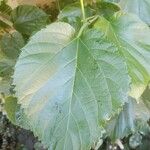
Morus macroura
King White Mulberry · Himalayan Mulberry · Long Mulberry · Pakistan Mulberry · Tibetan Mulberry
Description
Source: leafsnapMorus macroura, commonly known as the Pakistani mulberry or Himalayan mulberry, is a deciduous tree belonging to the Moraceae family. Native to Pakistan, India, and Nepal, this tree can reach heights of 10 to 15 meters. It features a broad crown with spreading branches and produces large leaves up to 20 cm long. The fruit of Morus macroura is an elongated berry that can grow up to 5 cm in length. It boasts a sweet flavor with a slightly tart taste and is rich in vitamins A, C, and E, along with minerals such as potassium. The Pakistani mulberry tree thrives in well-drained soil with full sun exposure but can also tolerate partial shade. It grows best in warm climates but can withstand cold temperatures down to -10°C. For centuries, Morus macroura has been valued for its medicinal properties, including treating diabetes mellitus and reducing inflammation, due to its high antioxidant content. Additionally, its leaves are commonly used to feed silkworms, which produce high-quality silk fibers. Overall, Morus macroura is an important plant species because of its nutritional value and medicinal properties, making it a vital component of traditional medicine practices across South Asia.
Care Guide
💧 Water Every 7 days
The Himalayan mulberry thrives in the Himalayan region, where it prefers moderate humidity and balanced water intake. It requires watering every 1-2 weeks. As a deciduous plant, the Himalayan mulberry enters dormancy during the dry season to conserve water and increase its chances of survival.
☀️ Light Full sun
The Himalayan mulberry comes from open habitats, such as sunny meadows and forest edges, which provide abundant light. It thrives in Full Sun but can also tolerate Partial Sun, adapting well to various sunlight conditions.
🌡️ Temperature 15–35°C
Himalayan mulberry has good adaptability to temperature, able to tolerate higher heat and wide temperature fluctuations. In hot conditions, attention should be paid to watering and providing suitable shade to avoid sunburn. Conversely, Himalayan mulberry is relatively sensitive to low temperatures; although it can endure some cold, overly severe cold can cause frost damage.
💨 Humidity
🪴 Soil 6-7
🌱 Fertilizer
The Himalayan mulberry needs adequate nutrients for optimal fruit production. Fertilize in early spring to encourage new growth and bloom development. Regular fertilization keeps the plant healthy, boosts production of delicious fruit, and prevents nutrient-deficiency issues like yellowing leaves and poor fruit production.
🪴 Pot & Repot
✂️ Pruning
The Himalayan mulberry thrives in temperate climates and produces long, mulberry-like fruits. To maintain its shape and encourage fruiting, it is important to prune the tree in early spring. Start by removing any dead branches, and thin out the growth to improve air circulation. Be sure to use clean tools and make your cuts above healthy buds or where branches meet.
🌿 Propagating
🐛 Diseases & pets
☠️ Toxicity
Characteristics
- Plant Type
- Tree
- Life Cycle
- Perennial
- Genus
- Morus
- Family
- Moraceae
- Hardiness Zone
- 7-10
- Mature Height
- 10.06 m
- Mature Spread
- 10.06 m
- Leaf Color
- Dark Green, Forest Green
- Leaf Type
- Deciduous
- Flower Size
- 0.51 cm to 0.76 cm
- Bloom Time
- Mid spring, Late spring
- Planting Time
- Spring, Summer, Autumn
- Harvest Time
- Summer
- Native Area
- Nepal, India, Malaysia, Indonesia, Cambodia, Vietnam, Myanmar, Bhutan, Bangladesh, Laos, Thailand, China